

Sorry for initially posting this in a new thread instead of this existing one!
I found these images of Cassiopeia A region by JWST. Then I decided to "stack" a part of the field of view in order to reveal the interstellar stream. Just imagine: the scene spans over 2 light-years and the animation covers "only" 40 days... personally, I'm just fascinated by that!
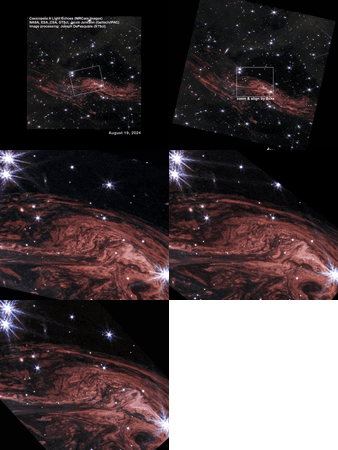
Scales: the diagonal of the pics are ca.2 light-years => now I'm wondering: could these streams move at relativistic speed or are they in the foreground? (hence, closer than the 11'000 light-years told in the source)
I'm estimating the general motion to be 0.023ly/40d = 0.023*(365/40) = ca.20% of the speed of light!!! => yes, the speed would be relativistic
I found these images of Cassiopeia A region by JWST. Then I decided to "stack" a part of the field of view in order to reveal the interstellar stream. Just imagine: the scene spans over 2 light-years and the animation covers "only" 40 days... personally, I'm just fascinated by that!
Scales: the diagonal of the pics are ca.2 light-years => now I'm wondering: could these streams move at relativistic speed or are they in the foreground? (hence, closer than the 11'000 light-years told in the source)
I'm estimating the general motion to be 0.023ly/40d = 0.023*(365/40) = ca.20% of the speed of light!!! => yes, the speed would be relativistic
Last edited:


