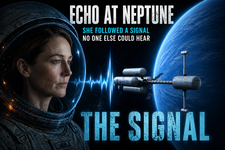
I present to you ECHO AT NEPTUNE, a short film created from my concept and novella which you can read below if you'd like! Special thanks to
@dgatsoulis for all his help with 3D models and ideas.

ECHO AT NEPTUNE
I. THE ECHO
The memory always started with the static.
It wasn't the cold, digital hiss of deep-space telemetry. It was the warm, crackling fuzz of a cheap yellow plastic radio.
Maya was six years old, sitting cross-legged in a sea of tall, drying wheat. It was the golden hour on Earth—that fleeting moment when the sun dips low and the world turns to amber and fire. The wind smelled of heated soil and pollen.
She frowned at the radio in her hands. “It’s broken,” she said, shaking it. “I can’t hear anything.”
Her mother sat beside her. Evelyn Rourke was wearing her brown flight jacket adorned with the Deepstar mission patch that smelled faintly of ozone and spearmint gum. She reached over, her hands young and strong, and covered Maya’s small fingers.
“It’s not broken, baby,” Evelyn said softly. “You’re just listening to the noise. You have to listen to the space in between.”
Evelyn guided her hand. They turned the plastic dial together, millimeter by millimeter.
Ksshhht... Pop... THRUM.
A rhythmic, beating pulse cut through the white noise. It sounded like a heartbeat underwater.
“There,” Evelyn whispered. “Hear that? That’s the echo. It means I’m still here.”
Maya looked up, her brown eyes wide, reflecting the setting sun. “Even when you go to space?”
Evelyn smiled, but it was a sad smile—the kind that tries to hide a goodbye. She brushed a strand of hair from Maya’s forehead. “No matter how far I go. No matter if I go off the map entirely. If you tune the dial right, you can always find me.”
The sun dipped below the horizon. The light in Maya’s eyes faded.
II. THE DEVIATION
Maya blinked, and the golden field vanished.
The warm amber light was replaced by the harsh, industrial red glow of Mars.
Commander Maya Rourke sat in the cockpit of the USRV Kepler. She was forty-eight years old now. The wide, hopeful eyes of the child were gone, replaced by the tired, bloodshot gaze of a woman who had spent too long in the void.
Outside the viewport, Ares Station was a hive of activity. The massive space station orbited the Red Planet, surrounded by swarms of cargo drones and welding sparks. It was the edge of civilization. Safe. Crowded. Loud.
“Kepler, you are cleared for disconnect,” the Station Control voice crackled in her ear. “Refueling complete. Good luck on the survey run, Commander.”
Maya rubbed her face. “Copy, Ares. Disengaging.”
She flipped the release switch. A heavy metallic CLUNK vibrated through the hull as her spacecraft detached. The Kepler drifted away from the station, floating into the black.
Maya reached for her coffee pouch. She was about to initiate the survey protocol when the comms panel lit up.
It wasn't a voice. It was a rhythm.
THRUM-THRUM... THRUM-THRUM...
Maya froze. Her hand hovered in mid-air. She hadn't heard that sound in forty years, but she’s been listening for it since she was 10 years old. It cut through the chatter of the station traffic like a knife.
“Vera,” she said, her voice trembling. “Isolate that background signal.”
“Signal isolated,” the ship’s AI replied. The voice was calm, synthetic. “Source is faint. Origin point: Sector 8, Neptune vicinity.”
“Identify.”
The waveform resolved on the screen. The text decrypted in a flash of green.
[ ID: UES DEEPSTAR ]
Maya stopped breathing. The coffee pouch floated out of her hand, forgotten.
Deepstar. The ship that vanished without a trace. The ship her mother commanded.
“Identification error,” the AI stated. “UES Deepstar listed as MIA, forty-one years ago. Re-calibrating sensors.”
“It’s her,” Maya whispered. The exhaustion vanished, replaced by a terrifying focus. “Computer. Scuttle the survey mission. Plot a course for the signal source.”
A holographic map projected into the air. A red line drew itself from Mars to the distant, icy outer rim.
“Course plotted,” the AI said. “Standard Hohmann Transfer. Estimated time of arrival: Twelve years, four months.”
Maya stared at the number. Twelve years.
“Too long,” she whispered. “I can’t wait twelve years. She might not... she might not have that long.”
Maya gripped the console. “Computer. Calculate a high-energy transit. Constant acceleration burn. 1G continuous.”
The cockpit lights shifted from white to AMBER WARNING.
“Calculation complete,” the AI said. “Time to arrival: Two years, three weeks.”
“Do it.”
“Warning,” the AI interjected. “This trajectory consumes 98% of total fuel reserves.”
“I don't care.”
“Warning,” the AI persisted. “Insufficient fuel remains for orbital insertion retro-burn. Upon arrival, you will be traveling at 25,000 kilometers per hour relative to Neptune. You will be unable to stop.”
Maya stared at the red planet rotating below her. She thought of the wheat field. She thought of the silence that had defined her life.
“Is there a solution?”
“Only one,” the AI said. “Aerocapture maneuver. You must dip into the Neptunian atmosphere to use drag to shed velocity. Hull integrity probability is 40%.”
The text on the screen blinked in large, red letters:
[ RETURN FUEL: 0% ]
[ ONE-WAY TRIP CONFIRMED? ]
Maya looked at the photo of her mother taped to the console—a faded snapshot from a life she barely remembered.
“Override safety protocols,” Maya said clearly. “Authorization Rourke-Alpha-One.”
“Authorization accepted. One-way trajectory locked.”
Maya gripped the throttle. Outside, the Kepler’s main engines ignited—not a gentle puff, but a blinding cone of blue ion fire. The ship tore away from the slow-moving traffic of Ares Station, accelerating violently. Mars shrank to a marble, then a dot, then nothing.
Maya didn't look back.
III. THE AEROBRAKE
Two years later.
Neptune filled the viewport. It was a monster—a wall of violent, swirling blue storms the size of continents.
The Kepler was no longer the gleaming ship that had left Mars. Its white paint was graying. The engine nozzles were glowing cherry-red. Inside, the cockpit rattled with the violence of a ship pushing past its limits.
“Atmospheric interface in T-minus ten seconds,” the AI warned. “Brace for deceleration.”
Maya strapped into the pilot’s chair. She looked ragged. Two years of isolation had carved deep lines into her face.
“Come on,” she gritted out, grabbing the stick. “Just hold together.”
She tipped the nose down.
The ship hit the upper atmosphere of Neptune at Mach 25.
It wasn't a glide; it was a collision. The roar was deafening. Outside the window, the universe vanished, replaced by a sheet of orange plasma. Fire danced over the glass, fighting the blue gloom of the clouds below.
“Hull integrity critical!” the AI screamed. “Shield breach in Sector 4!”
Maya fought the G-force pressing her chest into the seat. Her vision grayed. If she dipped too low, the pressure would crush the ship like a tin can. If she bounced off, she would drift into the dark forever.
She held the line. She watched the velocity readout plummet. 20,000 kph... 15,000... 8,000...
The heat shield cracked. A spiderweb fracture raced across the viewport.
And then, silence.
The Kepler popped out of the atmosphere, smoking and scorched, captured by Neptune’s gravity. She was in a stable orbit.
And floating right in front of her, untouched by the violence, was the target.
UES DEEPSTAR.
It was pristine. A gleaming white relic of a hopeful past.
Maya checked her fuel gauge. Empty.
She didn't care. She initiated the docking sequence with the last gasp of her maneuvering thrusters.
Clang.
The magnetic clamps locked. The airlock hissed.
IV. THE REUNION
Maya floated through the connection tube. Her flight suit was scorched, carbon-scored from the atmospheric entry.
She manually spun the wheel of the DEEPSTAR’s airlock. It turned smoothly. The inner door swung open.
The air inside smelled of ozone and spearmint.
Maya drifted onto the bridge. It was dim, lit only by emergency power. Wires hung from the ceiling. In the center of the room, huddled under a thermal blanket near a small electric heater, was a woman.
She looked up.
She was young. Her hair was raven black, her skin smooth and unblemished. She couldn't have been more than thirty-three.
Evelyn Rourke.
Maya stopped. She held onto a handrail, her breath catching in her throat. She felt the weight of her own age—her aching knees, her graying hair—contrasted against the terrifying youth of her mother.
Evelyn stood up. She let the blanket fall. She looked at the stranger in the scorched suit.
“Who are you?” Evelyn whispered.
Maya took off her helmet. She let it float away.
“I heard you,” Maya said, her voice cracking. “I tuned the dial.”
Evelyn’s eyes went wide. She stepped closer, searching Maya’s face. She traced the jawline, the nose, the eyes that mirrored her own.
“Maya?”
“I’m here, Mom.”
Evelyn didn't ask how. She didn't ask when. She surged forward, wrapping her arms around her daughter. They collided in the microgravity, holding onto each other as if they were the only two solid things in the universe.
V. THE ONE-WAY TICKET
The adrenaline had faded, leaving a cold, hard clarity.
Evelyn stared at Maya’s suit. She touched the carbon scoring on the sleeve.
“You came in atmospheric,” Evelyn said softly.
Maya nodded. “I had to.”
“A standard transfer takes twelve years, Maya. You would have had plenty of fuel to slow down. You didn't need to burn up your heat shield.”
Maya looked out the viewport at the swirling clouds. “I didn't take a standard transfer. I burned everything I had. I got here in two years.”
Evelyn looked at her daughter with a dawn of horror. “Two years? Constant acceleration?”
“Yes.”
“But... Maya. That means...”
“It means my tanks are dry,” Maya said. She looked her mother in the eye. “I used every drop to stop. I’m not a rescue mission, Mom. I’m just here.”
Silence stretched between them. The realization hung in the air: They were both stranded.
“Why?” Evelyn whispered. “Why would you trade your life just to get here faster?”
“Because I didn't know if you’d still be alive in twelve years,” Maya said. “And I didn't want to wait anymore.”
Evelyn stood up. She paced the small room. She looked at the dead fuel gauge of the DEEPSTAR, then at the scorched hull of the Kepler docked outside.
“My ship has a cracked drive core,” Evelyn said. “I can't reach escape velocity to get us back to Earth. And your ship is a glider.”
“I know,” Maya said. “It’s okay. I’m with you. That’s enough.”
“It’s not enough,” Evelyn said fiercely. “I didn't leave my crew behind just to watch my daughter die in the dark.”
Maya looked up sharply. “What happened to the crew?”
Evelyn walked to the navigation console. She wiped a layer of dust off the screen and flipped a switch. A holographic map flickered to life.
“We found it, Maya,” Evelyn said. “The wormhole near Jupiter. We went through. There was a system on the other side. A black hole, but... there was a planet. Breathable air. Water. It was perfect.”
“Where are they now?”
“They stayed,” Evelyn said. “Because of the time dilation near the black hole, forty years had passed on Earth while we were gone for months. They had nothing to go back to. So they built a colony.”
Evelyn pointed to a monitor displaying a distant object. As Maya drifted closer, she instantly saw it. Hovering near Neptune’s moon, Triton. A shimmering, stable distortion.
“I came back for you,” Evelyn said, her voice trembling. “I took the DEEPSTAR and tried to race back to get you. But the wormhole drifted. It moved here, to Neptune. And my drive cracked on the exit. I’ve been sitting here, staring at that door, unable to go back, unable to go home.”
Maya looked out in the distance. The wormhole.
“It’s still open?”
“Yes,” Evelyn said. “And the DEEPSTAR... it can't make it to Earth. But it has just enough maneuvering fuel for a short burn.”
She pointed to the distortion.
“We can make it there.”
Maya stood up. She looked at the map. Then she looked at Earth—a tiny, invisible speck billions of miles behind them.
“If we go through,” Maya said, “we can never come back. My ship can't make the return trip. We’ll be stuck there.”
“Not stuck,” Evelyn said, taking Maya’s hand. Her grip was warm. “Home. The crew is there. A whole new world is there.”
Evelyn squeezed her hand.
“Earth is behind us, Maya. There’s nothing back there for either of us but ghosts. Do you trust me?”
Maya looked at her mother—the woman who had defied physics to come back for her. Then she looked at the scorched ship that had brought her here. She realized she had never planned the return trip. She had burned the bridge the moment she lit the engines at Mars.
Maya squeezed back.
“Tune the dial,” Maya said. “Let’s go.”
VI. THE DEPARTURE
The DEEPSTAR groaned as the engines fired. It was a dirty, stuttering burn, shaking the frame of the ship.
Maya’s small, scorched vessel remained clamped to the side, a barnacle on a whale.
Together, the two ships turned away from the sun. They turned away from the radio silence of Earth.
They accelerated toward the shimmer in the dark.
Inside the bridge, Maya and Evelyn sat side by side in the pilot’s chairs. They didn't look back. They watched the distortion grow larger, filling the view with impossible colors—violet, indigo, and a white so bright it felt like a new beginning.
“Ready?” Evelyn asked.
Maya smiled. For the first time in forty years, the silence didn't feel heavy.
“Ready.”
The ships hit the event horizon. Light bent. Time shattered. And in a flash of brilliance that outshone the distant sun, they vanished, leaving the map forever.


 )
)




 I am getting closer to the end of the list of features that I want to add. Mainly an LPAD landing AP and a hover take-off AP.