Humor Random Comments Thread

NASA uses the term TGO for Time to Go, at least during the burns.
During ascent, the term TMECO was used but that was not a countdown timer but rather an indicator of when guidance predicted MECO would be at. It being stable for the first few seconds of second stage ascent indicated that the guidance had converged on a solution and was good to the crew and there was no need to take manual control and fly the ascent according to the cue cards.
 
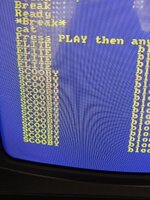
It's aliiive. Now I'll have to decide between floppy disk and casettes for Orbiter. I guess it depends on the number of truckloads 😂1000036723.jpg
 
It's aliiive. Now I'll have to decide between floppy disk and casettes for Orbiter. I guess it depends on the number of truckloads 😂

Use no textures and things might actually fit on a single 5.25"..... but where can you buy 5.25" today? Even the USAF does no longer use 8" anymore....
 
It's aliiive. Now I'll have to decide between floppy disk and casettes for Orbiter. I guess it depends on the number of truckloads 😂
Very nice!
I love those blue and green key-caps on the Amstrads!
Some day I'll have to get my hands on one of those (for a reasonable price) - Although here in Germany I might easier get my hands on the "Schneider CPC" variant, wich are not so colorful.
Reason why:
My collection is a bit "chicken-lips biased" now: C16, C64, SX-64, Amiga 500 ...
But hey, there's an Atari 600XL, a Philips Videopac G7000, a ZX81 and a 8085 Based Single-Board Computer in my posession, so some diversity already ;)
 
Last edited:
There is (almost) Orbiter for the CPC :p ...
Yep, I will be looking into running that when the tape adapter arrives. The annoying part is there is also an Elite videogames producer, and some of their games (that I have) are labeled as Elite as well. Almost thought I got lucky 😂

1000036755.jpg
The plan was initially getting an Atari computer, but I couldn't find any reasonable offer. The place where I got this one also had Atari diskettes, but they were useless by themselves, and it wasn't clear what was on them. I'd say it wouldn't be completely impossible to source some floppy disks, perhaps even the big ones, but that's just half the battle.

Now I'm trying a bit of a project with ChatGPT, I use my smartphone to record the data noise it does when it loads up a tape, using an app to produce a high-bitrate .wav file of it, which then gets sent to the AI for analysis. According to itself, it could probably reproduce the code and then maybe even modify it (in a file that will be used by the tape adapter). The one time I tried it so far, there was too much background noise, so I guess I'll try again on a weekend night when there's zero ambient noise.
 
Last edited:
According to itself, it could probably reproduce the code and then maybe even modify it
I would be extremely surprised if it could do that. I don't think there's enough sound material available to train an AI on it. And I'm not sure chatGPTs training involves any audio data at all...
 
I would be extremely surprised if it could do that. I don't think there's enough sound material available to train an AI on it. And I'm not sure chatGPTs training involves any audio data at all...

Well, I lost two good hours making a few recordings ,neither of which produced a useful outcome. It does accept sound files, but it hasn't yet produced any code, presumably due to the lack of quality in the recordings. It did show me some graphs that supposedly show there is indeed usable data in there, but that's it ( it basically explains what it's doing step by step).

It's odd, though. After a few tries, it started running into issues, including telling me that its memory had reset (???) and I kept having to send the same file again. Then it reverted to a sort of mini version (second time it did that on complex subjects),that was much slower, didn't really know what the discussion was all about, and I got a message that I should try the pro version. Eventually, we concluded that perhaps even it trying to denoise the file internally might have caused issues, so it would be best to try with the output of a cassette player, ideally a bare-bones one.

That made me a bit curious , though, so I asked some other AIs. Google's Gemini basically said that it's iffy, it would really depend on the recording, and, even if it worked, it would be time-consuming, as it would have to dig through libraries of code from that era to get an idea of what it's seeing.. Basically, it would probably see the signal, but would have a very hard time decoding it. DeepSeek, the new chinese wonder, said it could but then immediately backtracked and claimed it's only a text chatbot (despite the option to send it media existing). Then I got a 'server busy' message when I confronted it about its bs:ROFLMAO:
 
Interesting project to let AI decode a FSM encoded tape-file audio.
Maybe you could "nudge" the AI into the right direction by mentioning some of the properties of the audio format. It usually is more about the timing (zero-crossings per time to get either of the two frequencies representing one or zero) than the amplitude.
But getting some sense out of the bit-stream is almost impossible I would think. As the format (header, filename information, memory-location/load-address) is heavily based on the architectue of the Micro-Computer that audio file is used for...
Nevertheless, keep trying and keep us informed :D
 
The German Elections are getting a lot of coverage in the UK news, especially the BBC.
They have at least three reporters there, One in Berlin as you would expect, but the other two are in the West and South of the country. One town close to the Dutch border and one in Munich and surroundings.

Why would they chose these areas?
 
Why would they chose these areas?

Not sure why THESE places, but Berlin is a pretty anomaly inside Germany anyway, not much different to Washington DC. Maybe they just have some journalists there.
 
AI is driving me to pass initial judgement about whether some coding tutorial might be worth reading through by how bad the english is! 🤦‍♂️

Since chatGpTs inception, there's been more and more tutorials of the long-winded kind in clean english that start with basic concepts, entire project setup, and oftentimes annoyingly inaccurate, minimalistic and insufficient code examples.
And then there's the blog-post of some indian guy where you can barely make out what he's trying to say by the words he's writing, but the code speaks for itself, and what more do you need?
 
Last edited:
Its the same in PLM, there is a lot of bullshittery around, lately also AI generated, but if you want accurate information about something, look for a blog of some Indian guy, its sometimes even better than the manuals of the manufacturer. :cheers:
 
I think GPT works well on scifi stuff😃

The Foot of the Sleeper


The Rift at Chernobyl


The world thought it was just a meltdown. A catastrophe of human arrogance, a reactor breach that had scarred the land forever. That’s what they wanted to believe.


But the truth was never so simple.


The meltdown at Reactor 4 wasn’t an accident. It wasn’t even purely human in origin. It was the consequence of something that had been waiting beneath the world for far longer than the Soviet Union, longer than human civilization itself.


On April 26, 1986, something cracked open.


Deep in the bowels of the plant, beyond the concrete tunnels and coolant systems, a rift had formed. The initial explosion was not just from heat and pressure—it was the fabric of reality collapsing inward, an unsealing of something that had been held back since long before the Cold War.


And when the fire burned away, and the first responders fell to unseen forces beyond radiation, the foot remained.


The Elephant’s Foot, they called it. A mass of corium, glass, and death itself, melting the very ground beneath it. But the truth was far worse.


It was not corium.


It was flesh.


A limb—the colossal, blackened foot of something that had stepped through the breach, half-trapped in our world, unable (or unwilling) to fully emerge.


For years, it lay there, fused to the ruins, silent. Watching.


Waiting.


The Others


Chernobyl wasn’t the first.


Long before, in the forgotten depths of Soviet industry, other rifts had opened.


At Andreeva Bay, where submarines leaked radioactive waste into the Arctic waters, something had entered, or perhaps escaped. The sailors spoke of shadows in the deep—things that moved without sound, glimpsed only in sonar returns that vanished moments later.


At Kyshtym, the Mayak disaster in the late ‘50s had been more than just a nuclear accident. The explosion had ruptured something beneath the facility, a sealed chamber whose origins even the highest-ranking Soviet scientists had never understood. The survivors reported seeing figures in the irradiated mist—tall, unmoving, as if waiting for a command.


Had these things arrived by accident? Had they been here first, locked away by those who came before us?


The leaders of the world did not need to speculate.


They knew.


The Accord of Silence


By the late ‘90s, it was no longer a conspiracy. It was a quiet understanding.


Chernobyl was not entombed to contain radiation—it was sealed to contain him. The one who had stepped through. The one whose massive foot still pulsed, deep beneath layers of reinforced concrete.


The world governments, after decades of denial, had accepted the truth.


And so, a deal was made.


The Overlord, as some whispered, had no interest in conquest. He did not wish for war or destruction. He sought only to convene.


His minions, his kin—whatever they were—had already arrived decades before, waiting in their sealed tombs, beneath places the world called disasters.


And now, they held court.


The Airbus Beluga


The meetings began in the early 2000s. Officially, they did not exist. No records, no transmissions. Just an Airbus Beluga, a massive transport aircraft, repurposed for a purpose that no journalist or intelligence agency would ever acknowledge.


The craft carried no cargo.


It carried him.


Sealed away beneath the reinforced shell, the foot had long since begun to move. The Overlord traveled, unseen, across the world, moving from site to site. The destinations were never random—always near places of disaster, places of secrecy, places where humans had lost control.


Chernobyl. Andreeva Bay. Kyshtym.


And more.


Were the others his servants, waiting for their leader? Or had they been here long before him, locked away by something even older?


The world leaders did not ask.


They simply accepted the reality that had been hidden from the world.


The Airbus landed.


The cargo hold opened.


And beneath the tarmac, in places humanity had long buried in fear, the meetings continued.


Unseen. Unheard.


And as the plane lifted off once more, disappearing into the sky, the world remained oblivious.

 
Last edited:
The second and last part, but i'm quite amazed , honestly

The One Who Seeks


Ɐ’Thul-Gorr, the Lost Seeker


It had stepped through the rift, but it had not meant to.


The fires of Chernobyl were a distraction, a flash of energy that tore through the fabric of existence at just the right moment. And so, Ɐ’Thul-Gorr, the Seeker, was caught mid-stride, its foot left behind as it tumbled into this broken world.


It had been looking.


For the other.


The Old Signs


“X’tal-Ƀo'ka-nuhl'xa.” (The Rift of Fire.)


It had spoken the words to no one, dragging its fractured presence through the irradiated corridors, through tunnels carved by human hands but unknowingly sculpted upon something much older.


Chernobyl had not been its first destination.


The first had been a crash, a violent impact. A forgotten signal from the sky.


It had traveled long before the reactor burned. It had walked the endless ridges beneath the seas, stirring faint echoes from those who had been here before. It had searched in the caverns beneath Kyshtym, beneath the frozen waters of Andreeva Bay.


And still, it had not found him.


The one who had fallen before the rest.


The one whose light had been seen in Tunguska.


The Hidden Knowledge of the Russians


The humans did not understand, not at first.


When the great Antonov An-225 Mriya was built, they lied about its purpose. They said it was to transport rockets. To carry satellites. To bring forth the weight of Soviet industry.


But those who truly controlled the program knew.


It was not built for human cargo.


It was built for it.


For the day when Ɐ’Thul-Gorr would demand passage to the places where the sky had torn open before.


For the places where something else might have fallen.


The problem was simple:


They had lost the first one.


The Sleeping One


“Ny’ghal-Baï-Ka’al.” (The Drowned Rift.)


The humans feared Lake Baikal. Not for its depths, not for its age, not for the things that should live within it, but for the thing that should not.


Something was waiting beneath its frozen black waters, something beyond sonar, beyond searchlights.


The Antonov had been prepared for its retrieval, but the world changed too quickly. The Soviet Union collapsed before the operation could be carried out. Those who knew the truth vanished. The aircraft, once a vessel meant to carry something immense, was abandoned.


It was forgotten—by humans.


Not by Ɐ’Thul-Gorr.


It had waited.


It had learned.


And now, it would continue the search it had begun before this world had walls.


The Journey


The Airbus Beluga had carried the others, bringing them to the buried rifts across the world, where they whispered to those locked beneath. But it had never been the first.


The Antonov, the true carrier, was older, stronger. It had been meant to move something heavier.


And so, it moved again.


Through silent negotiations, unseen documents, and the will of those who knew the world was not their own, the Antonov was given flight once more. It crossed the frozen north, the mountains of Yakutia, and the lands where even humans knew not to build.


It came to Tunguska.


It came to the place where something had fallen in 1908.


And when it reached the frozen black waters of Baikal, where the lightless things whispered beneath, it finally spoke the words it had been holding for an eternity:


“Ka’al-nokt’huul… Xa'ghur-ta'al...”
(Where are you? I have come for you.)


And somewhere, deep in the abyss, the answer rumbled back.


A pulse.


A signal.


A call.


Something old stirred beneath the ice.


And the Seeker knew.


The other had heard.


The search was over.


The awakening had begun
 
AI is driving me to pass initial judgement about whether some coding tutorial might be worth reading through by how bad the english is! 🤦‍♂️

Since chatGpTs inception, there's been more and more tutorials of the long-winded kind in clean english that start with basic concepts, entire project setup, and oftentimes annoyingly inaccurate, minimalistic and insufficient code examples.
And then there's the blog-post of some indian guy where you can barely make out what he's trying to say by the words he's writing, but the code speaks for itself, and what more do you need?

Long before AI took off, during a discussion of poor English on tech support calls, a colleague mentioned that the best tech support he'd ever gotten was from some dude in the Philippines.
 
It's aliiive. Now I'll have to decide between floppy disk and casettes for Orbiter. I guess it depends on the number of truckloads 😂View attachment 42109
I have an old 32bit PC at home (not that old) but after many missteps I managed to install ArchLinux32 with 512MB of RAM (the other 512MB were broken and I was left with only one RAM card) and it only uses 42MB of RAM in TTY. I would like to try a graphical session with IceWM, and install OpenOrbiter on it. I could also produce 32bit binaries of my add-ons in case someone needs them.

By the way, your machine looks beautiful!
 
Back
Top