Hi,
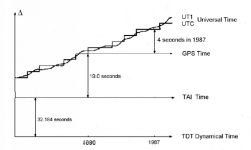
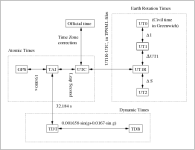
it was my understanding that the Celestial Body modules in Orbiter use TDB time frame to set their pos/vel, rather than UTC.
So any vessels or celestial bodies added to Orbiter using external data (e.g. JPL Horizons data) should use the TDB time as the epoch.
But...I just grabbed the pos/vel state vectors for Europa Clipper from JPL Horizons, relative to Jupiter, using TDB time frame, for just before the initial Ganymede flyby on arrival at Jupiter.
I was expecting a flyby of Ganymede at ~250km....but WHAM! I smack into the surface at unpleasantly high velocity. Periapsis altitude -415km.
So...I grabbed the pos/vel vectors using UTC time frame instead.
And I get a nice Ganymede flyby at 275km.
The difference between TDB and UTC is ~69s.
Ganymede orbital velocity ~10km/s
Periapsis altitude difference between the TDB vs. UTC data sets is ~690km
Which makes me think it is a TDB vs. UTC issue.
So..
Am I wrong in thinking I should use TDB as epoch when grabbing vectors or elements from JPL Horizons or elsewhere?
Or is it that ganymede.dll (and possibly other Galilean satellites) use UTC? (I suspect this is the case)
Or has there been an mix up between TDB/UTC at JPL Horizons?!
Anyway, I thought it might be of interest to Orbiter developers, or anyone simulating real life missions at Jupiter.
Here are the two data sets from JPL Horizons I used for epoch:
TDB
UTC
Cheers,
BrianJ
it was my understanding that the Celestial Body modules in Orbiter use TDB time frame to set their pos/vel, rather than UTC.
So any vessels or celestial bodies added to Orbiter using external data (e.g. JPL Horizons data) should use the TDB time as the epoch.
But...I just grabbed the pos/vel state vectors for Europa Clipper from JPL Horizons, relative to Jupiter, using TDB time frame, for just before the initial Ganymede flyby on arrival at Jupiter.
I was expecting a flyby of Ganymede at ~250km....but WHAM! I smack into the surface at unpleasantly high velocity. Periapsis altitude -415km.
So...I grabbed the pos/vel vectors using UTC time frame instead.
And I get a nice Ganymede flyby at 275km.
The difference between TDB and UTC is ~69s.
Ganymede orbital velocity ~10km/s
Periapsis altitude difference between the TDB vs. UTC data sets is ~690km
Which makes me think it is a TDB vs. UTC issue.
So..
Am I wrong in thinking I should use TDB as epoch when grabbing vectors or elements from JPL Horizons or elsewhere?
Or is it that ganymede.dll (and possibly other Galilean satellites) use UTC? (I suspect this is the case)
Or has there been an mix up between TDB/UTC at JPL Horizons?!
Anyway, I thought it might be of interest to Orbiter developers, or anyone simulating real life missions at Jupiter.
Here are the two data sets from JPL Horizons I used for epoch:
Code:
Date MJD 62601.5TDB
Code:
  STATUS Orbiting Jupiter
  RPOS  1154593569.42984  49149450.9101117  427453876.026179
  RVEL -12898.4977350327 -673.39823531841  8594.24079393013
UTC
Code:
  STATUS Orbiting Jupiter
  RPOS  1153700990.34268  49102853.3477609  428048404.614901
  RVEL -12903.9378378357 -673.631521003498  8592.22987175082
Cheers,
BrianJ