New Release Project Mercury X for Orbiter 2016

Wow! I never imagined that my code would be under that level of scrutiny!
Thanks a lot, will be fixed in the next release. :salute:

 
No sweat! It's just applied static code analysis ;)
I like to see how things are done, therefore I look at code from others to learn.

In this particular case I was just curious and ran Cppcheck on the code.

I've noticed that sometimes both MFDs are "disabled" and can not be switched on again...that looked to me as a unintended out-of-bounds write. So I just took the easiest route and ran Cppcheck. However that simple analysis run did not immediately find some obvious error that would explain that.

Keep up the good work!:cheers:
 
Haha, the MFD's disappearing is not a bug, it's a feature! It happens when you're out of radio contact (no surface base above the horizon), simulating the very restrictive communication conditions in the early 60s spaceflight.
(you can see the implementation in ProjectMercuryGeneric.h function InRadioContact on line 168)

You can disable this restriction by going to the config and changing the MercuryNetwork flag to FALSE. This must be done independently for all the vessels, which are all the ProjectMercury____.cfg files in the Config\Vessels\ProjectMercury\ folder.

Thank you for the flattering words!
 
Haha, the MFD's disappearing is not a bug, it's a feature! It happens when you're out of radio contact (no surface base above the horizon), simulating the very restrictive communication conditions in the early 60s spaceflight.
Uuups :blush: ...I should have Read The Fine Manual

Thanks :thumbup:
 
Slight bug with the Mercury-Scout...
Mercury-Scout.jpg
 
Awesome work! I just stumbled on it. I haven't been around for a while. Kids...Life...

I drew all the flown panels in support of my 1/4 and full scale Mercury projects. They are done meticulously with several layers starting at the sheet metal (for CNC) and moving outward. They were drawn in a very early version of AutoCAD but I could provide DXF files or separate PDF's if someone wanted to seriously work on panels for the Orbiter. I may be limited in providing other formats but someone smarter than me could convert them from DXF.

I have had LOTS of request for the CAD files and used to give them out but when I saw full scale printouts for sale online, I stopped. I have provided them to a few museums.

Here is a link for fellow Mercury Enthusiasts :)

Scott

http://www.spacecraftreplicas.com/panels
 
Thank you for the link!
I was actually searching for the website the other day, but could not find it back (had previously visited the page, but forgot to bookmark).

Thanks again, will be useful.

As for raw files, I don't think it's necessary. For the panels in this addon, I've used Python, which makes it easy to define animations and lights, as I already have the exact mesh coordinates.
 

Attachments

  • Skjermbilde 2020-05-22 10.27.00.jpg
    Skjermbilde 2020-05-22 10.27.00.jpg
    436.3 KB · Views: 30
Does not maintain Orbit

No matter what I do - even with autopilot , the mercury capsule remains in earth orbit for just a few minutes and starts re-entry .
Also there are no textures on the rocket until tit has reached the upper level of space and they suddenly appear
With Thanks
 
The rocket mesh disappearing is a bug I have not been able to remove. However, when it happens, you can press Ctrl+R to reload the mesh. The same thing happens with parachutes and landing bag, and the same keypress applies.

For failing to reach orbit, there can be many possible reasons.
  • Only the Mercury-Atlas configuration could reach orbit. If you launch with the Redstone (Freedom 7 & Liberty Bell 7), you will instead be sent on a suborbital trajectory.
  • Ensure that the Limited fuel setting in Orbiter Launchpad -> Parameters is checked. If not, you will encounter all kinds of problems.
  • Some scenarios have several failures activated, one of which is the booster failing to reach orbit. All the historical launch scenarios have failures deactivated, so these scenarios should follow the historic trajectory.
  • Is your [ORBITER_ROOT]\Config\Earth.cfg file edited (changed mass, radius, rotation speed, etc.)? If yes, you may encounter problems.

In general, can you tell me what scenario you're using? And also post the contents of the Orbiter.log file here inside [ CODE ] text [ /CODE ] tags (without the spaces)?
That will help me narrow it down.

As this is a historical accurate addon, the margins are very slim. A normal Atlas ascent should leave you with only ~500 kg of fuel left (in real life it was 473.6 kg for MA-9/Faith 7).
If you launch to a different inclination than 32.5 degrees, or perform a manual launch, the propellant margins will be even smaller.
 
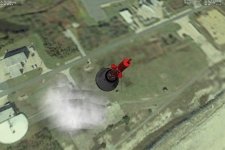
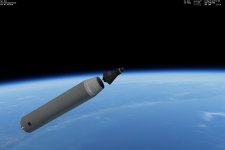
A new version has been released, v2.1.

The release includes
  • Added some buttons and switches to the 2D panel.
  • Beach Abort scenario (Program development folder).
  • Jupiter and Titan launch scenarios (Hypothetical missions -> Alternate launchers folder). Both requires Multistage2015. Titan scenario requires Multistage Titans by 4th rock.
  • Fixed problems reported by Kyle_E, kuddel and Star Voyager. Thank you all!
  • Bug fixes.

Alternate launcher meshes and Multistage2015 configurations delivered by 4th rock. As always a huge thanks to him. :thumbup:
 

Attachments

  • Skjermbilde 2020-06-06 21.23.21.jpg
    Skjermbilde 2020-06-06 21.23.21.jpg
    124.9 KB · Views: 29
  • Skjermbilde 2020-06-08 20.35.24.jpg
    Skjermbilde 2020-06-08 20.35.24.jpg
    68.3 KB · Views: 32
Thanks again for all the effort that went into this beautiful addon.

One thing I've noticed though: Shouldn't the launch be "heads down"?
I mean, shouldn't the booster be rotated 180° so that the Capsule is placing the Astronauts heads down when pitching?
I'm sure this was the case for Shuttle, Apollo and Gemini. Even DM-2 did it this way...and I believe it was the same on Mercury. Though I have no references to quote here ;)
 
Great question!
I'm fairly certain they launched heads up, although I have never read it being said explicitly.

The Redstone was certainly heads up, as the booster did not have much command over roll, just pitch and yaw.

Main reasons for thinking so for Atlas:
  • In tables of sequence of events during a mission, BECO, tower jett and SECO are listed during the launch phase, but no roll maneuver. Surely, it would have been listed if it occurred.
  • Also, there are records of pitch data during ascent, but no roll data. Surely, it would have been listed if a roll maneuver occurred.
  • No reports of the roll state were spoken during launch, eiter from astronaut or CapCom. If a roll was performed, it would at least have been reported by one of the astronauts in one of the four launches.

So we can be pretty certain no rollover was performed.
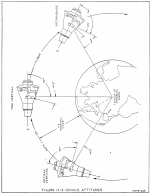
So could the capsule have been separated into orbit in a heads down position? In my view, no. The correct orbit attitude was 0 degree roll, 180 degree yaw, -14/-34 degree pitch (depending on mission and if in retro or periscope attitude).
And no rollover was performed after capsule separation.
  • After separation, there was a turnaround to the correct attitude, so it must have been in 0 degree roll already.
  • One (dangerous!) procedure in the flightOps manual involves the use of a retrorocket if the posigrade rockets used for capsule separation did not fire. In that case, the capsule was to pitch down 90 degrees during rocket burning, and no roll is mentioned, so it must have been in correct roll attitude (0 degrees) already.

So all evidence I know of supports a heads up launch.

I assume a heads down is used to get acceleration from the seat up during pitching down the gravity turn.
The Atlas and Redstone were short (Atlas was 28.7 m according to Wikipedia, which I assume is with escape tower, and Redstone was shorter), compared to the Titan-II on Gemini being 33 m with no escape tower.
So the astronaut was so close to the centre of mass on Mercury that the movement was small during pitching, i.e. the negative acceleration during pitching was small and therefore not a problem.

P.S.: I recommend checking out NTRS document 19730073391 for booster data of an Atlas launch. The figure on page 107 was especially useful to me when implementing the launch algorithm.
 
Last edited:
No, please don't roll! That's not what I've tried to say ;)

I just thought that the booster has to be placed ("rolled") 180° on the launch pad.
The pitch program would possibly be "negated" (so 40° pitch-up becomes 40° pitch-down or vice-versa), but no roll program!

But as I said, I don't have any evidence that head-down really was the case and as long as there is no evidence against your current implementation, that's fine :thumbup:

Thanks again for your effort.

---------- Post added at 01:19 ---------- Previous post was at 00:54 ----------

The only reference I could find so far about the X- Y- and Z-axis orientation is in this PDF 19680025550.pdf page 33 (Page 17).

So from that drawing a positive pitch would place the astronaut head-down...

But the booster guidance might have a different coordinate system, so not 100% sure...
(On Apollo-Saturn the command module and the booster actually had 180 degree opposite Y axis orientations, for reasons I don’t actually know.)

I hope someone else can find a definitive answer to that anyway.

---------- Post added at 01:30 ---------- Previous post was at 01:19 ----------

"Three-view drawing of basic Atlas configuration"
p85.jpg
from https://history.nasa.gov/SP-45/ch5.htm
 
Last edited:
Just tested 2.1, after BECO an additional booster mesh is still attached to the spacecraft even though the separated booster is still venting behind. I did see the maneuvering stage was attachment/adapter rings were fixed and the beach abort is a nice touch as well. Also, really cool to add the newer launchers, will definitely have a ton of fun with those! Thank you!
 
No, please don't roll! That's not what I've tried to say ;)

I just thought that the booster has to be placed ("rolled") 180° on the launch pad.
The pitch program would possibly be "negated" (so 40° pitch-up becomes 40° pitch-down or vice-versa), but no roll program!

But as I said, I don't have any evidence that head-down really was the case and as long as there is no evidence against your current implementation, that's fine :thumbup:

Thanks again for your effort.

---------- Post added at 01:19 ---------- Previous post was at 00:54 ----------

The only reference I could find so far about the X- Y- and Z-axis orientation is in this PDF 19680025550.pdf page 33 (Page 17).

So from that drawing a positive pitch would place the astronaut head-down...

But the booster guidance might have a different coordinate system, so not 100% sure...
(On Apollo-Saturn the command module and the booster actually had 180 degree opposite Y axis orientations, for reasons I don’t actually know.)

I hope someone else can find a definitive answer to that anyway.

---------- Post added at 01:30 ---------- Previous post was at 01:19 ----------

"Three-view drawing of basic Atlas configuration"
IMG from https://history.nasa.gov/SP-45/ch5.htm

What I meant is that the Atlas must have been either heads up during the entire launch or heads down during the entire launch.
And since the correct orbit attitude was heads up, and no mention of a 180 degree roll maneuver exists, I conclude with that the launch was heads up.

Additional evidence I just found:
In this image ( https://upload.wikimedia.org/wikipe...ew_of_Launch_Complex_14_-_GPN-2000-000609.jpg ) from MA-9/Faith 7, if you look closely, you can see the insignia on the capsule (large white star, bottom left of capsule) and white seal around the entry hatch to the right. The window over the astronaut's face was directly above the insignia.
As you know, the rocket was launched towards the water. But the roll rate was at most 3.5 deg/s for MA-9, with the automatic abort to trigger at 6.4 deg/s. The booster roll program was from T+2 to T+15 seconds.
I.e. a max roll of 3.5*13=45 degrees (83 deg limit abort condition) was attainable.

Thus, the launch must certainly have been heads up. QED

---------- Post added at 08:14 ---------- Previous post was at 08:12 ----------

Just tested 2.1, after BECO an additional booster mesh is still attached to the spacecraft even though the separated booster is still venting behind.

Ah :censored:. I thought I had fixed that. Thanks.
 
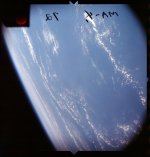
There are photo sequences of the ascent taken from the capsule: https://tothemoon.ser.asu.edu/gallery/Mercury/4/Maurer 220G 70 mm
The camera is pointing sideways, but you can see that the orientation is heads up.

Also the capsule's attitude indicator
p282b.jpg

show normal orbital attitude and retro with negative pitch (nose down). So it's head-up.
 
Last edited:
There are tons images here taken by cameras looking out the window during ascent... more info to confirm the ascent profile... :shrug:

Also, found these, which if not of use, they are at least high in the "holy cow" scale. :lol:
[ame="https://twitter.com/humanoidhistory/status/856993123469340675"]https://twitter.com/humanoidhistory/status/856993123469340675[/ame]
 

Attachments

  • MA-4-A.jpg
    MA-4-A.jpg
    87.2 KB · Views: 15
  • MA-4-B.jpg
    MA-4-B.jpg
    79.2 KB · Views: 12
Last edited:
Yes, but we know that the in-orbit attitude was heads up.

See the later photo from after SECO.
 

Attachments

  • MA-4-4713-092_s.jpg
    MA-4-4713-092_s.jpg
    36.5 KB · Views: 15
  • MercFamiliarisationManual.png
    MercFamiliarisationManual.png
    151.2 KB · Views: 18
I've now updated the Orbithangar files to version 2.1.1, which fixes the non-disappearing Atlas mesh after capsule separation.

Optionally, if you already have v2.1, and don't want to download the 50 MB, you can extract the DLL attached to this post into the Modules\ProjectMercury folder.
 

Attachments

Back
Top