

You are using an out of date browser. It may not display this or other websites correctly.
You should upgrade or use an alternative browser.
You should upgrade or use an alternative browser.
News Beagle 2 found intact on Mars 11 years after disappearance
- Thread starter Cosmic Penguin
- Start date
 h:
h:


Unstung
Active member
Every article seems to be confident in reporting that Beagle 2 is partially deployed and the EDL system worked properly. Also, there is enough resolution in the photo to see that the first two solar arrays deployed in the proper order.I don't want to jump too high for joy - the "deployed petals" could also simply be the airbags.

- Joined
- Feb 6, 2008
- Messages
- 38,965
- Reaction score
- 3,937
- Points
- 203
- Location
- Wolfsburg
- Preferred Pronouns
- Sire
Every article seems to be confident in reporting that Beagle 2 is partially deployed and the EDL system worked properly. Also, there is enough resolution in the photo to see that the first two solar arrays deployed in the proper order.
Ahem... every article quotes the same source.
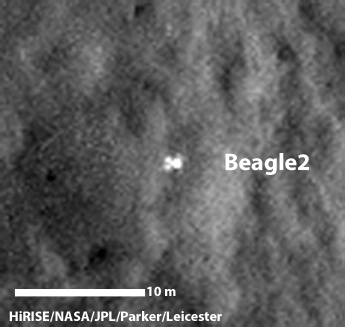
Also am I the only one who is a bit critical about the second petal being simply drawn on a bigger blob of pixels than the first one? Or that each petal is six pixels high in the image, which corresponds to a minimum diameter of 1.8 meters for each petal for the HiRise camera? And have the petals really been deployed in that claimed order?
Unstung
Active member
Then read the source material yourself: http://www.esa.int/Our_Activities/Space_Science/Mars_Express/Beagle-2_lander_found_on_MarsAhem... every article quotes the same source.
Up to four panels are thought to be deployed, but only two appear to be obviously visible.
The "larger" array seems to be reflecting more light directly into the HiRISE camera and thus appears bigger. It's possible that any dust on the lander's surface can be cleared by wind and be reflective after years of sitting on Mars. An animation of the deployment sequence can be seen here.Also am I the only one who is a bit critical about the second petal being simply drawn on a bigger blob of pixels than the first one? Or that each petal is six pixels high in the image, which corresponds to a minimum diameter of 1.8 meters for each petal for the HiRise camera? And have the petals really been deployed in that claimed order?
- Joined
- Feb 6, 2008
- Messages
- 38,965
- Reaction score
- 3,937
- Points
- 203
- Location
- Wolfsburg
- Preferred Pronouns
- Sire
Then read the source material yourself: http://www.esa.int/Our_Activities/Space_Science/Mars_Express/Beagle-2_lander_found_on_Mars
Wrong:
https://www.gov.uk/government/news/uk-led-beagle-2-lander-found-on-mars
Its actually university of Leicester.
Up to four panels are thought to be deployed, but only two appear to be obviously visible.
I am no friend of believing in invisible solar arrays - that's a too lazy interpretation.
And still, there is no explanation why the HiRise images have been claimed to have 10 cm/pixel resolution suddenly, if the official best performance is 30 cm/pixel.
---------- Post added at 12:15 PM ---------- Previous post was at 12:07 PM ----------
If you use this raw image as reference, it is much clearer that this is clearly something beagle-shaped, but that the Leicester interpretation of its status allowed itself a lot of artistic freedom:
Unstung
Active member
And still, there is no explanation why the HiRise images have been claimed to have 10 cm/pixel resolution suddenly, if the official best performance is 30 cm/pixel.
Again, the apparent size of the solar arrays can be due to reflections. HiRISE uses CCDs so it might be a result of saturated pixels.
I don't have time to read the articles again, but I do not recall them claiming that HiRISE has a resolution of 10 cm/pixel. The outline of Beagle 2 might have an inaccurate scale.
Last edited:
- Joined
- Feb 6, 2008
- Messages
- 38,965
- Reaction score
- 3,937
- Points
- 203
- Location
- Wolfsburg
- Preferred Pronouns
- Sire
Again, the apparent size of the solar arrays can be due to reflections. HiRISE uses CCDs so it might be a result of saturated pixels.
But the reflections don't magnify the whole shape of the spacecraft! :facepalm:

RGClark
Mathematician
- Joined
- Jan 27, 2010
- Messages
- 1,635
- Reaction score
- 1
- Points
- 36
- Location
- Philadelphia
- Website
- exoscientist.blogspot.com
Thanks for that. Great story.
Bob Clark
Bob Clark
Unstung
Active member
Here's an animation, created from three images captured by HiRISE, that shows how the "whole shape of the spacecraft" changes under different lighting conditions due to the spacecraft's reflectivity:
Compare the reflective spacecraft to the candidate parachute. The semi-transparent parachute does not appear to change shape much in comparison and diffusely reflects light, but it may be blown around slightly by the wind. Metallic objects can specularly reflect a lot of light directly back into a camera depending on the angle.
The article that's linked above provides an explanation about Beagle 2's glinting.
Compare the reflective spacecraft to the candidate parachute. The semi-transparent parachute does not appear to change shape much in comparison and diffusely reflects light, but it may be blown around slightly by the wind. Metallic objects can specularly reflect a lot of light directly back into a camera depending on the angle.
The article that's linked above provides an explanation about Beagle 2's glinting.
The team acquired several more images, which showed a bright spot that seemed to move around. "That was consistent with Beagle-2," McEwen said. "Because its solar panels were arranged in petals, each one would reflect light differently depending on the angles of the sun and MRO, especially if the lander was resting on sloping ground."
The HiRISE images reveal only two or three of the motorized solar panels, but that may be due to their favorable tilts for sun glints. Further imaging and analysis is planned to narrow down the options for what happened.


- Joined
- Nov 20, 2007
- Messages
- 11,964
- Reaction score
- 765
- Points
- 188
Supporting evidence that the Beagle-2 probe is sitting intact on the surface of Mars has come from a new imaging technique developed by UCL scientists.
Their method stacks and matches multiple pictures taken from orbit to resolve more detail than can be retrieved through standard processing.
http://www.bbc.co.uk/news/science-environment-36136035
RGClark
Mathematician
- Joined
- Jan 27, 2010
- Messages
- 1,635
- Reaction score
- 1
- Points
- 36
- Location
- Philadelphia
- Website
- exoscientist.blogspot.com
Thanks for that. Here's another article on the new imaging technique:
Mars' surface revealed in unprecedented detail.
Date: April 26, 2016
I'd like to see some images of the famous Mars gullies that may have been sculpted by liquid water. Could small changes be seen that would suggest they were still evolving?
What other areas would be great to see at higher resolution? Perhaps White Rock?
Bob Clark
Mars' surface revealed in unprecedented detail.
Date: April 26, 2016
Even with the largest telescopes that can be launched into orbit, the level of detail that can be seen on the surface of planets is limited. This is due to constraints on mass, mainly telescope optics, the communication bandwidth needed to deliver higher resolution images to Earth and the interference from planetary atmospheres. For cameras orbiting Earth and Mars, the resolution limit today is around 25cm (or about 10 inches).
By stacking and matching pictures of the same area taken from different angles, Super-Resolution Restoration (SRR) allows objects as small as 5cm (about 2 inches) to be seen from the same 25cm telescope. For Mars, where the surface usually takes decades to millions of years to change, these images can be captured over a period of ten years and still achieve a high resolution. For Earth, the atmosphere is much more turbulent so images for each stack have to be obtained in a matter of seconds.
https://www.sciencedaily.com/releases/2016/04/160426101307.htm
I'd like to see some images of the famous Mars gullies that may have been sculpted by liquid water. Could small changes be seen that would suggest they were still evolving?
What other areas would be great to see at higher resolution? Perhaps White Rock?
Bob Clark
Col_Klonk
Member
I've known about that 'quote' (methods) for 25 years, which is why i say all the low res mars and moon pics fed to us by NASA are BS... 
If anyone has any clue of standard Surveying optical methods used nowdays.. you be surprised on the accuracy and resolution achieved.
If anyone has any clue of standard Surveying optical methods used nowdays.. you be surprised on the accuracy and resolution achieved.
Last edited:
- Joined
- Nov 20, 2007
- Messages
- 11,964
- Reaction score
- 765
- Points
- 188
http://www.bbc.co.uk/news/science-environment-37940445
The new results will be discussed by Mark Sims and Geraint Morgan at the Colin Pillinger Memorial Talk at Bristol University next Wednesday 16 November
Bummer!
N.
Beagle 2, the failed British mission to Mars in 2003, came "excruciatingly close" to succeeding, a study shows.
A new analysis of pictures of the Beagle 2 spacecraft shows that it did not crash-land on the Martian surface.
Instead, it indicates that the landing went to plan and at least three of its four solar panels opened successfully.
The new results will be discussed by Mark Sims and Geraint Morgan at the Colin Pillinger Memorial Talk at Bristol University next Wednesday 16 November
Bummer!
N.
Last edited:
Similar threads

- Replies
- 10
- Views
- 5K


- Replies
- 3
- Views
- 2K


- Replies
- 32
- Views
- 11K

- Replies
- 0
- Views
- 5K