Launch News Soyuz-2.1a launch with Cobalt-M (Kosmos 2495), May 6, 2014

Cosmic Penguin

Geek Penguin in GTO
News Reporter
Donator
Joined
Jan 27, 2011
Messages
3,672
Reaction score
3
Points
63
Location
Hong Kong
In post-conquering-Crimea-Russia, old spysats trumphs over you!

......oh wait, isn't that always what the Russians are doing anyway? :uhh:

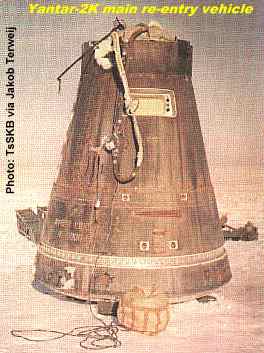
Well anyway the Russians did launch a spysat on Tuesday to boost the imaging capabilities from above. On May 6 at 13:49 UTC, a Soyuz-2.1a rocket blasted off from pad 43/4 at the Plesetsk Cosmodrome, placing a satellite in a very low Earth orbit (175 x 280 km x 81.4 deg.) named Kosmos 2495. But its identity has never been in doubt - public infomation shows that it is the newest Cobalt-M film-return optical spysat to fly, returning after a 2 year absence (previous examples were launched in November 2008, April 2009, April 2010, June 2011 and May 2012). A member of the Yantar series of film-return optical spysats, the 6.7 tonne satellite has a lifetime in orbit of up to 6 months (though previous flights were usually 4-5 months long) and has a reported resolution of ~0.3 meters. After the film is used up, the cone ("Mecury-shaped") return module would separate and return to Earth aiming at the flat plains east of th Ural mountains. See the links above for more details about the satellite (thanks to member SiberianTiger for doing all of them!). :tiphat:

img_8579_1242148244_full.jpg


yantRV.jpg


However the era of film-return spysats in Russia may be coming to an end (and around the world, since the US stopped flying them by the mid-1980s and the Chinese since almost 10 years ago), as public info shows that only one more Cobalt-M is planned to fly after this one (perhaps next year) with new generation spysats using digital methods to beam down photos. In fact, it is already surprising that such satellites are still flying more than 50 years after the first film-return satellites!

NASASpaceflight.com: Soyuz-2-1A launches Kobal’t-M reconnaissance satellite

Here's the launch in its full glory:

 
Last edited:
That's kind of ironic for a spy-sat to re-enter over there. :huh:

But what advantages does a film-return satellite have? Was this one launched because it was old stock and it might as well be used?
 
That's kind of ironic for a spy-sat to re-enter over there. :huh:

But what advantages does a film-return satellite have? Was this one launched because it was old stock and it might as well be used?

Quality - those analogue cameras provided much better images than any digital sensors some years ago could have done. Only the recent improvements in data handling and CCD sensor technology made it easy to stop relying on them.
 
Quality - those analogue cameras provided much better images than any digital sensors some years ago could have done. Only the recent improvements in data handling and CCD sensor technology made it easy to stop relying on them.
To add, the highest resolution photos of the moon were taken by the Lunar Orbiter probes until the Lunar Reconnaissance Orbiter entered orbit in 2009. The old spacecraft had to develop and scan their own film in deep space.

First_View_of_Earth_from_Moon_-_reprocessed.png
 
But still...

http://www.satobs.org/seesat/Sep-2014/0090.html

From: Ted Molczan via Seesat-l <seesat-l_at_satobs.org>
Date: Tue, 9 Sep 2014 23:07:21 -0400
I am now confident that the fireball seen over the western U.S. on 2014 Sep 03 near 04:33 UTC was not Cosmos 2495 (14025A / 39732). That became improbable when it was recognized that the slow-moving fireball seen more than 10 h earlier over Western Kazakhstan and Orenburg region (Russia) must have been Cosmos 2495. For it to have been the cause of both fireballs would have required an incomplete de-orbit burn.

I tested that hypothesis by creating a TLE at the approximate time of the de-orbit burn (2014 Sep 02 17:40 UTC), that when it reached Kazakhstan ~45 min later, would have just reached the altitude when re-entering objects become self-luminous, which I normally take to be 96 km. I then fit a decay term by trial and error using Satevo, that would have resulted in re-entry on Sep 03 near 04:40 UTC, several minutes after the U.S. fireball sighting.

The resulting de-orbit TLE, shown below, passes over Western Kazakhstan at about 18:14 UTC, at about 96 km altitude:

1 70000U 14245.73611112 .17600000 00000-0 80777-4 0 05
2 70000 81.3770 299.0950 0128000 52.4336 214.0000 16.37300000 00

This is the final TLE before re-entry of the above orbit, propagated by Satevo:

1 70000U 14246.17706951 1.15185463 27284 2 16568-3 0 90009
2 70000 81.3675 298.4863 0025344 50.6326 309.5915 16.65049125 77

It passes over the area of the fireball sighting in the U.S. on Sep 03 near 04:24 UTC, about 10 min earlier than the fireball was seen. This represents the best-case scenario, and it depends on favourable, but unrealistic assumptions.

No effort was made to estimate the decay term from the object's actual ballistic coefficient. Had this been done, I suspect the decay term would have been significantly greater, causing the object to decay well before it reached the U.S. Based on the videos of the Kazakhstan fireball, the re-entry probably had progressed well below 96 km. Had a more realistic altitude been chosen, the case for survival to reach the U.S. would be further weakened.

My preliminary analysis of the possibility that the U.S. fireball was due to uncatalogued debris jettisoned just prior to the de-orbit burn tends to support, but does not prove that hypothesis.

I propagated the last known TLE to the approximate time of the de-orbit burn, and assumed that the orbit of the jettisoned debris would have differed only in rate of decay. I then fit a decay term by trial and error using Satevo, that would have resulted in re-entry on Sep 03 near 04:40 UTC, several minutes after the U.S. fireball sighting:

1 70001U 14245.73611113 .13400000 00000-0 78682-2 0 01
2 70001 81.3770 299.0950 0034344 130.9033 134.4989 16.17169265 09

This is the final TLE before re-entry of the above orbit, propagated by Satevo:

1 70001U 14246.18294601 2.42452645 43066 2 41010-2 0 90000
2 70001 81.3681 298.4965 0008820 129.1327 230.9457 16.47601197 72

This orbit passed over the region of the U.S. fireball sightings about one minute too early. Since the underlying model of TLEs (SGP4) is not designed to propagate the final descent accurately, I made lower altitude versions of the above, closer to the likely altitude of the fireball. I was able to obtain a reasonably good agreement with the trajectory data reported by the Cloudbait observatory, albeit about one minute early. The result is sufficiently close to warrant a more rigorous analysis. The meteor explanation is not ruled out.

It is necessary to review the previous eight Kobal't-M launches to learn as much as possible about the debris jettisoned prior to the de-orbit burn. Of particular interest is the typical time of jettison relative the de-orbit burn, the delta-V of separation, and the ballistic coefficient. The number of pieces of debris catalogued has ranged between zero and three. The zeros may have been the result of decay before cataloguing could occur.

Ted Molczan

Videos of the mentioned Western Kazakhstan fireball:


(and there are more of such)
 
Back
Top