The newest satellite for the largest satellite radio operator in the United States has now finally reached the launch pad after a long, convoluted journey from construction to rocket roll-out.
When ordered in 2007, Sirius FM-6 was once planned to be placed into a "tundra orbit" like 3 of its predecessors - a high elliptical orbit at 63.4 degrees inclination with an orbital period of 24 hours - that would place it constantly overhead high latitude regions, but it was later decided to place it into a regular GEO slot. In late 2011 it was shipped to Baikonur for launch in January 2012 (then moved to February and then early March), only to find
the previous Proton launch delayed twice. When that launch did occur with the SES-4 satellite, that satellite almost failed to deploy its solar arrays. With this satellite being of the same satellite bus (Space Systems/Loral's LS-1300), it was decided to ship the satellite back to the factory for modifications. When it was done, no launch slots can be obtained until today - more than 1.5 years after its first visit to Baikonur. In the interim 3 Protons failures delayed the launch even further. In fact another delay was averted at the last minute when a Briz-M problem was cleared yesterday!
Interestingly the Proton rocket for this launch was also on its 2nd visit to Baikonur - it was being transported to Baikonur for the launch of Satmex-6 last November when it was damaged during the journey, and it was shipped back to Khrunichev for repairs.
This is the 6th commercial mission of the year for ILS and the 83rd ILS Proton mission since the first commercial flight of the Proton in April 1996.
This is the 6th Sirius XM satellite launched with Proton and the 27th SSL-built satellite launched on Proton.
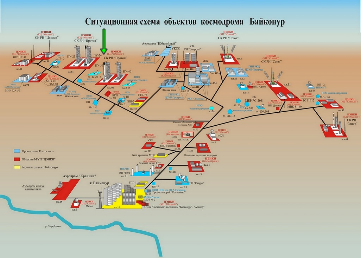
Launch location:
Baikonur Launch pad no. 200/39 46° 2'23.85"N, 63° 1'54.98"E
Launch dates and times:
[table="head"]{colsp=6}Launch times
Time Zone|
Baikonur / UTC+6
|
Moscow / UTC+4
|
Universal / UTC
|
Washington / EDT
|
Los Angeles / PDT
Launch time (Primary):
|
00:08:06
|
22:08:06
|
18:08:06
|
14:08:06
|
11:08:06
on:
|
Oct. 26, 2013
|
Oct. 25, 2013
|
Oct. 25, 2013
|
Oct. 25, 2013
|
Oct. 25, 2013
{colsp=6}
[highlight][eventTimer]2013-10-25 18:08:06?before|after;%dd% Days %hh% Hours %mm% Minutes %ss% Seconds %c%[/eventTimer] Sirius FM-6 Launch[/highlight]
[/table]
Live Coverage Of The Launch:
PAYLOAD
Sirius FM-6 communication satellite:
Mission Summary
Space Systems/Loral (SS/L) and Sirius Satellite Radio announced in August 2007 that SS/L has been awarded a contract from Sirius to build Sirius FM-6, a new, high-power satellite designed to operate in a highly inclined elliptical orbit (HIEO). This satellite is the sixth SS/L-built spacecraft in the Sirius fleet.
Sirius FM-6 provides nearly double the power of the satellites in Sirius' existing first-generation in-orbit HIEO constellation, continuing to improve service for Sirius subscribers. Scheduled for completion in 2010, the new satellite provides more than 15 years of service life.
The spacecraft design is mostly identical to Sirius FM-5.
It was to replace the Sirius FM-1 and FM-2 satellites, which would have reduced the HIEO-constellation from three to two satellites, but it was later decided, that FM-6 would also be placed into the geostationary orbit at 116.15° west.
[table="head"]{colsp=2}Summary
Parameter|
Value
Working Orbit:
|
GEO
Orbital Location:
|
115.2° West
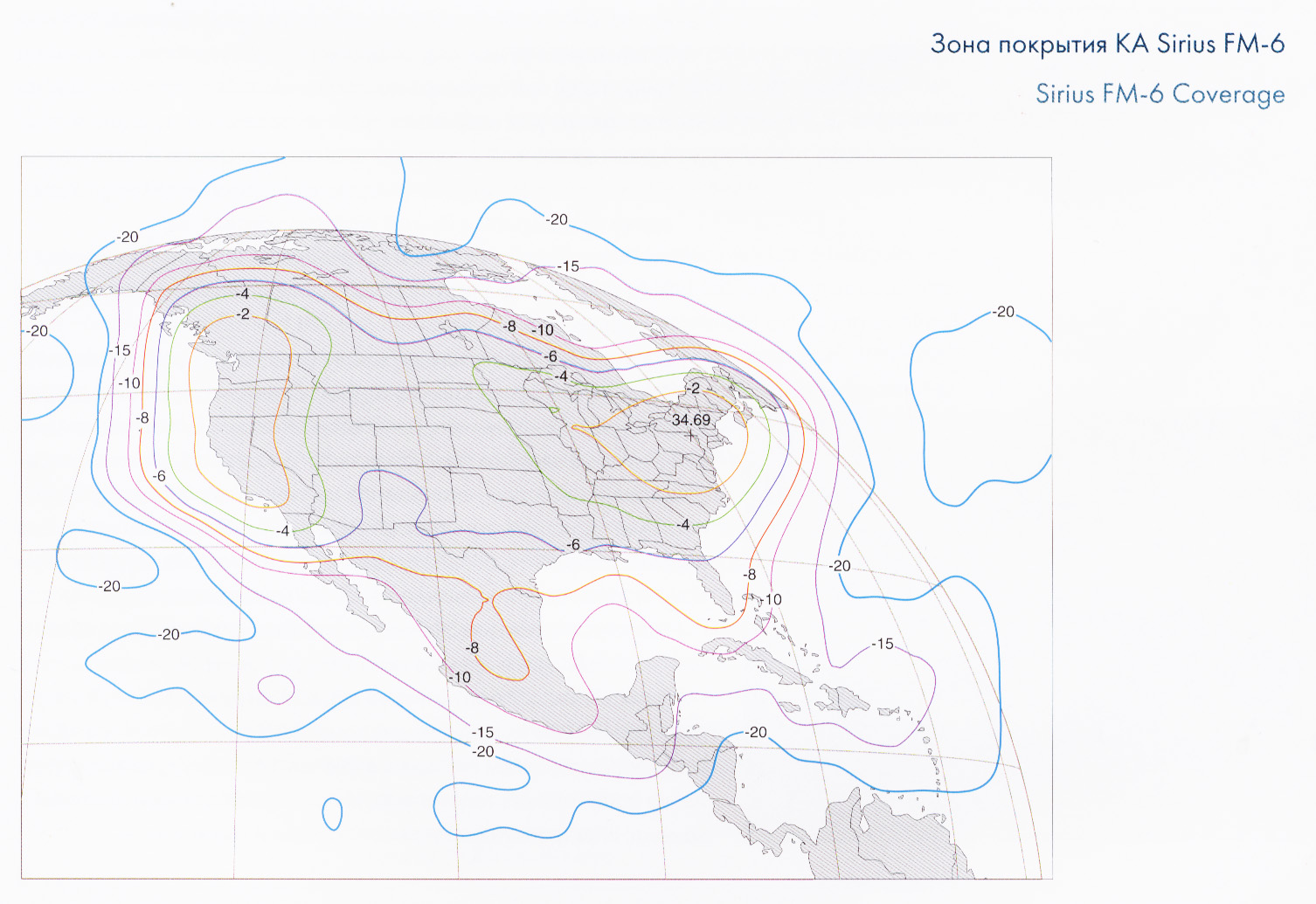
Coverage:
|
North America
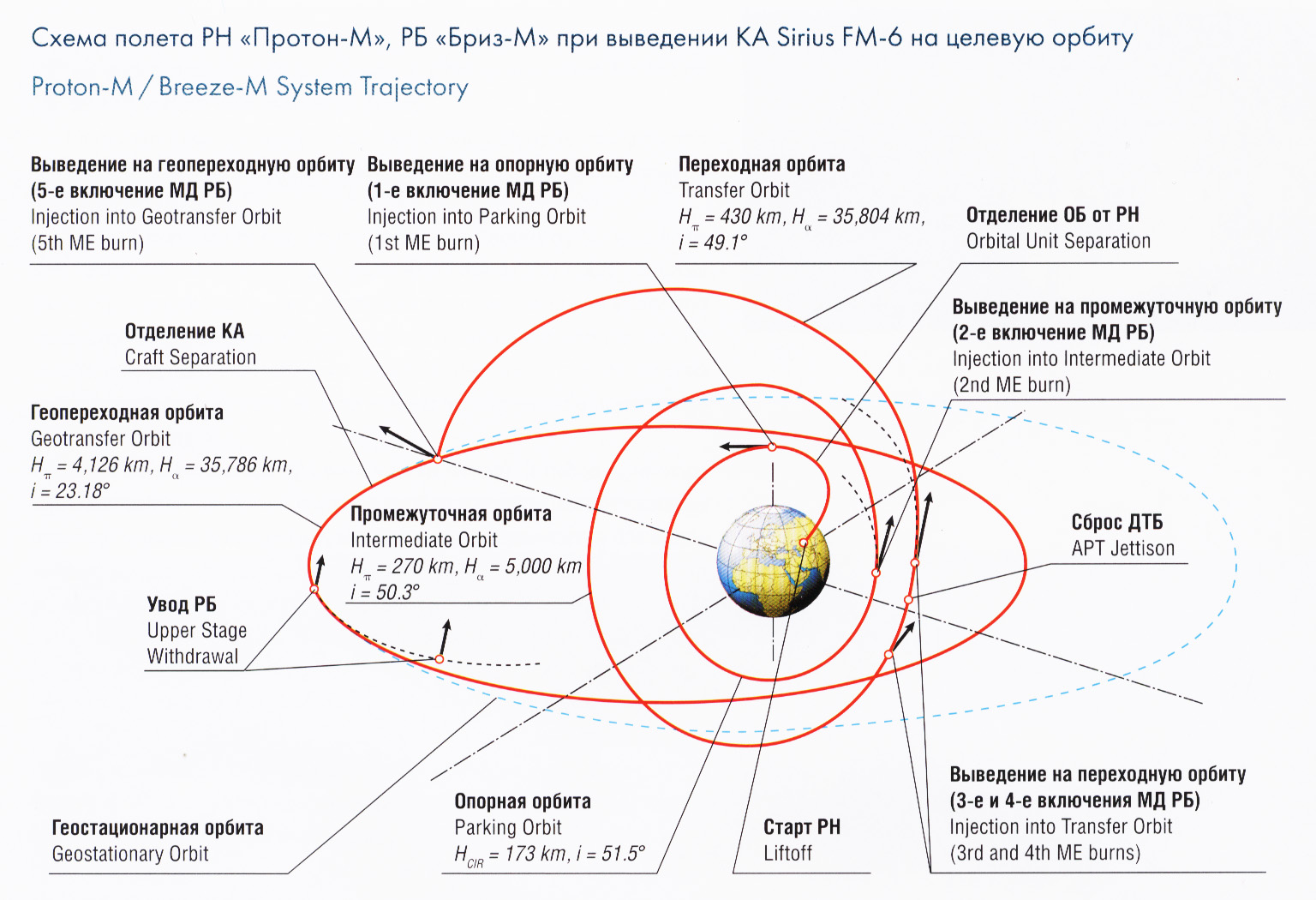
ApA at separation:
|
35786 km
PeA at separation:
|
4126 km
Inc at separation:
|
23.2°
[/table]
[table="head"]Characteristics|
Sirius FM-6
Customer:
|
Prime contractor:
|
Platform:
|
Mass at Separation:
|
Dry Mass:
|
Stabilization:
|
Dimensions (stowed):
|
Batteries:
|
Payload:
|
Life time:
|
Coverage:
|
|
[/table]
Launch Vehicle:
[table="head"]{colsp=2}Characteristics
|[table="head"]{colsp=2}
Proton-M / Briz-M
Prime contractor:
|
GRAU Index:
|
Height:
| 58.2 m with upper stage and payload fairing
Diameter:
| max 7.4 m
Liftoff mass:
| 705 metric tonnes
Payload mass:
| ~22 tonnes at LEO
1st stage:
|
- 6 X RD-275 engines
- Empty 30.6 tonnes
- Propellants 419.41 tonnes (UDMH and NTO)
- Thrust in vacuum 1069.8 tonnes of force
- Thrust at sea level 971.4 tonnes of force
2nd stage:
|
- 1 X RD-0211 engine 3 X RD-0210 engines
- Empty 11.4 tonnes
- Propellants 156.113 tonnes (UDMH and NTO)
- Thrust in vacuum 237.4 tonnes of force
3rd stage:
|
- 1 X RD-0213 engine & 1 X RD-0214 vernier engine
- Empty 3.7 tonnes
- Propellants 46.562 tonnes (UDMH and NTO)
- Thrust in vacuum 59.36 (core) + 3.15 (vernier) tonnes of force
Upper Stage:
|
- GRAU Index: 14S43
- Common Name: Briz-M
- Designer & Manufacturer: Khrunichev Space Centre
- Dimensions: Length 2.654 m, Diameter 4 m
- Empty Mass 2.2 tonnes
- Propellants 6 660 kg UDMH + 13 260 kg N2O4
- Flight time: no less than 24 hours
- Main Engine: 1 X 14D30
- Thrust in vacuum 2.0 tonnes of force
- ISP 328.6 s
- Main engine restarts: up to 8 times
- Precision Manoeuvering Engines: 4 X 11D458
- Thrust in vacuum 400 N each
- ISP 252 s
- RCS Engines: 12 X 17D58E
- Thrust in vacuum 13.3 N each
- ISP 274 s
Payload Fairing:
|
- Diameter 4.35 m
- Length 11.6 m
[/table]
[/table]
The vehicle's
reliability statistics according to
http://www.spacelaunchreport.com/log2013.html#rate:
Code:
================================================================
Vehicle     Successes/Tries Realzd Pred  Consc. Last     Dates
                             Rate  Rate* Succes Fail
================================================================
Proton-M/Briz-M  61    67    .91  .90      5    12/08/12 2001-
Sirius FM-6 Ascent Profile
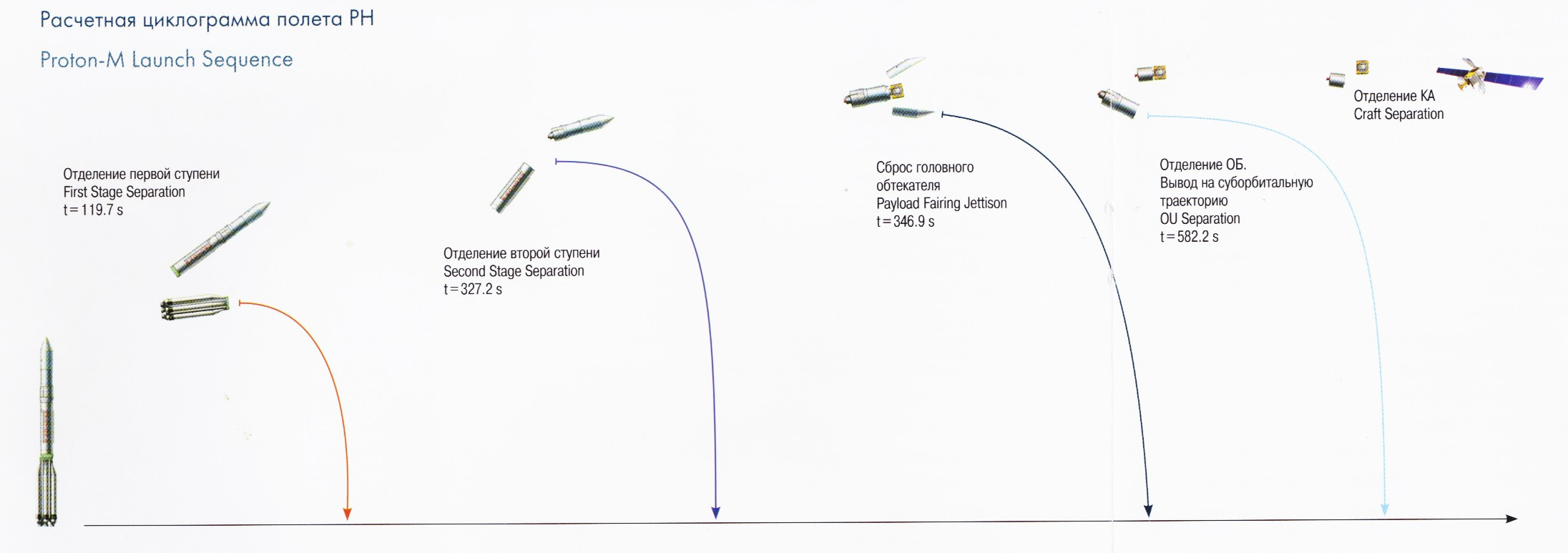
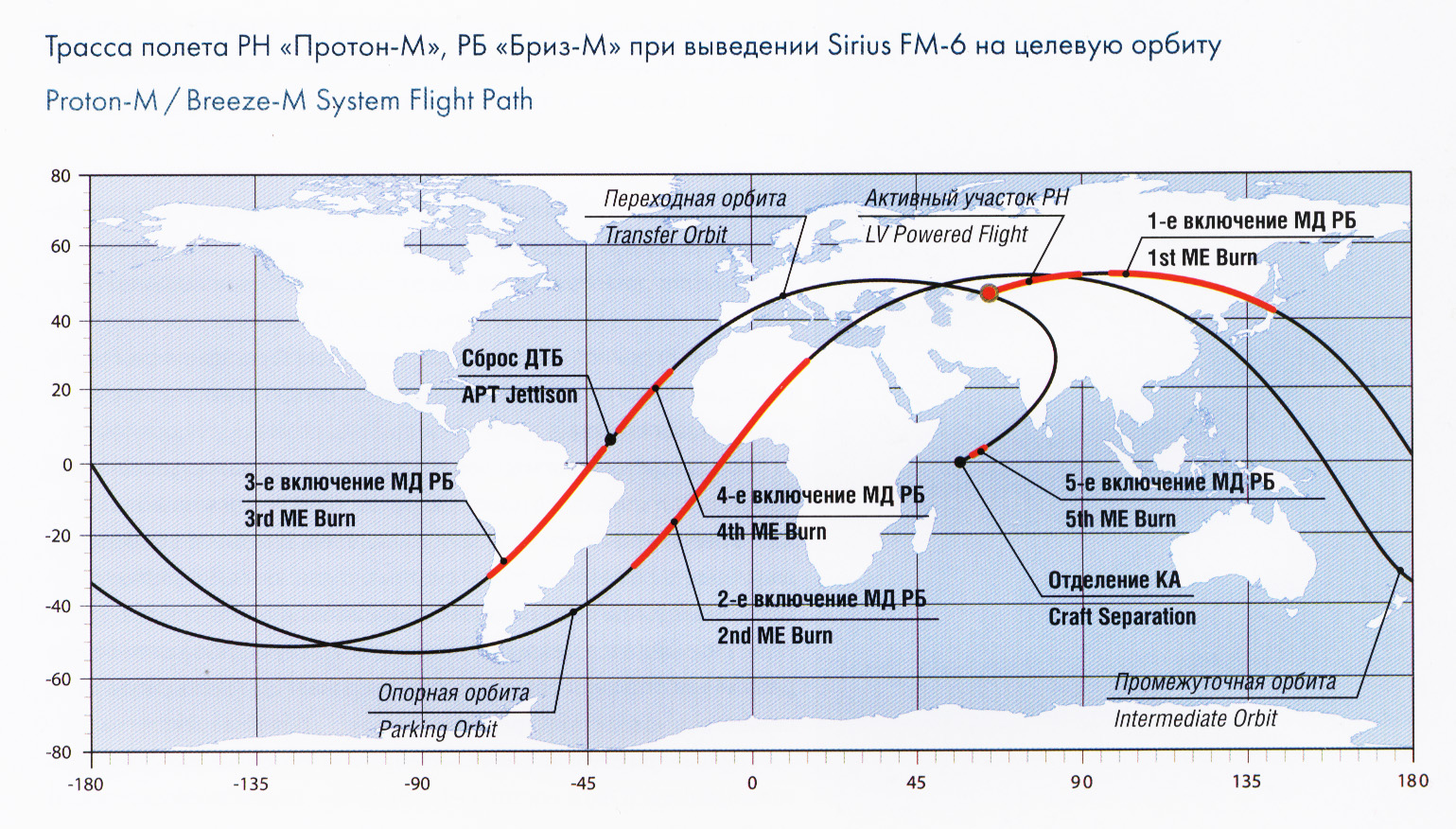
The Proton-M first three stages place the orbital unit (OU), which consists of a Breeze-M upper stage, adapter system and Sirius FM-6, into a 51.5° inclination suborbital trajectory.
Proton-M powered flight lasts 582 seconds. The OU powered flight begins at the moment of the third stage separation.
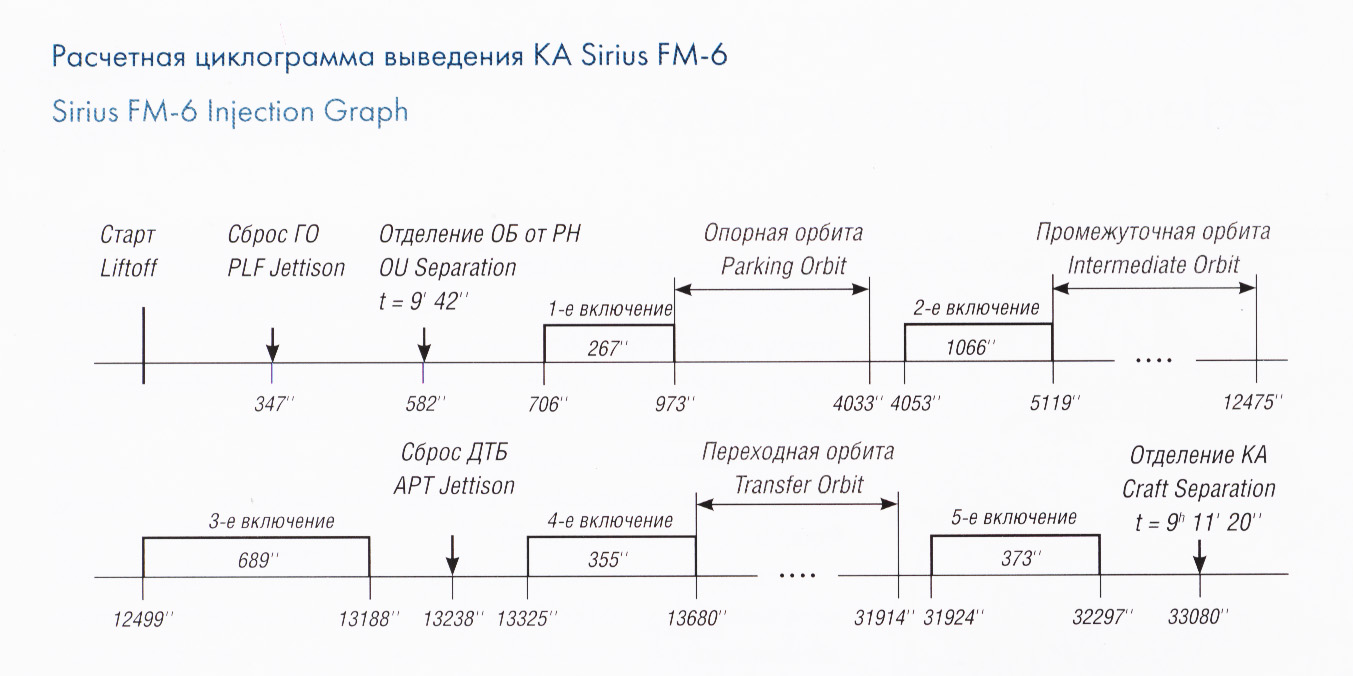
Immediately after the separation of the third stage booster, the Breeze-M stability engines start, damping the angular velocities of the third stage separation and then providing orbital unit orientation and stability during coast flight along a suborbital trajectory to await the first burn. The upper stage follows a five-burn injection profile.
Sirius FM-6 Ascent Timeline
[TABLE="head"]Event|Time rel lift-off|Time UTC|Comment
Ignition Start Sequence|-00:00:02.5|18:08:03.5|
Stage 1 Ignition (40% thrust)|-00:00:01.75|18:08:04.25|
Command Stage 1 (100% thrust)|-00:00:00.9|18:08:05.1|
Maximum Dynamic Pressure|00:01:02|18:09:08|
1st/2nd Stage Separation|00:02:00|18:10:06|
2nd/3rd Stage Separation|00:05:27|18:13:33|
Payload Fairing Separation|00:05:47|18:13:53|
3rd Stage/Breeze M Separation|00:09:42|18:17:48|
1st Burn Ignition|00:11:46|18:19:52|
1st Burn Shutdown|00:16:13|18:24:19|1st Burn's Duration 00:04:27
2nd Burn Ignition|01:07:33|19:15:39|
2nd Burn Shutdown|01:25:19|19:33:25|2nd Burn's Duration 00:17:46
3rd Burn Ignition|03:28:19|21:36:25|
3rd Burn Shutdown|03:39:48|21:47:54|3rd Burn's Duration 00:11:29
APT Jettison|03:40:38|21:48:44|
4th Burn Ignition|03:42:05|21:50:11|
4th Burn Shutdown|03:47:59|21:56:05|4th Burn's Duration 00:05:54
5th Burn Ignition|08:52:04|03:00:10|
5th Burn Shutdown|08:58:17|03:06:23|5th Burn's Duration 00:06:13
Spacecraft Separation|09:11:20|03:19:26|
[/TABLE]
Weather forecast for Baikonur, Kazakhstan on October 26, 2013 (12 a.m.)
Partly cloudy. Low of 3C. Winds from the NNE at 10 to 15 km/h.
Time|Temps|Dew Point|Relative Humidity|Precip|Snow|Cloud cover|Pressure|Wind|Weather
11 PM|4°C|-4°C|58%|0%|0%|74%|1028 hPa|13 km/h NNE|
Mostly Cloudy
References
http://www.federalspace.ru
http://tvroscosmos.ru
http://www.khrunichev.ru
http://www.ilslaunch.com
http://tihiy.fromru.com/Rn/RN_Proton.htm
http://space.skyrocket.de/doc_sdat/sirius-cdr-6.htm
http://www.siriusxm.com/
http://www.tsenki.com
http://forum.nasaspaceflight.com
http://www.novosti-kosmonavtiki.ru
http://www.spacelaunchreport.com
http://english.wunderground.com/cgi-bin/findweather/getForecast?query=44.84999847,65.50000000