Sci-Fi World Building: Design a martian spaceplane

Hlynkacg

Aspiring rocket scientist
Addon Developer
Tutorial Publisher
Donator
Joined
Dec 27, 2010
Messages
1,868
Reaction score
4
Points
0
Location
San Diego
For the last year or so I've been working on a "Plausible Near-Future" RPG setting and several short stories set in the same. I need a way for my martian colonists to get to orbit and back as well as visit isolated stations on the planet's surface. The image in my head is essentially a DGIV or large "Jump-Jet" optimized for the Martian atmosphere and envroment.

My problem is that I have no Idea what such an air/spacecraft would actually look like, and as such I am looking to the internet for input and inspiration.

What sort of craft would a Martian "[ame="http://en.wikipedia.org/wiki/Bush_flying"]bush pilot[/ame]" fly?

Conceptual Constraints:
  • Dv budget of5 - 6 km/s. *note
  • Minimum lift capacity of 1.5 metric tonnes, 5 - 10 tonnes ideal.
  • Single stage, and fully reusable. Should be able to lift off and land multiple times without needing any logistical support other than fuel.
  • Engines use locally available propellants.
  • Plausible (Think Moon or 2001) tech level, no unobtainium required.

So what do you say guys?

ETA:
Dv figure arrived at through several test flights made in Orbiter using the XR-2 and Delta Glider. I would launch from Olympus, attain a 400 km circular orbit, and then return to Olympus noting my fuel consumption along the way. Atmospheric lift was utilized moderately during ascent and for the majority of my descent. Hover-thrusters were only engaged on initial lift-off and final approach to bring my touchdown velocity within safe limits.

Out of 5 round trip flights my best result was 4.93 km/s worth of fuel burned in a DGIV. My worst was 6 km/s in a XR-2.
 
Last edited:
How about a rocket powered blimp ?
 
How about a rocket powered blimp ?

I don't really see how a blimp would be effective in Mars' thin atmosphere. It might work on Venus or Titan though.
 
I wonder if a spaceplane is a good idea for Mars - there is no oxygen in the air, so you have to use rockets.
Would the lift help any, or just increase the air resistance losses?
I can't estimate that off the top of my head.

Even landing is somewhat speculative - you'd have to go at around the speed of sound to get the lift, so loooong runway and good brakes, all to save about 300-400m/s of DV.
Would that pay off the reduced payload of having wings and brakes?
 
I wonder if a spaceplane is a good idea for Mars - there is no oxygen in the air, so you have to use rockets.
Would the lift help any, or just increase the air resistance losses?
I can't estimate that off the top of my head.

Even landing is somewhat speculative - you'd have to go at around the speed of sound to get the lift, so loooong runway and good brakes, all to save about 300-400m/s of DV.
Would that pay off the reduced payload of having wings and brakes?

I'm not sure but in orbiter at least, using atmospheric lift in the DG and XR2 leads to significant fuel savings, particularly on the return leg. There is also the suborbital mission to consider. For example when the colonists at Olympus want to visit Gale Crater or thier sister-station on the Marineris Rim. ;)

As I stated above, hover thrusters were used during the final minute or so of my test flights to lower my touchdown speeds.
 
Last edited:
Any aircraft designed specifically for the Martian atmosphere will look a lot more like modern gliders than the DG/XR2.
 
Any aircraft designed specifically for the Martian atmosphere will look a lot more like modern gliders than the DG/XR2.

Yes, but likely with a much different aspect ratio. The compromises needed for our gliders (or the U-2) wouldn't apply to a martian glider.
 
Except that gliders are not spaceplanes and cannot re-enter.

And I do have a semi-realistic Earth-Mars spacecraft with DG-esk landing shuttles for a nation-building projects space agency.

SMR%20Odin.png
 
Any aircraft designed specifically for the Martian atmosphere will look a lot more like modern gliders than the DG/XR2.

I realize that, but I'm having problems envisioning how to blend that with the need to survive re-entry and hyper-sonic flight. I also need to figure out just how big this thing needs to be and thus how heavy it is likely to be.

Yes, but likely with a much different aspect ratio. The compromises needed for our gliders (or the U-2) wouldn't apply to a martian glider.

That's the kind of stuff I would like help from the community to figure out.

---------- Post added at 13:51 ---------- Previous post was at 13:43 ----------

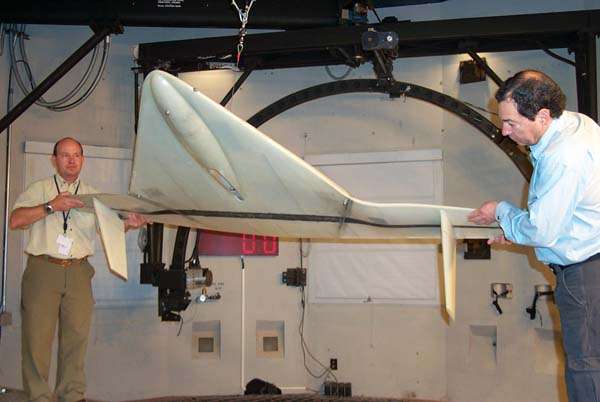
I Just found the following on a google image search for "martian flyer", looks interesting.

mars20flyer203indexun1.jpg


Caption: Joe MacKrell (left) of Naval Research Laboratory and Larry Lemke of NASA Ames demonstrate the Vertical Wind Tunnel testing of the Mars Flyer Model. (Air Force photo Holly Jordan)
 
Last edited:
Well, you have to remember, that you are quickly supersonic on Mars, because of the low pressure relative to the density of the CO2 rich atmosphere.

(Speed of sound is 244 m/s at the reference surface)
 
Last edited:
I'm thinking back to Red Mars by Kim Stanley Robinson, and the flyers they used early on in the colonization and terraforming process... Lots of ultralight, high-aspect planes for short range work, and rocket planes for longer range work. I think that there should be two designs: one optimized for short-range work, and one for longer trips. However, if you're aiming for a single design, I'd go for the long range design with some concessions to the need for shorter hops as well. Maybe a Variable Geometry design?
 
Except that gliders are not spaceplanes and cannot re-enter.
Why not?

Maybe some kind of variable geometry wings? Lifting body fuselage with the more glider-like wings stowed for re-entry, extended for atmospheric flight?
 
That adds weight which needs a longer wingspan which will need bigger machinery to move the wing which will mean you need a bigger wing...
 
That adds weight which needs a longer wingspan which will need bigger machinery to move the wing which will mean you need a bigger wing...
And not having an efficient wing design for the thin Martian atmosphere means you'll need to go faster to generate sufficient lift, which means more dangerous takeoff/landing speeds, more energy lost to drag, and more weight carrying the additional fuel you'll need due to being inefficient...
 
Why not?

Maybe some kind of variable geometry wings? Lifting body fuselage with the more glider-like wings stowed for re-entry, extended for atmospheric flight?

After finding the image I posted above this is the direction I'm leaning.

I figure I can steal a page from Moach's G42-200 and have longer high-efficiency wings that cant upwards during re-entry, to reduce the stresses upon them.

picture.php
 
While I dont have any expertise in this subject(let alone anything).

I would say the most realistic mars spaceplane vehicle would have a design that would look like a cross between the Kliper plane and the dream-chaser craft. It would launch vertically like the space shuttle. And it would land horizontally(also like a space shuttle) using small rockets to slowdown during touchdown. I doubt that long runways would be of priority to a fledgling colony so you may have to start thinking of ore exotic ways to stop the craft. You could add arrestor wires and/or EM catapults to these small runways.

The only real use of the wings would be to increase drag during reentry. This craft would also be powered by a Meth/Ox engine.
 
A while back, I was playing around with a "switchblade" configuration for the DG, for Mars suborbital flights and unpowered landings.

Switchblade_zpsc27b51ff.jpg

On the left is the standard DG wingspan.

Very loosely based on the [ame="http://en.wikipedia.org/wiki/Northrop_Switchblade"]Northrop Switchblade - Wikipedia, the free encyclopedia[/ame]

Just throwing it out as an alternative to the folded wing.
 
I like that and may end up appropriating it.

I think I'm going to need to do some sketches to figure out how the whole thing would fit together.
 
There's several problems here... only the first of which is engineering the optimal solution. The tough thing is devising a low-maintenance solution that the "isolated stations" can actually support and doesn't become a useless hunk of metal when a critical part breaks down.

The other thing is fuel/propellant: That has to be available too.

The thin atmosphere of Mars provides several advantages and disadvantages.

First, you need a lot of lift for landing and takeoff. VTOL or a tailsitter might be a better solution than a craft with wings large enough to generate the needed lift for takeoff and landing without needing a stupendiously long landing strip that will also be difficult to maintain.

An advantage is that you reach supersonic speeds pretty soon and with a lot less structural burden to the plane, meaning it would need less maintenance than a plane cruising at comparable speeds on earth. So the wings, once you're up to velocity, don't need to be that large... the plane will more follow a suborbital logic than a cruising one.

Something like a tailsitter that can get out of the densest atmosphere fast, then can gain velocity for a more or less balistic trajectory to the target, and something along the lines of wings, majorly used for braking, does seem like a rather good solution in the eyes of this complete non-engineer... Anything with too complex machinery (like a scram or somesuch) or variable geometry wings sounds a bit too sophisticated to be succesfully maintained by a near future Mars colony.

Can't say anything about the engines and the propellant, though. Don't know what kind of propellant would be feasible to produce on Mars.
 
Compressed CO2 fed through a NTR or a thermal storage bed. ISP's terrible, but all you need is electricity to compress the CO2, and you've got fuel ANYWHERE.
 
Back
Top