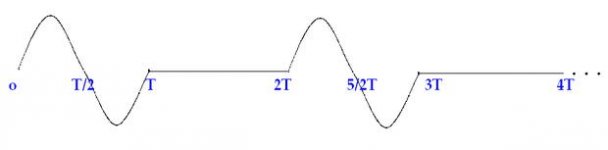
A function that describes your wave form is this one:
[math]\frac{1}{2}\biggl(SquareWave \biggl(\frac{t}{2T} \biggr) + 1\biggr)sin(2 \pi t / T)[/math])
Afaik, the function you have there is not analytical, but it is harmonic, therefore I tried to run it through wolfram alpha to get a fourier series, but it cannot solve it:
http://www.wolframalpha.com/input/?i=FourierSeries[(1/2+(SquareWave[t/(4pi)]+++1)Sin[t])]
(I disabled the url so as not to flood poor Alpha with the same query over and over again, lest it becomes as depressive as Marvin

)
In order to compute the fourier series of your waveform, you have to compute the fourier series of the square wave, which is known (check
http://mathworld.wolfram.com/FourierSeriesSquareWave.html ), the fourier series of the constant (it only has the coefficient [math]a_0[/math], the fourier series of sin(t).
Once you have got the coefficients for the three series, you add those of the constant (1) and the square wave, then you have to perform a Cauchy product between the coefficients you obtained via the sum and the ones of sin(t):
http://mathworld.wolfram.com/CauchyProduct.html
Also, whatever method you use to compute your coefficients, watch out for the periods of the functions you are using, to be sure that there is the same scaling.
I hope I did not make any mistake

and that it is actually useful.
PS: I still

for the math functionality included in the forum.