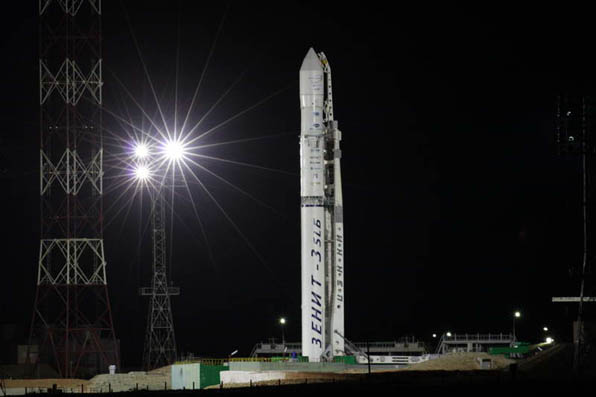
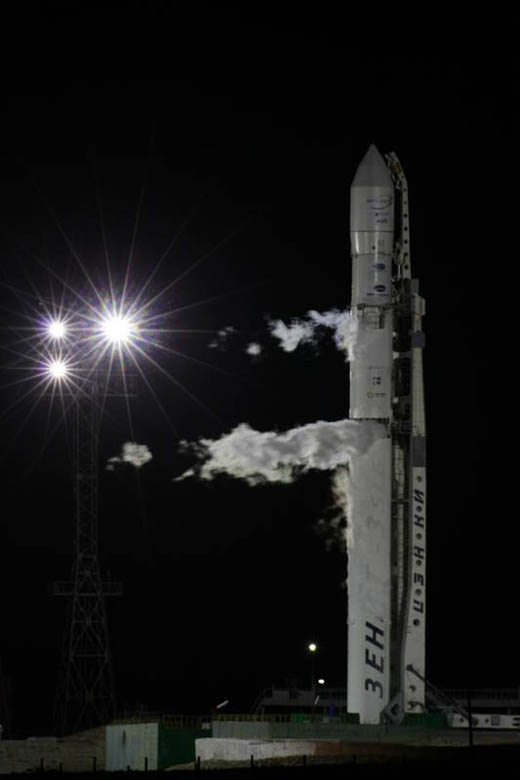
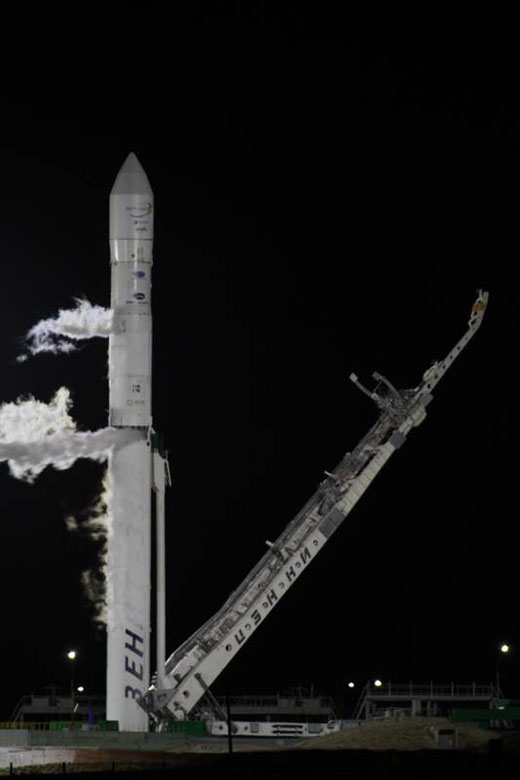
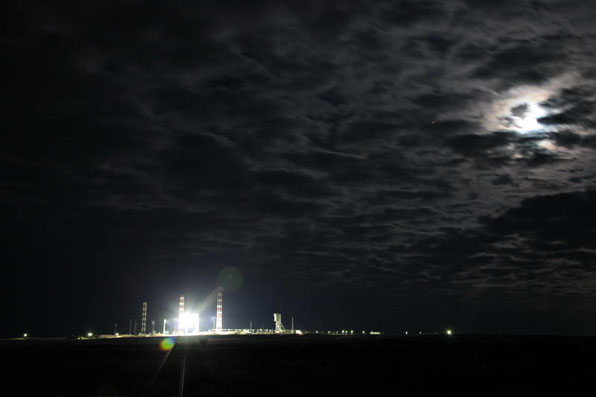
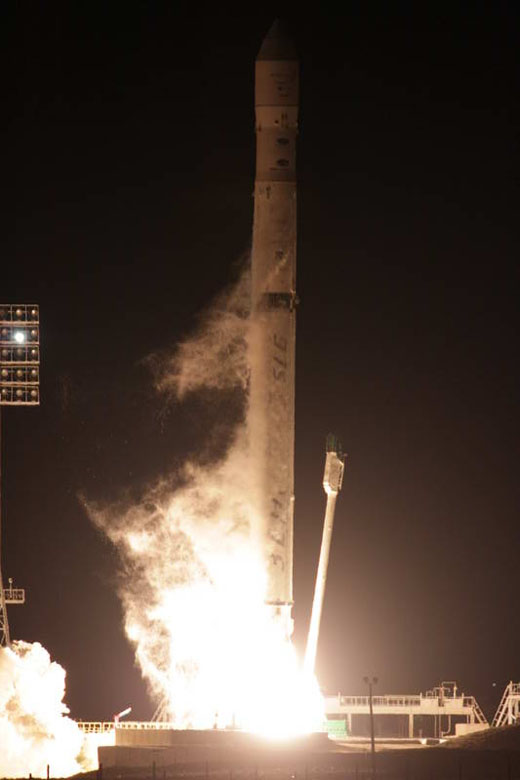
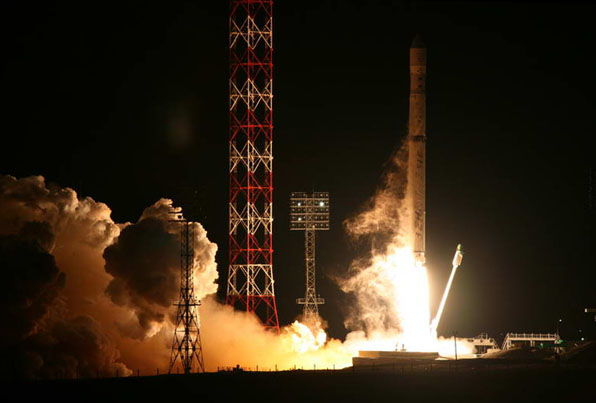
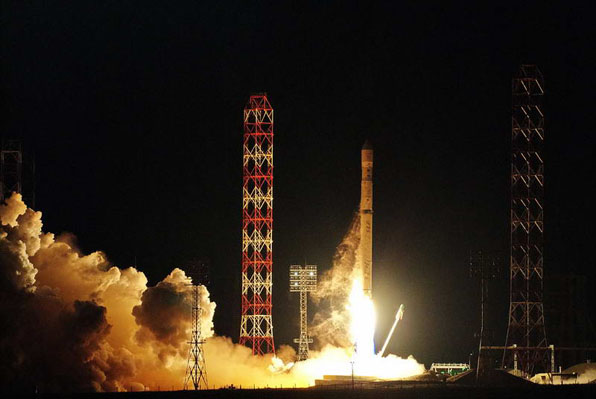
After a relatively quiet period for the Zenit launch vehicle for the past few years (with 0 launches in 2010), it seems that there is a renaissance of the "rocket to the zenith of the sky" in Baikonur, with 4 launches scheduled for 2011. Of more importance is the restart of Sea Launch's Land Launch operation, after the bankrupt of the original Sea Launch co-operation halted commercial launches from Baikonur for close to two years. Now, it is finally back for launching a new communication satellite for the world-famous Intelsat cooperation.
Launch location:
Baikonur Launch pad no. 45/1 45°56'35.87"N, 63°39'10.83"E
Launch dates and times:
[table="head"]{colsp=5}Launch times
Time Zone
|
Baikonur / UTC+6
| Universal / UTC
| Washington / EDT
| Los Angeles / PDT/
Launch time (Primary):
|03:00:00
|21:00:00
|17:00:00
|14:00:00
on:
|Oct. 6, 2011
|Oct. 5, 2011
|Oct. 5, 2011
|Oct. 5, 2011
{colsp=5}
[highlight][eventTimer]2011-10-05 21:00:00?before|after;%dd% Days %hh% Hours %mm% Minutes %ss% Seconds %c%[/eventTimer] Intelsat 18 Launch[/highlight]
{colsp=5}[highlight][eventTimer]2011-10-06 03:34:38?before|after;%dd% Days %hh% Hours %mm% Minutes %ss% Seconds %c%[/eventTimer] Intelsat 18 Spacecraft Separation[/highlight]
{colsp=5}[highlight][eventTimer]2011-10-06 03:34:38?before|after;%dd% Days %hh% Hours %mm% Minutes %ss% Seconds %c%[/eventTimer] Intelsat 18 Spacecraft Separation[/highlight]
[/table]
Live Coverage Of The Launch:
- TsENKI Video Stream: http://www.tsenki.com/en/broadcast/
PAYLOAD
Intelsat 18 communication satellite:

Spacecraft Overview
Intelsat 18 is one of ten STAR GEO communications satellites ordered by Intelsat. The spacecraft will carry a hybrid C- and Ku-band payload and will be located at an orbital slot at 180 degrees East Longitude. The satellite's C-band payload will serve Eastern Asia, the Pacific and the Western United States and its Ku-band payload will serve French Polynesia, Eastern Australia and the United States.
Built by Orbital Sciences Corporation, the satellite will provide capability to enable enhanced DTH coverage and network services capabilities via Ku-band and C-band platforms. Once operational in November, it will replace Intelsat 701 at 180oE and is expected to have a useful life of nearly 17 years.
“Intelsat 18 will provide the infrastructure for customers to deliver media content directly to homes throughout the Pacific Ocean region, as well as broadband services directly to government and commercial users,” said Intelsat CEO David McGlade. “Intelsat’s strategy aligns our fleet investments to support our customer’s growth needs. The Intelsat 18 payload includes a Ku-band beam designed to the requirements of Office des Postes et Communications (OPT) of French Polynesia. The customer will use this beam to provide new broadband, expanded domestic DTH service and improve its infrastrastructure across French Polynesia, with the ability to serve the South Pacific.”
[table="head"]{colsp=2}Summary
Parameter|Value
Working Orbit:
|GEOOrbital Location:
|180° EastCoverage:
|Pacific Region (Pacific Islands, North America West Coast, East Asia, Australia, New Zealand)ApA at separation:
|35786.0 kmPeA at separation:
|5517.6 kmInc at separation:
|19.50°[/table]
[table="head"]Characteristics|
Intelsat 18
Customer:
|- Intelsat Ltd.

Prime contractor:
|- Orbital Science Corporation

Platform:
|- Star-2 Bus 2.4
Mass at Separation:
|- 3200 kg
Dry Mass:
|- ?
Stabilization:
|- 3 axis stabilized, with a zero momentum system
Dimensions:
|- ?
Power at end-of-life:
|- 6.8 kW
C-band Payload:
|- Repeater: 24 active transponders with two groups of 16-for-12 redundant TWTA's
- Antenna: 2.5 m x 2.7 m single shell super-elliptical deployable reflector; 1.45 m deck-mounted antenna
Ku-Band Payload:
|- Repeater: 12 active transponders with two groups of 8-for-6 TWTA's
- Antenna: 2.7x2.5 m single shell deployable reflector
Propulsion:
|- Propulsion: Liquid bi-propellant transfer orbit system; Monopropellant (hydrazine) on-orbit system
Power System:
|- Solar Arrays: Four panels per array, UTJ Gallium Arsenide cells
- Batteries: Two >4840 W-Hr capacity Li-Ion batteries
Coverage area:
|
|

|

|

|

Life time:
|- 15+ years
|

Launch Vehicle:
[table="head"]{colsp=2}Characteristics
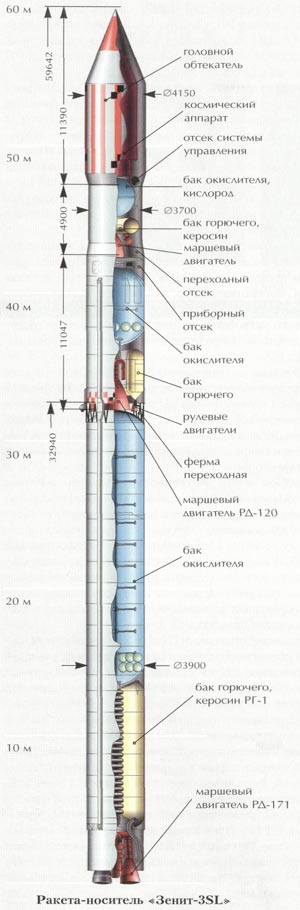
Zenit-3SLB / Blok DM-SLB
Prime contractor:
|- Yuzhmash (A.M. Makarov Yuzhny Machine-Building Plant) - Ukraine
GRAU Index:
|- 11K77
Height:
| 58.7 m with upper stage and payload fairing Diameter:
| max 4.1 mLiftoff mass:
| 473 metric tonnes Payload mass:
| ~3.75 tonnes at GTO1st stage:
|- 1 X RD-171 engine
- Empty 33.9 tonnes
- Propellants 318.8 tonnes (RG-1 Kerosene and LOX)
- Thrust in vacuum 7 908 kN
- Thrust at sea level 7 259 kN
2nd stage:
|- 1 X RD-120 engine + 1 X RD-8 vernier engine
- Empty 9.3 tonnes
- Propellants 80.6 tonnes (RG-1 Kerosene and LOX)
- Thrust in vacuum 834 + 78 kN
Upper Stage:
|
- GRAU Index: - 11S861
- Common Name: Block DM-SLB
- Designer: Designer: RKK Energia
- Manufacturer: "Krasmash" Krasnoyarsk Machine Building Plant
- Dimensions: Length 5.5 m, Diameter 4.1 m
- Empty Mass: 2.2 tonnes
- Propellants load: 15.095 tonnes (RP-1/LOX)
- Main Engine: 1 X RD-58M
- Thrust in vacuum 8.67 tonnes of force
- ISP 352 s
Payload Fairing:
|- Diameter 4.1 m
- Length 10.4 m
[/table]
[/table]
The vehicle's reliability statistics according to http://www.spacelaunchreport.com/log2011.html#rate:
For Zenit-3SLB,
Code:
================================================================
Vehicle     Successes/Tries Realzd Pred  Consc. Last     Dates
                             Rate  Rate* Succes Fail
================================================================
Zenit 3SLB/DMSLB  3     4    .75  .67      3(B) 4/28/08  2008-

(B) Amos-3 inserted in orbit with 1,500 km short perigee and
  0.7 deg unplanned inclination.  Amos 3 reportedly lost two
  to three years of 18 year design life.
Intelsat 18 Ascent Profile

[TABLE="head"]Orbit #|Orbit Nature|Perigee h, km|Apogee H, km|Inclination
1|2nd stage separation|-2414.1|410.6|51.38°
2|Parking|175.2|670.3|51.38°
3|GEO-transfer|192.6|35981.8|49.01°
4|Target GTO|5517.6|35786.0|19.50°
[/TABLE]
Intelsat 18 Ascent Timeline


[TABLE="head"]Event|Time UTC|Comment
Lift-off|21:00:00 (Oct. 5)|
1st Stage Separation|21:02:29|
Payload Fairing Separation|21:05:13|
2nd/upper Stage Separation|21:08:31|
1st Burn Ignition|21:08:40|
1st Burn Shutdown|21:12:38|1st Burn's Duration 00:03:58
2nd Burn Ignition|22:20:03|
2nd Burn Shutdown|22:25:21|2nd Burn's Duration 00:05:18
3rd Burn Ignition|03:22:25 (Oct. 6)|
3rd Burn Shutdown|03:23:48|2nd Burn's Duration 00:01:23
Spacecraft Separation|03:34:38|
[/TABLE]
Photos and videos of the preparations for the launch will come soon.
References
http://www.sea-launch.com
http://www.yuzhmash.com
http://www.yuzhnoye.com
http://forum.nasaspaceflight.com
http://www.novosti-kosmonavtiki.ru
http://www.spacelaunchreport.com
http://www.intelsat.com/network/satellite/
http://www.orbital.com/SatellitesSpace/Communications/Intelsat18/
Last edited: