Science Afordable (Non-Gas) Energy

Most Theoretical Predominate Energy Source

  • We will predominately use Wind

    Votes: 0 0.0%
  • We will predominately use Hydroelectric

    Votes: 0 0.0%

  • Total voters
    16

fsci123

Future Dubstar and Rocketkid
Addon Developer
Joined
Aug 18, 2010
Messages
1,536
Reaction score
0
Points
0
Location
?
I was reading some stuff about peak oil and i decided to open this thread about alternative energies and how we may theoreticaly make it affordable.
A common list of affordable NG energies are:
Nuclear
Solar
Hydroelectric
etc...

As far as my understanding go... Solar is not effieceint enough
 
I hope "We will predominately use Nuclear Fussion" thats why i've voted this :)
And i'll hope that ITER would work!

I belive, that nuclear fission is a bad solution, because no one know where all the garbage could be savety storaged for the next billion years... Thats the highest risk next to the risk of a maximum credible accident in a power plant... also the risk of small accident witch only lokal contamination is real and high.
Mineral fuels have the disadvantage that they are limited, but growing plants are ok, if the planting / harvest efficience is good enogh, because they only give the CO² back to the air they've collected in their live. But here the disadvantage is, that they displace areas for more important foodstuffs, also in poor contrys where they don't have enogh food, and so the food would be more expensive for the people living there.
I think wind energy is also verry good, if you have enogh land with enogh wind.

But what i really thing is, that in the near future (in our livetime), it would became a mix of all of them.
 
Last edited:
Well, I voted for Fission, but it just struck me that this poll doesn't really cover the options for dealing with running out of oil well. Electricity generation already uses a combination of all the options listed here (mostly coal, AFAIK), and very little oil.

The concern with running out of oil is finding new sources of fuel for automobiles. None of the options given in the poll are easy to use in a car. My own personal favorite is biogasoline, but we'll just have to see.

Once we run out of coal, I'd say fission is the best source for electrical energy, followed by fusion whenever that is developed.
 
I don't think people will, in this dumbed down society, ever use any type of nuclear power for personal use. Like in having your own reactor in the basement. Too many "grown-up" responsibilities.. I think solar is the 'safe' choice.

Knowing what I know about idiotic behaviors in young folks, I would not want the neighbor's teenage daughter making a nuclear hairdryer. I could just imagine a mini-pile and tiny control rods for the heating elements. The never-ending gossip is enough to blow the hot air around. And she'd be the hit of the nightclub with glowing hair!


---------- Post added at 08:47 PM ---------- Previous post was at 08:43 PM ----------

I also gotta say, that solar/electric is a great choice if you plan ahead a little. I don't mind waiting a bit to get my solar car all gassed up and ready. If we have a rainstorm, I know its only for a while, and my solar car will be ready to roll when the sun comes out.
 
Last edited:
Of the alternatives to fossil fuel, I find it very hard to say that one will dominate. I'm assuming that "we" means USA. If that's the case, USA has a lot of wind and solar potential. There is enough potential in each of these to provide the entire USA with electrical power.
 
I do not see us using fission in mass to fuel the world. Where do you store all the waste as stated earlier in the thread. Also the thing i am thinking would power everything in 100 years i don't think will be wind fusion fission tidal or wind. I think it will be basically using the energy stored inside of matter directly instead of indirectly. Sort of using matter as a battery that will virtually never run dry.
 
Well, I voted for Fission, but it just struck me that this poll doesn't really cover the options for dealing with running out of oil well. Electricity generation already uses a combination of all the options listed here (mostly coal, AFAIK), and very little oil.

The concern with running out of oil is finding new sources of fuel for automobiles. None of the options given in the poll are easy to use in a car. My own personal favorite is biogasoline, but we'll just have to see.

Once we run out of coal, I'd say fission is the best source for electrical energy, followed by fusion whenever that is developed.
I suspect we may just go to electric cars for a time, with the electricity being generated in plants by one of these methods. (I go for nuclear fusion if we can work that out)
 
I think it will be basically using the energy stored inside of matter directly instead of indirectly. Sort of using matter as a battery that will virtually never run dry.

What do you mean? Annihilating matter so that you turn all of the mass into energy? Even if you had the antimatter to do that, the energy released in such reactions usually ends up in gamma rays which are very difficult to capture.

You can't just poof things into existance. This ain't Star Trek.
 
No not antimatter. Like just extracting the energy directly not through nuclear fusion/fission or antimatter or stuff like that. Not exactly sure how it would work but it should be possible with the right technology. As i said i think this will be in 100 years.
 
Of the alternatives to fossil fuel, I find it very hard to say that one will dominate. I'm assuming that "we" means USA. If that's the case, USA has a lot of wind and solar potential. There is enough potential in each of these to provide the entire USA with electrical power.

The U.S.A. has enough hot air to blow every wind turbine worldwide! :rofl:
 
Fission can be as clean as fusion if advanced reactors and fuel cycles are used that consume all nuclear fuel not just 1% as in currently used reactors. Developing such advanced reactors would also allow to deal with currently produced spent fuel and produce energy in the process. Mastering thorium fuel cycle would basically solve world energy problems forever. Even common granite have 10 - 12 ppm of thorium inside.
A nuclear fusion also would produce some nuclear waste because of neutron irradiation.
Main problem with solar and wind is unreliablity. In my country (and in most of the Europe) during winter when electricity demand is highest there can be several weeks with next to no wind and thick cloud cover which combined with short daylight hours would make solar and wind power a no go for large scale applications.
 
I disagree with the premise of the thread. Affordability is relative to the price of one Btu of conventional energy. Give me ten different oil prices, and I will give you ten sources of energy that become "affordable" / competitive at that level, and fifteen that can be subsidized so that learning and network effects kick in. For more information, would suggest visiting this site: http://www.eia.doe.gov

As a side note, I'd be grateful if the OP installed a spellchecker.
 
No not antimatter. Like just extracting the energy directly not through nuclear fusion/fission or antimatter or stuff like that. Not exactly sure how it would work but it should be possible with the right technology. As i said i think this will be in 100 years.


Ok, this looks like a fun game. Let me try:

In 100 years we'll have floating space ships flying between all planets instantly, faster then the speed of light. I don't know how it'll work, but it'll be in 100 years, so whatever.
 
Even if you had the antimatter to do that, the energy released in such reactions usually ends up in gamma rays which are very difficult to capture.

Well... you can use those gamma rays to heat up a block of material that intercepts gamma rays well, and then basically get energy out of that in the same way you'd get it out of a hot nuclear reactor core.

That also limits you to the efficiency of a heat engine (or whatever thermoelectric gizmo you're using), so...

No not antimatter. Like just extracting the energy directly not through nuclear fusion/fission or antimatter or stuff like that. Not exactly sure how it would work but it should be possible with the right technology. As i said i think this will be in 100 years.

I'm gonna have to go with RisingFury and say that you can't "poof stuff into existence".

"We're gonna extract energy directly from matter in 100 years if we have the right technology" is about as plausible as me saying "I might build a flying car by Tuesday".


I really, really do not see one form of renewable energy predominating. Today no single source of energy predominates, and not even a single form of fossil fuel energy predominates... oil accounts for most energy production, but the numbers of oil coal and gas are rather similar.

Electricity production/heating and transportation are two different things. Transportation is mostly dependant on oil, electricity production is mostly dependant on coal, and heating is mostly dependant on gas.

The electricity production demand is easy to fill because electricity is generic and as long as you can generate it cheaply and effectively, things are fine. Heating can be achieved also by electric heaters, and the need for artificial heating can be reduced by using proper insulation and managing solar energy.

Vehicles however require specific fuels to work, and these fuels either have to be gathered and refined, or synthesised. One can talk about 'electric cars' all day long, but things like air and sea travel consume large amounts of energy and these are not exactly the sorts of vehicles that can run on batteries.

In this regard, I think it would be useful to look at several visually startling graphs:

Remaining oil reserves:
500px-Remaining_oil.svg.png


- The 11 ZJ mark for undiscovered reserves might be optimistic.

- One might assume that as technology and abilities progress at least some of the 'unrecoverable oil' reserves would become recoverable.

500px-World_energy_usage_width_chart.svg.png


- Displays the breakdown of energy sources quite well.

- Photovoltaic power makes up only 0.04% of the total, wind power makes up only 0.3%.

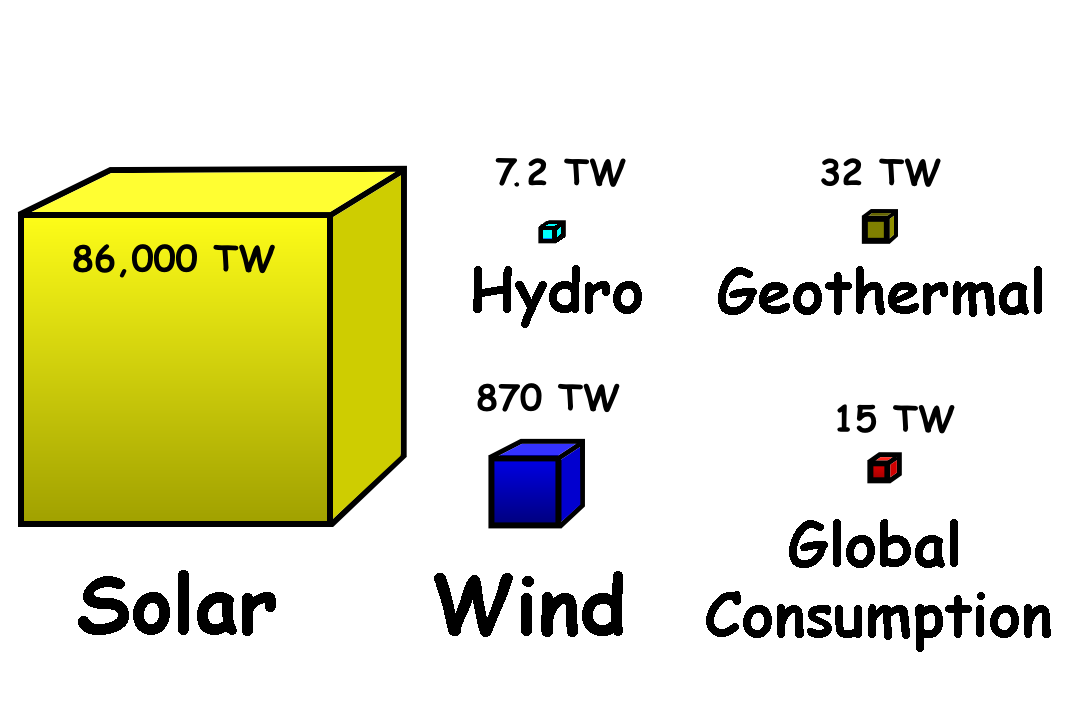
Available_Energy-4.png


- Visual display of renewable energy sources compared to current power production.

- Power production has since increased from 15 TW, and is set to increase in future (estimate of 22 TW by 2030).

- Care must be given when regarding the ecological impact of the use of renewable energy; just because something is sustainable does not mean it doesn't have a non-zero impact. All that energy is already going into the natural system of the planet and disrupting a good deal of it could change many ecosystems.

All in all, I think we will continue to use oil, coal and gas until they become prohibitively expensive, that nuclear power production will increase somewhat, and that renewable forms of energy such as solar, wind and hydropower will increase to fill the gap.

Nuclear fission power is perfectly safe (read: the potential for a catastrophic incident is low enough to be acceptable) when used correctly (in fact, I would not be surprised if the number of people who have died due to coal-based air pollution is far higher than those who have died due to nuclear accidents), and differing fuel use methods can allow a far more efficient use of nuclear fuel as well as lowered production of waste.

I think solar really depends on where you are. South Africa, Australia, and the US would be particularly good places for solar power, because they have high insolation and large tracts of arid or semi-arid land that would have little value for other projects such as farming.

Europe is at a really high latitude, it can be overcast often, and land is often taken up by farmland for example. I would not call places like it ideal for solar power.

However, if electricity can effectively be transmitted over thousands of kilometers, it might make sense to produce power in "solar rich" places and export it to "solar poor" places. There is already a nice large "solar collection area" just south of Europe. :P

Space based solar power is another option, but has its own problems (like, for example, being in space). Nevertheless I have been interested for quite some time in an economic comparison between a ground-based and space-based solar powerplant.

Another idea, though one that is firmly in the mega-engineering category, is that of damming the Mediterranean, at least partially, to achieve a lower sea level by means of natural evaporation and thus using inflowing Atlantic water to generate hydroelectric power. Such a grandoise scheme would however have to have a minimal ecological and economical impact, which would naturally be quite hard to achieve.

Fusion power is currently something like a 'holy grail', but I don't think we should look to it as a saving grace... break-even fusion power will probably become a reality within the next 100 years, but the complexity of the generators and the rarity of the required fuels would be bad setbacks to its implementation as an economical power source.

As for transport, I think it will be necessary for humans to develop a means by which to synthesise various hydrocarbons within a currently existing (although augmented) carbon cycle... it is the way life has done things for billions of years, and if we can't learn to work though and with such a system, we have very, very big problems.

 
I don't particularly like electric cars right now, but my thinking is that batteries will continue to advance as quickly as they have been, getting smaller and more powerful, etc.
 
- One might assume that as technology and abilities progress at least some of the 'unrecoverable oil' reserves would become recoverable.

Yes, I want to know exactly what they mean by "unrecoverable" there. Is it unrecoverable in terms of "you'll spend more money recovering it than you'll get out of selling it at current market prices" or "you'll spend more energy recovering it than you'll get from burning it"?

If it's the former, then the pool of "unrecoverable oil" will shrink automatically as prices rise. The price rise won't be pretty for Americans, (we're currently screaming bloody murder at $3.50-ish a gallon, which is .66€ / liter), but we can count on the stuff being there for whoever can afford it. If it's the latter, then, while some of it probably will be made recoverable by future technological advances, it's nothing we can count on.
 
Back
Top