The Day Of Seven Billion

DanM

Поехали!
Joined
May 23, 2010
Messages
1,131
Reaction score
1
Points
38
Location
Chicago
I've heard that this upcoming year will bring in the day of seven billion. It's getting kind of crowded here. It looks like mankind has two options: Spread out or have less kids. The first one is inevitable if we want to survive as a species. You just can't have so many people crammed into one place and expect to make it that long.

What are your thoughts on this?
 
When I see that 2000 years ago there where only 200 million of us on the entire planet compared to today's 6.9 billion. It really puts things in perspective. And it is also scary realising this, knowing that there where so few of us such a short time ago. And 2000 years before that only 35 million. All the way down to 10,000 BCE at 1 million. With the last correct estimate of only 100,000 humans on the entire planet alive in 70,000 BCE.

We have come a long, long way. And the only significant development in our entire species was in the last 500 years. There was a boom in the classical period 3000 years ago, however all of that died off at around 2010 years ago, until the Renaissance. And of those 500 years of progress, the most significant was the last 100. We are capable of far greater things and achievements that are beyond imagination. However; part of who we are deep down in the core of our make up is the last great obstacle holding us back. Until we are ready and able to evolve past that, we will never be able to achieve the great sum of all that our species is capable of. And only then will we be able to join the cosmos in the great story of life, evolution, and success.


.
 
Last edited:
Thoughts? We are heading to violent wars in century 21, regardless one wants it or not.

Watch out for peaks of birthrates of boys over girls and unusually high gathers of mushrooms.
 
Last edited:
One day we will HAVE to colonize new planets for our species to survive. I don't know when but people need to realize that. We can't stay on Earth forever. I say bases on the moon, mars, and expeditions to new solar systems when technology allows. We could build bases if we wanted too. It's just that the people with the ability to make it happen don't care about it and there people who can do it but need help get ignored. Darn bureaucrats don't care about space exploration and don't see the benefit and need for it!
 
Darn bureaucrats don't care about space exploration and don't see the benefit and need for it!

'cause they can count. Until nobody proves that space can return ivested money, no investments will flow in. And by the way, this doesn't have anything common with space colonization, yet.
 
Seven billion by itself isn't anything to worry about, but the growing population is; something will be done, good or bad. Oh, money.

Turbinator reminded me or Carl Sagan.
 
With the last correct estimate of only 100,000 humans on the entire planet alive in 70,000 BCE.

It might have been even less than that. There are some studies that indicate there were only few thousand humans alive somewhere 50 000 - 75 000 years ago. If true then humans already went through near extinction event most likely caused by large scale eruption of Toba volcano.
 
This entire topic just reminded me of another thing I like to think about. Our search for extra-terrestrial life always concentrates on either sentient lifeforms that evolved to a technological standpoint, or microbes. What about fauna on other planets? There must be hundreds of thousands of alien worlds teaming with animal life. Discovering something like that would be pretty much exactly on par as discovering sentient life. And it is something we don't even think about, much less mention. Even tough it highly likely is the most common form of lifeforms in the universe as what we humans think qualifies as a lifeform. It's always microbes or green aliens, it's time we start thinking of fauna on other planets.
 
We have come a long, long way. And the only significant development in our entire species was in the last 500 years.


Yea, if we hadn't gone through the intelectual vacuum known as the Dark Ages, you'd be enjoying your Christmas and New Year on the Moon. Burning people alive sure didn't help...
 
Welll, yes. We start at microbes and then skip to sapient life, we don't really consider any organisms in between.

They don't necessarily have to be animal-like, any complex life will do, really. Animals are limited to Earth; the clade Metazoa, belongs here and nowhere else (unless introduced). But that doesn't stop other organisms from evolving into something quite similar to animals on Earth.

Animal life is sentient, in regards that an animal has an awareness of the environment around it and itself. Sapience is more appropriate when describing intelligent life such as humans.

I personally would be utterly thrilled to discover complex alien life... it is both visually impressive, and it also does not want to wage genocide on you if you don't convert to millenarian klkltatz (:rolleyes:). And of course it is of immense scientific importance.

Such a discovery would change public perceptions of spaceflight and the universe at large forever. Primarily because alien animals are awesome. Some bacteria that alledgedly ate arsenic? Bah humbug. A hexapedal, 6-meter long armored predator? Every 8 year old boy will be obsessed...

Thoughts? We are heading to violent wars in century 21, regardless one wants it or not.

Violent wars, just like the one that broke out between the USSR and the US? :rolleyes:

I will definitely not say something as moronic such as that there is peace for our time. But it is more important to address root causes of how global geopolitics could play out during the next 90 year period, than simply say, that there will be war.

I still believe that there's still plenty of living space on earth. That space also stays on the same ratio of humans to nature.

Living space, yes. What bugs me is space to grow food, considering that a well fed person would need... what, 10 sq kilometers of land to be decently fed? Something like that?

I keep on thinking of places where we have deforestation and habitat destruction occuring due to loss of land to farms... I dunno, maybe that is just bad farming practices. But you can still only feed so many people with so much land, and it turns out that the best land for farming is often in areas of biodiversity. We can't, say, use some of that biologically useless land in the Sahara or Antarctica to farm- not without serious (and probably impractical-certainly in the second case) attempts to make the environment fit.

And then there is energy resources... don't think, that something is sustainable, because it does not rip energy from the nucleus of an atom or the fossil of a plant. Sure, sustainable energy isn't harmful now, but that is because it does not see such widespread use. But what, hypothetically, if you used up all the wave energy on the Earth? Where are there going to be waves? Waves to stir up ocean sediments and fertilise the waters that are home to our vast reserves of phytoplankton? Waves to erode coastlines? Waves that provide habitats to a huge amount of species in tidal zones? Or what about making use of solar power to such an extent that the low albedo of the collectors starts to create localised warming?

And other resources such as water? Are we going to wait until we deplete our temperamental natural supplies? Can we effectively recycle water, or reconfigure industrial applications to use less of it.

So... living area, is a very small problem in the grand scheme of things. Unless you are, I dunno, an island state...

Maybe the world will have to adopt chinese-like birth policies.

I think that is only for a worst case scenario. Today, we can help lowering birth rates by fostering education and economic enrichment in undeveloped nations.

Implementing a one child policy in, say, the UK or Germany, is utter nonsense when people in the DRC average 6-7 children, because they have either not been educated about birth control, or have it made available, or even worse, have been told off of it. Or they have many children for other reasons, like family labour.

1000px-Countriesbyfertilityrate.svg.png


Purple: 7-8
Pink: 6-7
Red: 5-6
Orange: 4-5
Yellow: 3-4
Green: 2-3
Light blue: 1-2
Dark blue: 0-1

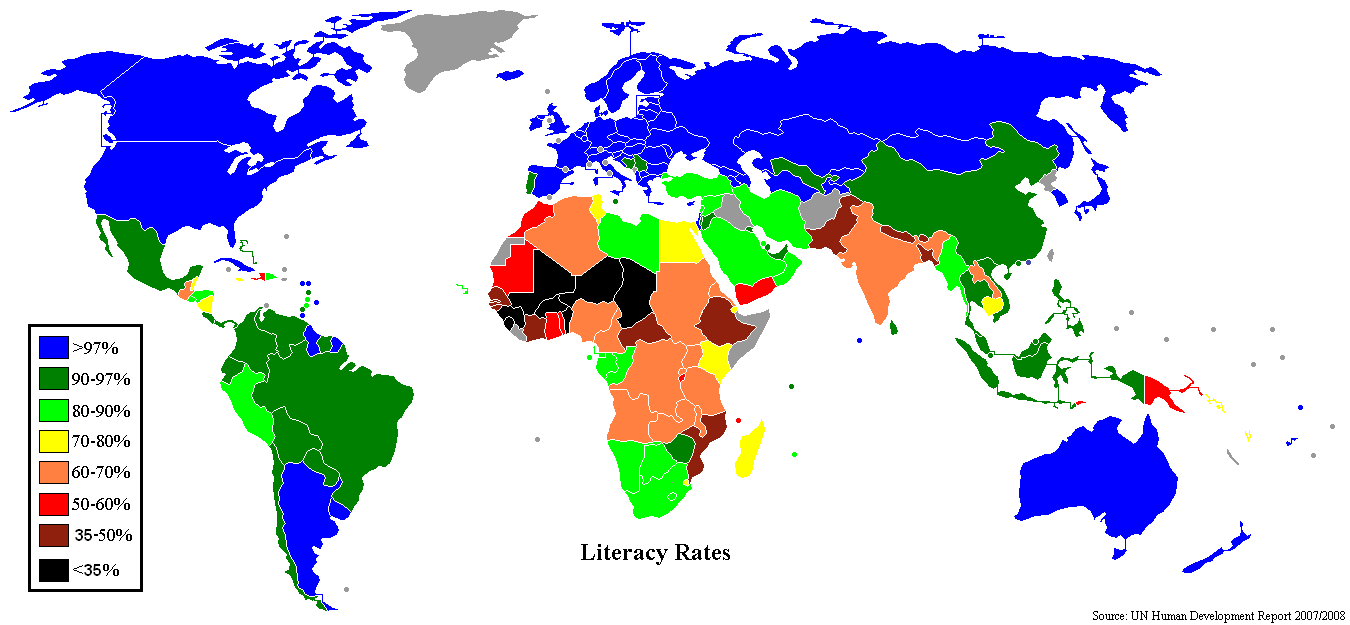
We can compare with literacy rates:
World_literacy_map_UNHD_2007_2008.png


Blue: >97%
Dark green: 90-97%
Light green: 80-90%
Yellow: 70-80%
Orange: 60-70%
Red: 50-60%
Brown: 35-50%
Black: <35%

Poverty rates:
1000px-Percentage_population_living_on_less_than_%241.25_per_day_2009.svg.png


Dark blue: Under 2%
Light blue: 2%-5%
Yellow: 6%-20%
Orange: 21-40%
Red: 41-60%
Dark red: 61-80%
Grey: No data.

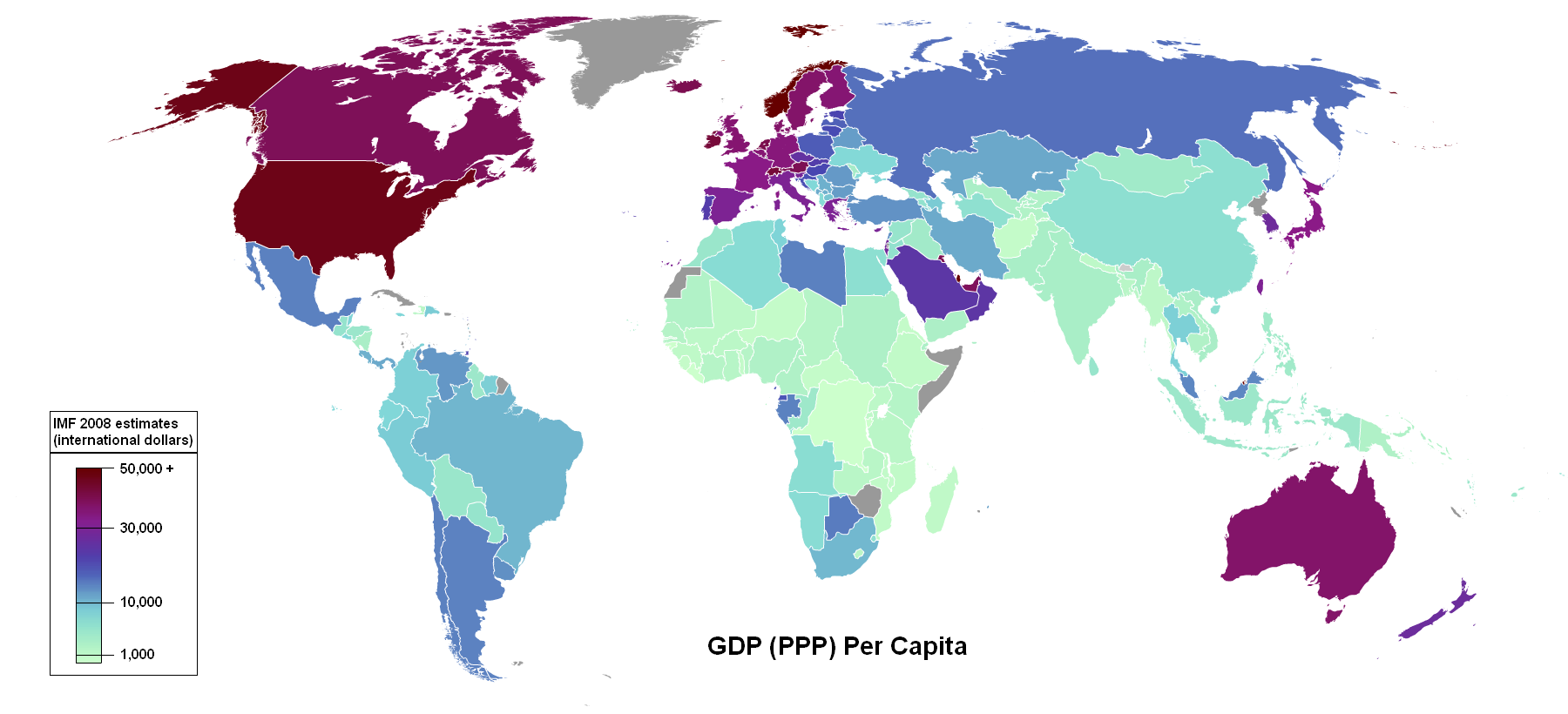
And also somewhat GDP per capita:
GDP_PPP_Per_Capita_IMF_2008.png


Darker-higher, lighter-lower.

Also co-relevant to birth rate, and more important, really, is overall population growth:
Population_growth_rate_world.PNG


Yellow: more than 3%
Green: 2%
Light blue: 1%
Dark blue: 0-1%
Purple: -0%

It is to be noted that more limited population growth and population decline in many third world countries (such as South Africa) are due to diseases such as HIV/AIDS and in the worst cases, poverty, and malnutrition.
 
Last edited:
There is lots of free room, and with current technology, harsh climate is not a problem. Las Vegas in the US is one of the best examples of that : that big town was build in the desert. If we can't colonize places like Siberia or Chinese deserts, then we are certainly not ready to colonize Mars or giant planets "interesting" satellites (Europa, Titan & so on...).

And I remember that some demographs were predicting 15 years ago that the population in 2010 would be around 12 billions. What most people doesn't take into account is that population seems to "autoregulate".

Also, even in France, where the density is considered "high", there is lot of unused land in the inside of the country. Building new motorways would solve the problem, it's just that those places are in the middle of nowhere. It's even more true for the United States : this country is vast and there enough room. Spain is mostly a desert. Germany has an huge density but I went there and would'nt say it's crowded.

The only country where living space is a real problem is Japan, or small islands like Malta (mediterranean). Hardly surprising.

Concerning food production, the problem is merely political/economical. A lot of land is being used to produce bio-ethanol and other ethanol-derived products, and the surface usually devoted to grains has shrinked. But the output didn't decrease, because agricultural technology is making progress everyday (the experiments on vegetals made in space greatly contributed on this).

World_population_density_1994.png
 
Last edited:
To T.Neo - as usual, v. cogent argument. :tiphat:
To Rising Fury - I'd be wary of labelling early mediaeval period as Dark Ages or "intellectual vacuum". The centre of progress simply shifted to China and the Arab world, where there were enough resources to feed, among other non-productive folks, scientists, artificers, astrologers and alchemists. It is highly doubtful that Europe, tiny in the overall scheme of things, could skip a phase and, without colonies' riches, several European academies, population burst, fine mechanics, and Versailles treaty, introduce complex rocketry not two but twenty generations earlier.
 
Violent wars, just like the one that broke out between the USSR and the US? :rolleyes:

I will definitely not say something as moronic such as that there is peace for our time. But it is more important to address root causes of how global geopolitics could play out during the next 90 year period, than simply say, that there will be war.

I would say that the situation of the USSR vs the USA standoff is unlikely to repeat: both for the reason that nuclear weapons are slowly driven off their throne of unstoppable punishment by development of technologies, and by unlikelihood of appearance of an equally large political counterweight to the USA till at least the middle of the century 21.

The world order that existed during that standoff, was crumbling over last decades and the world gets more dynamic in development. At the same time, ongoing crises in economy correlate with growing problems with today's distribution of roles and profits in world economy.

It does not take to be a prophet to say that fire is gonna happen sooner or later in a workshop littered with wood pieces and shavings if carpenters are drunk, careless and occasionally throw cigar stubs under their feet.

Poverty rates:
1000px-Percentage_population_living_on_less_than_%241.25_per_day_2009.svg.png


Dark blue: Under 2%
Light blue: 2%-5%
Yellow: 6%-20%
Orange: 21-40%
Red: 41-60%
Dark red: 61-80%
Grey: No data.

How did they define poverty measured for this chart, by the way?
 
Overpopulation isn't a problem, Malthus was plainly wrong. On average, humans are living better than they ever were with more "stable" population sizes. Our technological progress has clearly been able to catch up with our demands, and there's no indication it's about to stop. At present, it is estimated Earth could support up to 15 billion humans, and that number is increasing far more rapidly than the actual human population. "Population control" reeks of the same genocidal mania that plunged the 20th century into unimaginable wars.
 
How did they define poverty measured for this chart, by the way?

Don't quote me on this, but should be something like 1 dollar per day (at purchasing power parity, not at the market exchange rate).
 
Last edited:
Las Vegas in the US is one of the best examples of that : that big town was build in the desert.

That's a good example, but it is almost like a hydraulic state. What if there was a drop-off in the flow of the Colorado river, for example?

I like new dams, but can we afford their ecological impact? What about their social impact, to displaced peoples etc?

If we can't colonize places like Siberia or Chinese deserts, then we are certainly not ready to colonize Mars or giant planets "interesting" satellites (Europa, Titan & so on...).

Well, yes. But we all know that the real limitation against a colony on Mars, etc, is motivation, and it's the same here. It is a little less problematic though.

It is important to remember that in Antarctica, for example, you face worse problems than on Mars, for example from the thick air trying to remove your heat... and on the seafloor, that becomes more problematic, and you now have to deal with high pressures as well.

Though in response to Siberian Tiger earlier, anyone who can count can see the value of spaceflight. Particularly the satellite systems that allow the modern world to run. But that unfortunately has nothing to do with human colonisation, at least, not yet. But I don't know how it could matter.

Also, even in France, where the density is considered "high", there is lot of unused land in the inside of the country.

Unused land that also happens to be ecologically rich old-growth forest? :uhh:

Concerning food production, the problem is merely political/economical. A lot of land is being used to produce bio-ethanol and other ethanol-derived products, and the surface usually devoted to grains has shrinked. But the output didn't decrease, because agricultural technology is making progress everyday (the experiments on vegetals made in space greatly contributed on this).

Indeed, but... eventually there is a limit on how little water you can feed your crops and still expect them to grow, and there is a limit on how little land you can get a set amount of food from.

Vertical farming, maybe? It strikes me as very attractive, but like everything, it has problems.

I would say that the situation of the USSR vs the USA standoff is unlikely to repeat: both for the reason that nuclear weapons are slowly driven off their throne of unstoppable punishment by development of technologies, and by unlikelihood of appearance of an equally large political counterweight to the USA till at least the middle of the century 21.

Don't discount nuclear weapons. Despite technological development and disarmament efforts, I would not expect them to disappear any times soon... adding to that, the fact that you don't need a lot of nukes to be very destructive (which is by and large their purpose for existence as a weapon). You don't have to fight as envisioned in the cold war- an all-out barrage of nuclear weapons, intended as an approximation of the apocalypse. The threat, of just one nuclear weapon, striking a city such as New York or Moscow... I wouldn't want to think of it.

I agree though that a USSR-USA standoff is unlikely to repeat, but for other reasons (namely the root cause). Here we have the US and the EU as allies, China as a communist-in-name-only world factory, and then Russia... I'm struggling to see why the US and Russia would want to go to war. But with changing geopolitics over what? 20? 30? 50 years? I'm not sure.

The USA has a military that is far more than nukes, they have the largest military expenditure on the planet... there are a lot of things it cannot do (and fails at doing rather spectacularly), but that does not mean it is wholly worthless.

We have emerging superpowers, mini superpowers maybe... maybe they should be called mesopowers. Brazil, India... there is a lot of change that could happen there, and lead to conflict, but potentially not lead to an actual world war (unless or until the bigger entities get involved).

Conventional war can be pretty damn destructive, and WWII proved that. That is not necessarily something any sane person would wish for.

The world order that existed during that standoff, was crumbling over last decades and the world gets more dynamic in development. At the same time, ongoing crises in economy correlate with growing problems with today's distribution of roles and profits in world economy.

Yes but... how does that cause a war? I agree with you in part, but how is it in and of itself, a stimulus for global conflict?

It does not take to be a prophet to say that fire is gonna happen sooner or later in a workshop littered with wood pieces and shavings if carpenters are drunk, careless and occasionally throw cigar stubs under their feet.

Well, no. But the problem is: I see no careless carpenters. Maybe drunk ones, sure, but not anyone downright stupid. I can't think of a leader of a superpower or at least a powerful nation, since 1945, who has been stupid enough to seek out conflict.

How did they define poverty measured for this chart, by the way?

They defined it as less than $ 1.25 per day. At the time of posting, that is equivalent to 0.95 Euro, 8.28 Yuan, 0.81 British Pounds, 56.47 Indian Rupees, and 8.43 South African Rand.

At present, it is estimated Earth could support up to 15 billion humans, and that number is increasing far more rapidly than the actual human population.

Yes, but, at what cost?

I think one of my worst nightmares would be a world covered in cities and farms, with no natural land left... the only biodiversity would be cockroaches, pidgeons, rats...

Not the kind of organism that you can easily make aspirin out of, either. :P

"Population control" reeks of the same genocidal mania that plunged the 20th century into unimaginable wars.

Indeed. Or the Human Extinction Movement.

One would expect such nonsense to die out soon enough. :rolleyes:
 
Last edited:
Unused land that also happens to be ecologically rich old-growth forest?

I never said you have to build on forest. There are a lot of little towns and villages that could be expanded without such things as razing forest.

Also, in France & in most of Europe, most of the forests were cut down during the middle ages, for farming purposes. What remains is strictly protected.

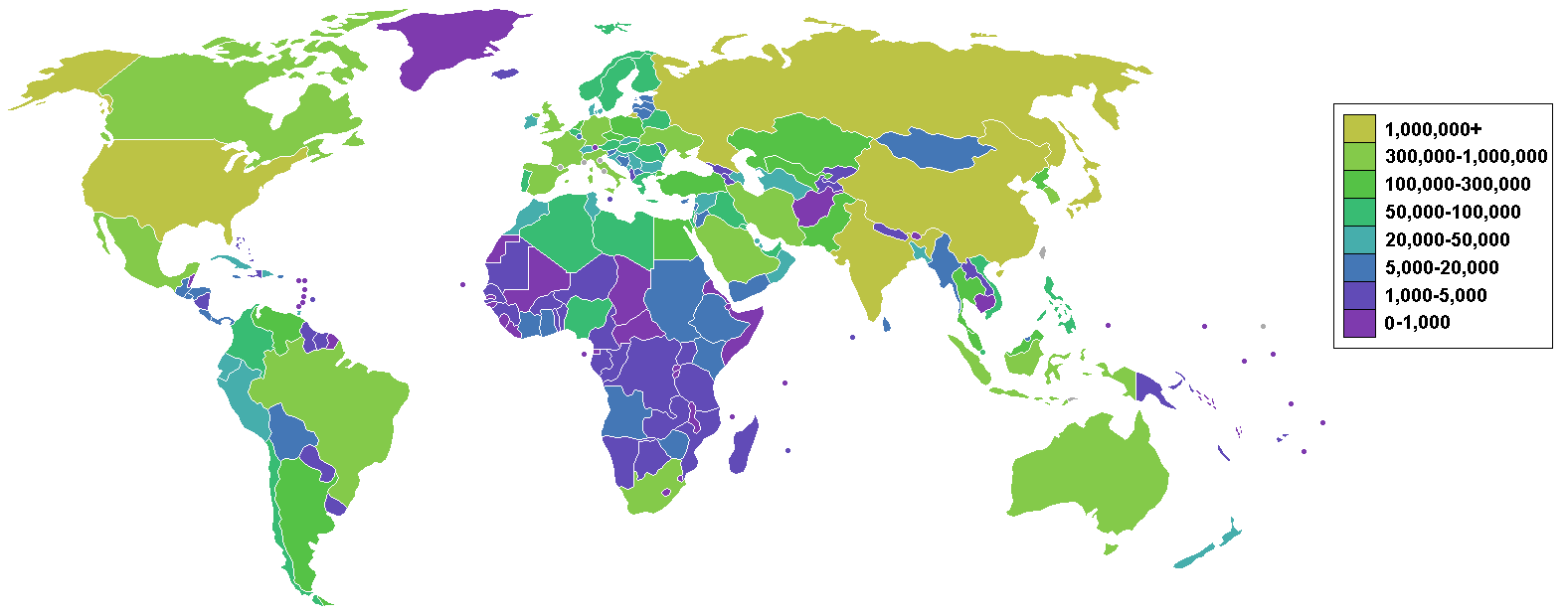
Limiting the impact on environnement of the population growth is clearly an essential goal for the next centuries.

Countries_by_carbon_dioxide_emissions_world_map.PNG

Countries by carbon dioxide emissions in thousands of metric tons, based on List of countries by carbon dioxide emissions as of March 2006
 
It is interesting... Africa has a lot of blue and purple on that map, but it isn't because of ecologically sound energy use. :(
 
Back
Top