Launch News (Failure!) Triple GLONASS-M atop Proton-M / Block-DM03 on December 5, 2010

SiberianTiger

News Sifter
News Reporter
Donator
Joined
Feb 13, 2008
Messages
5,398
Reaction score
8
Points
0
Location
Khimki
Website
tigerofsiberia.livejournal.com
The third GLONASS satellite triplet in year 2010 (Launch Block #43) will be put to orbit by Proton-M/Block-DM03 stack. This will boost complement on the constellation of navigation satellites from 26 to 29 active satellites in total. Also in this year, first test article of new Uragan-K satellite in going to launched solo on December 27, finalizing manifest of Russian launches in 2010.

glonass.jpg


glonass.jpg
foto_logotip2.jpg


Launch location:

Baikonur Launch pad no. 81/24 46° 4'15.38"N, 62°59'5.11"E

Launch dates and times:

[table="head"]{colsp=6}Launch times

Time Zone|
Australia - Sydney/AEST
|
Baikonur / UTC+6
|
Moscow / MSK/
|
Universal / UTC
|
Washington / EST

Launch time (Primary):
|
8:25:19 p.m.​
|
16:25:19​
|
13:25:19​
|
10:25:19​
|
5:25:19 a.m.​

on (Primary):
|
Dec. 5, 2010
|
Dec. 5, 2010
|
Dec. 5, 2010
|
Dec. 5, 2010
|
Dec. 5, 2010

Launch time (Backup):
|
8:21 p.m.​
|
16:21​
|
13:21​
|
10:21​
|
5:21 a.m.​

on (Backup):
|
Dec. 6, 2010
|
Dec. 6, 2010
|
Dec. 6, 2010
|
Dec. 6, 2010
|
Dec. 6, 2010

{colsp=6}
[highlight][eventTimer]2010-12-05 10:25:19?before|after;%dd% Days %hh% Hours %mm% Minutes %ss% Seconds %c%[/eventTimer] the triple Glonass Launch[/highlight]​
[/table]

Live Coverage Of The Launch:


PAYLOAD

3 Uragan-M (11F654M, 14F113) navigation satellites:

Stack Summary

[table="head"]{colsp=2}Summary
Parameter|Value
Manufacturer's article numbers:​
|39, 40, 41
GLONASS System numbers (expected):​
|739, 740, 741
COSMOS designators (expected):​
|Cosmos-2470, -2471, -2472
NORAD designators (expected):​
|37244 and after?
International designators (expected):​
|2010-066A, -066B, -066C, -066D
Target Orbit:​
|MEO
ApA X PeA​
|19 100 X 19 100 km
Inclination:​
|64.39°
RA of Asc. Node:​
|266° (GLONASS plane I)
GLONASS place I slots to take (expected)​
|3, 4, + backup at some other
[/table]

Uragan-M spacecraft are the second generation of GLONASS satellites with an increased lifetime of 7 years following up the first generation Uragan spacecraft.

[table="head"]Characteristics|
Uragan-M

Customer:​
|
  • Roscosmos, Russian Ministry of Defense

Prime contractor:​
|
  • JSC "Information Satellite Systems" Reshetnev Company

Mission:​
|
  • Satellite for providing global navigation services for military and civilian users

GRAU Index:​
|
  • 11F654M or 14F113

Type of Platform:​
|
  • Pressurized

Mass:​
|
  • Total mass at lift-off 1 415 kg

Stabilization:​
|
  • 3 axis stabilized

Navigation Payload:​
|
  • L-Band
  • 25 channels separated by 0.5625 MHz intervals in 2 frequency bands: 1602.5625 - 1615.5 MHz and 1240 - 1260 MHz
  • Right hand circular polarized.
  • On-board cesium clocks provide time accuracy to 1000 nanoseconds

On-board power:​
|
  • 1 400 W

Life time:​
|
  • 7 years

Coverage area:​
|
  • Global

|
ka_glonass-m_b.gif
[/table]

Launch Vehicle:

[table="head"]{colsp=2}Characteristics

gl2_protonM-DM.jpg
|[table="head"]{colsp=2}
Proton-M / Block DM-03

Prime contractor:​
|
  • Khrunichev Space Centre

GRAU Index:​
|
  • 8K82KM

Height:​
| ~57 m with upper stage and payload fairing

Diameter:​
| max 7.4 m

Liftoff mass:​
| ~700 tonnes

Payload mass:​
| ~22 tonnes at LEO

1st stage:​
|
  • 6 X RD-275 engines
  • Empty 30.6 tonnes
  • Propellants 419.41 tonnes (UDMH and NTO)
  • Thrust in vacuum 1069.8 tonnes of force
  • Thrust at sea level 971.4 tonnes of force

2nd stage:​
|
  • 1 X RD-0211 engine 3 X RD-0210 engines
  • Empty 11.4 tonnes
  • Propellants 156.113 tonnes (UDMH and NTO)
  • Thrust in vacuum 237.4 tonnes of force

3rd stage:​
|
  • 1 X RD-0213 engine & 1 X RD-0214 vernier engine
  • Empty 3.7 tonnes
  • Propellants 46.562 tonnes (UDMH and NTO)
  • Thrust in vacuum 59.36 (core) + 3.15 (vernier) tonnes of force

Upper Stage:​
|
DMinFarning.gif

  • GRAU Index: 11S861-03
  • Common Name: Block DM-03
  • Designer: RKK Energia
  • Manufacturer: "Krasmash" Krasnoyarsk Machine Building Plant
  • 1 X RD-58M engine
  • Empty 2.2 tonnes
  • Diameter 4.1 m
  • Propellants 15.095 tonnes (LOX and Kerosene RG-1)
  • Thrust in vacuum 8.67 tonnes of force
  • ISP 254 s
  • Flight time 7-21 hours

Payload Fairing:​
|
  • Diameter 4.35 m
  • Length 10 m

[/table]
[/table]

The vehicle's reliability statistics according to http://www.spacelaunchreport.com/reliability2010.txt:

Code:
================================================================ 
Vehicle     Successes/Tries Realzd Pred  Consc. Last     Dates    
                             Rate  Rate* Succes Fail    
================================================================
Proton-M/DM-2     6     6   1.00  .88      6    None     2007-

(ranks at 22nd among all rockets and 7th among GEO launchers)

Official Rocket Debris Warning for Citizens of Tomsk Terriory
(http://obzor.westsib.ru/news/335943)

The debris deposit area intersects territory of Verkhneketsky and Kolashyovsky districts of Tomsk Terrirory:
karta_rp.jpg


There are lakes Vargato and Tresh, as well as several hunting entities and grounds within the border of the deposit area. The type of debris is second stage fragments. Falling and destruction of the stage is distinguished by emitting a bright illumination.

The public are advices to keep clear of the endangered territory at the indicated time. If you find fallen space debris, please report to Department of Natural Resources and Environment of Tomsk Territory.
Weather forecast for Baikonur, Kazakhstan on December 5, 2010 (4 p.m.)

Time|Temps|Wind|Chill|Heat Index|UV Index|Dew Point|Relative Humidity|Precip|Snow|Clouds|Visibility|Wind|Weather
4 PM|-2°C|-6°C|-2°C|0|Low|-17°C|22%|0%|0%|0%|16KM|E 2.68 m/s|
wx_85.png
Sunny

Sunrise/Sunset and associated twilight times for Baikonur on Sunday, December 5, 2010

Times are local.
Event|Time
Astronomical twilight begins|07 : 24
Nautical twilight begins|08 : 00
Civil twilight begins|08 : 38
Sunrise|09 : 10
Transit (sun is at its highest)|13 : 37
Sunset|18 : 07
Civil twilight ends|18 : 36
Nautical twilight ends|19 : 13
Astronomical twilight ends|19 : 49

References
http://www.federalspace.ru
http://tvroscosmos.ru
http://www.khrunichev.ru
http://www.glonass-ianc.rsa.ru
http://tihiy.fromru.com/Rn/RN_Proton.htm
http://www.energia.ru
http://krasm.com
http://www.iss-reshetnev.com/
http://forum.nasaspaceflight.com
http://www.novosti-kosmonavtiki.ru
http://www.spacelaunchreport.com
http://www.intellicast.com/Local/Forecast.aspx
http://www.good-stuff.co.uk/suntimes/sunmap.php
 
Last edited:
History in pictures

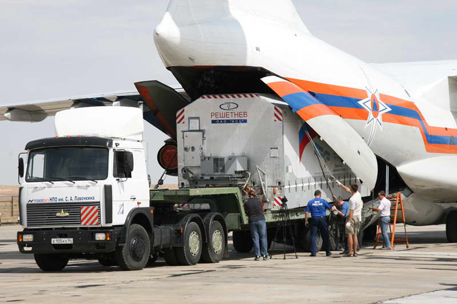
Departure one Glonass-M satellite to the cosmodrome (01.11.2010):

011110s.jpg


Arrival of the sat at Baikonur on 02.11.2010:

2309c36455657bdc211202e243724bef.JPG


Rolling out and erection of the vehile on 02.12.2010:

IMG_8666.JPG


IMG_8658.JPG


IMG_8709.JPG


IMG_8677.JPG


IMG_8739.JPG


IMG_0104.JPG


IMG_0117.JPG


IMG_8796.JPG


History in videos

Arrival of a Glonass-M satellite at Baikonur

Rolling out and erection on the pad
 
That's really unexpected :blink:
 
http://www.rian.ru/incidents/20101205/304807333.html

16:29 05/12/2010

Moscow, December 5 - RIA Novosti. Three Glonass-M satellites launched this Sunday from Baikonur on Proton-M launch vehicle to finish forming constellation of GLONASS satellites, have reeneterd the Earth's atmosphere and hit ocean at a non-navigable area, approximately near Hawaii islands. This information was provided by a source from space industry.

"Our ballisticians checked everything: the DM-3 upper composite with the spacecraft was found neither in primary, nor in intermediate, nor in off-nominal orbits. Calculations tell us, that it has most probably hit ocean at an area approximately near Hawaii islands." - told us the source.

Earlier a person who took part in the launch operations informed us that the satellites had been delivered to an orbit higher than was needed.

Sorry, looks like no "Cosmos-2470" etc. this time.
 
http://www.rian.ru/incidents/20101205/304812247.html

16:46 05/12/2010

Moscow, Dec 5 - RIA Novosti

"According to preliminary information, the problem was not caused by DM-3 upper stage's malfunction, as specialists have initially believed. Our latest information tells us that Proton-M rocket diverted from the programmed launch trajectory and even before the upper composite's separation pitched 8 degrees off nominal. This caused a so-called suborbital trajectory insertion". - told us the source.

:facepalm:
 
http://www.vesti.ru/doc.html?id=411659

"Loss of the GLONASS satellites costs several billion roubles"

The article states that Western counterparts of the lost Glonass satellites cost $100-200 million per unit. Despite Russian satellites cost much less, the total cost of the whole triplet was in order of billion roubles.

In addition, the cost of launch of one Proton-M rocket with a Block DM upper stage is $70 million (by unofficial information).

An unofficial loss estimate is 3-5 billion roubles ($100-160 million).

It was 11th Proton launch in 2010. Last time a Proton failed on the 3rd stage burn was in 1993.
 
Bad year, this is the 3rd failure this year isn't it?
The US one that can slowly get there
The European one that is in the wrong orbit Edit: Dead
And the Russian one that is in the drink.
 
Last edited:
The European one that is in the wrong orbit

Correction: It is inert, dead, pushing up the space debris, deactivated, idle, an ex-satellite.

It had a oxidizer leak in the unified propulsion system right after separation from the launcher, that prevented it from doing any meaningful orbit maneuvers.
 
http://www.rian.ru/science/20101206/305091357.html

10:59 06/12/2010

Moscow, Dec 6 - RIA Novosti. Proton-M launch vehicle with Glonass-M satellites diverted from the target trajectory by 8 degrees because of errors in flight controlling software, programmed into the onboard computer, said us an informed source in Russian rocket industry this Monday.

"According to the very first raw information we could get, there was no mechanical problems with the Proton itself. Some specialists believe that the off-nominal regime of engines that pushed the rocket excessively and sent it off-course was caused by errors in the software programmed into the onboard flight-controlling computer." - said us the person.

He also informed us that development of mathematical and logistical support for this launch was carried out by specialists of Pilyugin Scientific Development and Production Centre for Automatics and Instrumentation (NPTs AP).

Website of the mentioned organization really confirms it is responsible for development of launch vehicle and spacecraft movement controlling methods and algorithms, as well as for preparation of testing harnesses for such software.

There are no official comments on this assumption of the disaster cause, just as we don't yet have an official confirmation of crashing the DM booster stage and triple GLONASS satellites into an ocean. Roscosmos still maintains that satellites are put into an off-nominal orbit.

Did we have a thread for a worst program bug ever? That might be a nice update for it.
 
IIRC first Ariane 5 also had guidance software bug which caused it to perform hard turn resulting in exccesicve structural stress and spectacular explosion.
 
http://www.rian.ru/economy/20101205/304924819.html

22:56 05/12/2010

Moscow, Dec 5 - RIA Novosti. President of Russia Dmitry Medvedev ordered the General Prosecutor of Russia Yuri Tchaika and Head of Presidental Control Department to check expenditure of funds on Russian GLONASS satellite navigation system development, informed us last Sunday Natalia Timakova, Press Secretary of the President.

Dmitry Medvedev asked to "check why the three GLONASS satellites were lost and present him advices on measures of responsibility of people involved in activities surrounding the event" - Timakova said.

I hear axe sharpening sound... :shifty:
 
http://www.rian.ru/science/20101206/305117453.html

12:03 06/12/2010

Moscow, Dec 6 - RIA Novosti. The interdepartmental committee for investigation of the off-nominal situation due to which Russia had lost three Glonass-M satellites will be headed by an independent official, head of TsNIIMASH Engineering agency Gennady Raikunov, informed us this Monday a source from rocket and space industry.

"Head of Roscosmos Anatoly Perminov ordered that to make sure investigation would be unbiased, the interdepartmental committee must be lead by a person respectable in the industry, but not involved in GLONASS system development. Supposedly, this position will be engaged by head of TsNIIMASH Gennady Raikunov."
 
Just some thoughts here in form of Q&A.

Question: How this launch was different from previous Glonass-M launches?

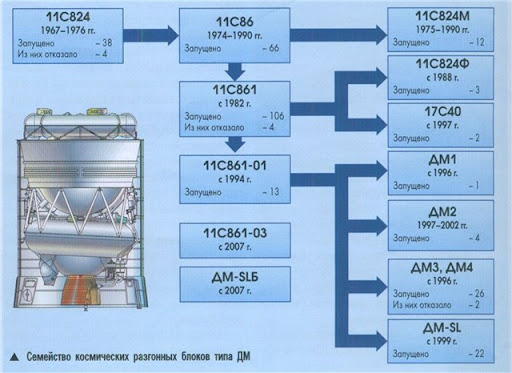
Answer: New DM series booster stage was going to be used. Actually, the history of DM upper stages, originating in Russian manned lunar program is complex, and its genealogy tree has many branches:

650c2d93796e.jpg


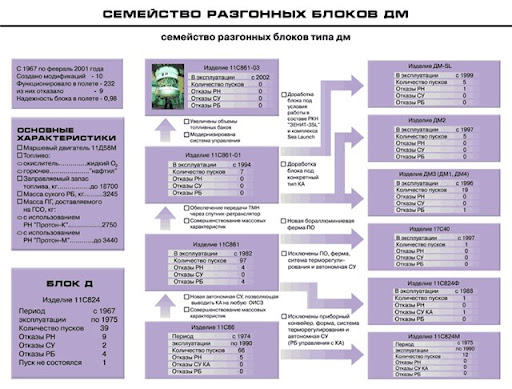
The next slide shows some a little bit outdated success statistics per specific model of a Block DM:

0a088a651cbc.jpg


For past launches, they used DM2 mod, and at the current one was a first flight of a 11S861-03 with enlarged tanks, another engine and improved control system.

Considering that Proton-M is finely adaptable to various types of payloads, including a range of upper stages and satellites of different masses, it was unexpected that using a next upper stage in the row might cause such problems. But it now appears evident that actual adaptation of the rocket's software required some underlying support work, and performers of that are now under investigation aim.

It is roughly believed that the total mass of the new upper composite in this launch was around 22 tonnes, but exact figures were never published, to my knowledge. Please mind that I have collected the data sheet on Proton-M/Block DM stack in the first post of this thread from generic sources, and it is not to be used as a reliable reference for making assumptions or argumentation - at least, in numbers part.

Question: Shall it impact further Proton launches?
Answer: I'm nobody, but I think yes, at least KA-SAT launch. I think Protons shall be grounded over a proper investigation period. At http://www.spacelaunchreport.com/reliability2010.txt, a line was added to mark the yesterday's failure:

Code:
================================================================ 
Vehicle     Successes/Tries Realzd Pred  Consc. Last     Dates    
                             Rate  Rate* Succes Fail    
================================================================ 
Proton-M/DM-03    0     1    .00  .33      0    12/5/10  2010-

While other Proton entries are remaining unaffected, but how much the problem is inherent to Proton core itself and not to the upper stage is yet to be established. It might turn out that every type of Proton stack is affected by it, therefore raising insurance fees for Proton launches and impacting badly Russian launch business.

Question: How bad is that for GLONASS system complement?
Answer: Not too bad. GLONASS now has 26 satellites in total, out of which 4 sats are brought out of service for maintenance (which might end in either returning to service or decom) and 2 are being spares (although there is no spare in the Plane I where the launch was intended to put the triplet to).

Code:
                  GLONASS Constellation Status
                      ( December 6, 2010)
 
|GLONASS|Cosmos|Plane/|Frequ.|   Launch   |   Intro    |  Status   |  Outage    |
|number |number| slot |chann.|    date    |    date    |           |    date    |
|-------|------|------|------|------------|------------|-----------|------------|
|  730  | 2456 | 1/01 |  01  | 14.12.2009 | 30.01.2010 | operating | .......... |
|  728  | 2448 | 1/02 |  -4  | 25.12.2008 | 20.01.2009 | operating | .......... |
|  722  | 2435 | 1/03 |  -5  | 25.12.2007 | 25.01.2008 |  unusable | 01.10.2010 |
|  727  | 2447 | 1/04 |  06  | 25.12.2008 | 17.01.2009 |  unusable | 08.09.2010 |
|  734  | 2458 | 1/05 |  01  | 14.12.2009 | 10.01.2010 | operating | .......... |
|  733  | 2457 | 1/06 |  -4  | 14.12.2009 | 24.01.2010 | operating | .......... |
|  712  | 2413 | 1/07 |  05  | 26.12.2004 | 06.10.2005 | operating | .......... |
|  729  | 2449 | 1/08 |  06  | 25.12.2008 | 12.02.2009 | operating | .......... |
|  736  | 2464 | 2/09 |  -2  | 02.09.2010 | 04.10.2010 | operating | .......... |
|  717  | 2426 | 2/10 |  -7  | 25.12.2006 | 03.04.2007 | operating | .......... |
|  723  | 2436 | 2/11 |  00  | 25.12.2007 | 22.01.2008 | operating | .......... |
|  737  | 2465 | 2/12 |  -1  | 02.09.2010 | 11.10.2010 | operating | .......... |
|  721  | 2434 | 2/13 |  -2  | 25.12.2007 | 08.02.2008 | operating | .......... |
|  715  | 2424 | 2/14 |  -7  | 25.12.2006 | 03.04.2007 |  unusable | 24.10.2010 |
|  716  | 2425 | 2/15 |  00  | 25.12.2006 | 12.10.2007 | operating | .......... |
|  738  | 2466 | 2/16 |  -1  | 02.09.2010 | 12.10.2010 | operating | .......... |
|  718  | 2431 | 3/17 |  04  | 26.10.2007 | 04.12.2007 |  unusable | 29.11.2010 |
|  724  | 2442 | 3/18 |  -3  | 25.09.2008 | 26.10.2008 | operating | .......... |
|  720  | 2433 | 3/19 |  03  | 26.10.2007 | 25.11.2007 | operating | .......... |
|  719  | 2432 | 3/20 |  02  | 26.10.2007 | 27.11.2007 | operating | .......... |
|  725  | 2443 | 3/21 |  04  | 25.09.2008 | 05.11.2008 | operating | .......... |
|  731  | 2459 | 3/22 |  -3  | 02.03.2010 | 28.03.2010 | operating | .......... |
|  732  | 2460 | 3/23 |  03  | 02.03.2010 | 28.03.2010 | operating | .......... |
|  735  | 2461 | 3/24 |  02  | 02.03.2010 | 28.03.2010 | operating | .......... |

In the future year, one Glonass-M triplet launch used to be planned for September, 25th and two Glonass-M solo launches atop Soyuz-2.1a/Fregat on yet unspecified dates. In addition, two new Glonass-K satellies are to be launched, one very soon, on December 27, 2010 and another one in the seconds half of 2011. However, these satellites using unpressurized platform are completely new and can hardly serve as regular units until end of tests (might take couple of years since now). Until then, Glonass-M are to remain the mainstay of the system, providing the necessary level of signal availability.
 
Back
Top