Updates Mars Science Laboratory (Curiosity)

Videos of the rollout of MSL's Atlas 5 to the pad


Fingers crossed this goes better than PG has.
 
And there it is - the scheduled launch day.

The countdown is underway: T-03:20 hours and counting, L-04:00 hours.

Launch window today extends from 15:02 UTC / 10:02 a.m. EST to 16:45 UTC / 11:45 a.m. EST.

The weather outlook for today is 70 percent chance of being acceptable for the launch, scattered clouds at 3,500 and 5,000 feet, possibly some isolated showers, good visibility, easterly winds of 18 to 24 knots and a temperature of 73 degrees F.


NASASpaceflight: LIVE: Atlas V ready to launch NASA’s MSL Rover to Mars

Universe Today: Mars Trek – Curiosity Poised to Search for Signs of Life

Discovery News: NASA's Mars Mission Readies for Launch

Spaceflight Now:
  • Mission Status Center:
    Over the subsequent few hours, final preps for the Centaur's liquid oxygen and liquid hydrogen systems will be performed, along with a test of the rocket's guidance system and the first stage propulsion and hydraulic preps, internal battery checks and testing of the C-band system used to track the rocket as it flies downrange, plus a test of the S-band telemetry relay system. The Complex 41 site will be cleared of all personnel at 7:07 a.m.

    A planned half-hour hold begins at 7:22 a.m. when the count reaches T-minus 120 minutes. Near the end of the hold, the team will be polled at 7:49 a.m. to verify all is in readiness to start fueling the rocket for launch.

    Supercold liquid oxygen begins flowing into the Centaur upper stage around 8:09 a.m., followed by the first stage filling around 8:22 a.m. Liquid hydrogen fuel loading for Centaur will be completed a short time later.

    A final hold is scheduled at the T-minus 4 minute mark starting at 9:48 a.m. That 10-minute pause will give everyone a chance to finish any late work and assess the status of the rocket, payload, Range and weather before proceeding into the last moments of the countdown.
    The weather outlook for today's 103-minute launch window continues to predict a 70 percent chance of being acceptable for the Atlas 5 rocket to fly. Air Force meteorologists are calling for some scattered clouds at 3,500 and 5,000 feet, possibly some isolated rain showers, good visibility, easterly winds of 18 to 24 knots and a temperature of 73 degrees F.

    If the launch should slip to tomorrow for some reason, similar weather is expected as meteorologists once again give a 70 percent chance of acceptable conditions. The odds are 40 percent favorable on Monday as a cold front sweeps into the area.

  • Gallery: Atlas 5 rocket rolled out (GALLERY #1)
  • Gallery: Atlas 5 rocket rolled out (GALLERY #2)

  • Gallery: Atlas 5 rocket aims for Mars (GALLERY #1)
  • Gallery: Atlas 5 rocket aims for Mars (GALLERY #2)


Launch Timeline:
[table="head;width=500"]
T [MM:SS]
|Event

-00:02.7​
|Engine Start

{colsp=2}
The Russian-designed RD-180 main engine is ignited and undergoes checkout prior to launch.​


+00:01.1​
|Liftoff

{colsp=2}
The four strap-on solid rocket boosters are lit as the Atlas 5 vehicle, designated AV-028, lifts off and begins a vertical rise away from Complex 41 at Cape Canaveral Air Force Station, Florida.​


+01:52.5​
|Jettison SRBs

{colsp=2}
Having burned out of propellant approximately 20 seconds earlier, the spent solid rocket boosters are jettisoned to fall into the Atlantic Ocean. The separation event is staggered with two motors releasing first, then the others about 1.5 seconds later.​


+03:25​
|Nose Cone Jettison

{colsp=2}
The payload fairing that protected the MSL spacecraft during launch is separated once heating levels drop to predetermined limits after passage through the atmosphere.​


+03:31​
|Forward Load Reactor Jettison

{colsp=2}
The Forward Load Reactor deck that supported the payload fairing's structure to Centaur upper stage is released six seconds after the shroud's jettison.​


+04:21.5​
|Main Engine Cutoff

{colsp=2}
The RD-180 main engine completes its firing after consuming its kerosene and liquid oxygen fuel supply in the Atlas first stage.​


+04:27.5​
|Stage Separation

{colsp=2}
The Common Core Booster first stage of the Atlas 5 rocket separates from the Centaur upper stage. Over the next few seconds, the Centaur engine liquid hydrogen and liquid oxygen systems are readied for ignition.​


+04:37.4​
|Centaur Ignition 1

{colsp=2}
The Centaur RL10 engine ignites for the first of two upper stage firings. This burn will inject the Centaur stage and Juno spacecraft into an initial parking orbit.​


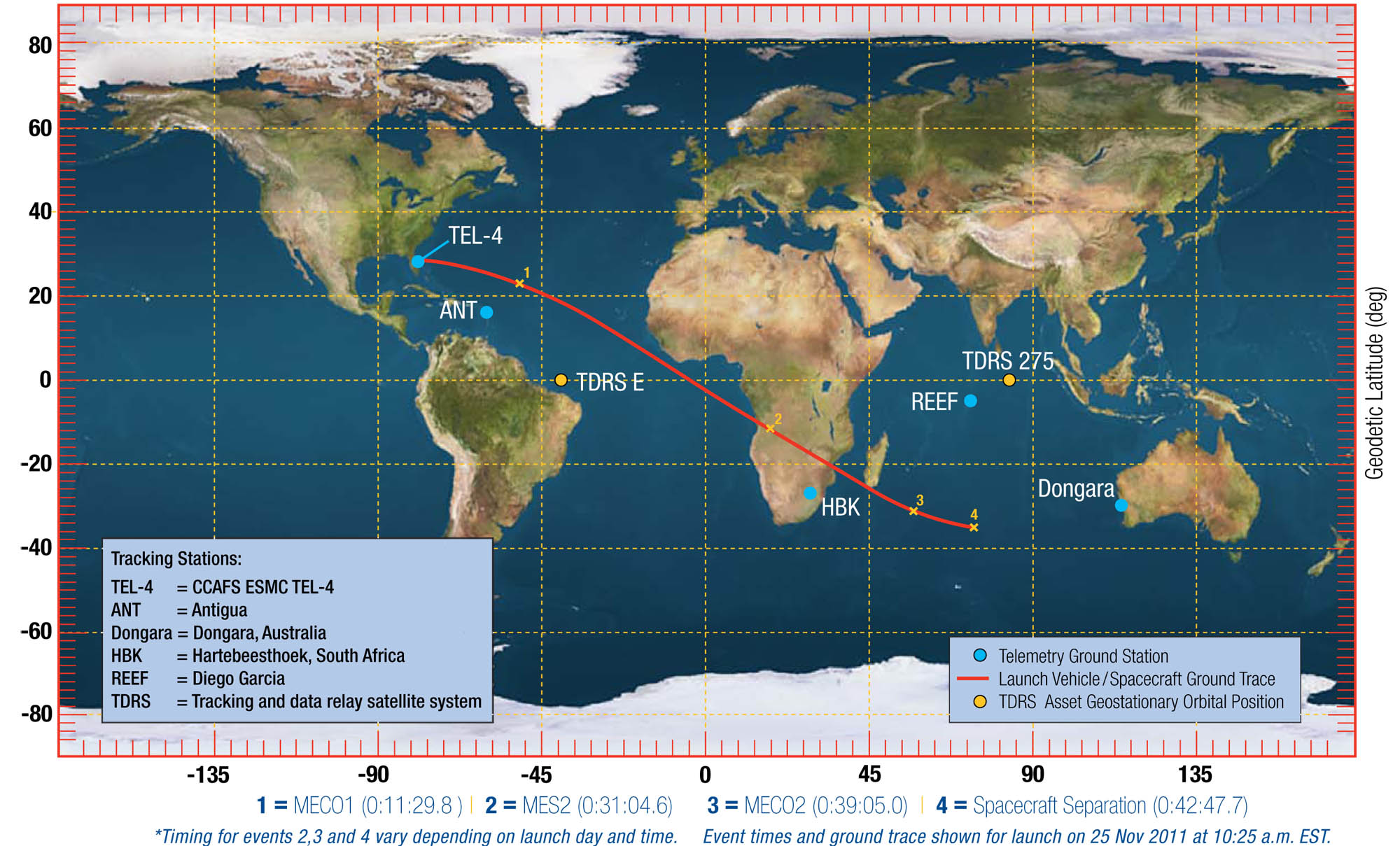
+11:29.8​
|Centaur Cutoff 1

{colsp=2}
The Centaur engine shuts down after arriving in a planned elliptical parking orbit of 102 by 201 miles. The vehicle enters a 20-minute coast period before arriving at the required location in space for the second burn.​


+31:04.6​
|Centaur Ignition 2

{colsp=2}
The Centaur re-ignites to accelerate the payload out of Earth orbit from the parking altitude achieved earlier in the launch sequence.​


+39:05.0​
|Centaur Cutoff 2

{colsp=2}
At the conclusion of its second firing, the Centaur will have propelled the MSL spacecraft on an Earth escape trajectory to begin the 8.5-month journey to Mars.​


+42:47.7​
|Spacecraft Separation

{colsp=2}
NASA's Mars Science Laboratory with its Curiosity rover is released into orbit from the Centaur upper stage to complete the AV-028 launch.​

[/table]​


Launch Ground Track:

[table=head]
Click on image to enlarge​

[/table]​
 
Did anyone do that "your name on MSL" thing?
 
Is the launch being covered live on the web dont have access to a tv right now?
 
The Atlas V's looking a little frosty.:lol:
 
+03:52.5
Jettison SRBs

Having burned out of propellant approximately 20 seconds earlier, the spent solid rocket boosters are jettisoned to fall into the Atlantic Ocean. The separation event is staggered with two motors releasing first, then the others about 1.5 seconds later.

+03:25
Nose Cone Jettison

The payload fairing that protected the MSL spacecraft during launch is separated once heating levels drop to predetermined limits after passage through the atmosphere.

Something seems to be wrong here. Shouldn't SRB sep be at +01:52.5? That would fit better to their 94 seconds of burn time.
 
T-4 minutes and holding. The final scheduled 10-minute built-in hold.
 
Back
Top