

Updates on the second Falcon 9 flight, Maiden flight of the Dragon vehicle.
(no patch available yet)
SOURCE OF ARTICLE: http://spaceflightnow.com/falcon9/002/100716firststage/
'Six weeks after the first Falcon 9 rocketed into orbit, pieces of the second launcher have begun arriving at Cape Canaveral for a shakedown flight of SpaceX's Dragon capsule in September, according to the company's top executive.
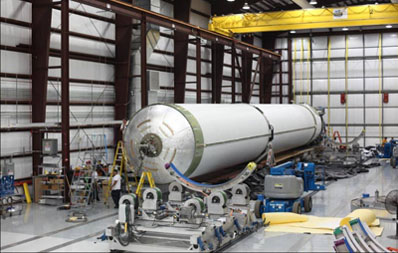
[FONT=Verdana, Arial, Helvetica, sans-serif][SIZE=-2]The Falcon 9 rocket's first stage inside the hangar at pad 40 on Thursday. Credit: SpaceX[/SIZE][/FONT]
The Falcon 9 first stage pulled into Cape Canaveral Thursday after a truck ride from SpaceX's test site in central Texas.
The stage was placed inside the company's rocket assembly hangar at launch pad 40. Officials said they untarped the rocket and completed initial inspections Thursday night.
Engineers plan more testing over the next several weeks to make sure the stage and its nine Merlin engines are ready for flight.
The Falcon 9 upper stage should arrive in Florida by August, according to Elon Musk, SpaceX's founder and CEO.
The objective of the privately-built rocket's second mission is to send the first operational Dragon spacecraft to orbit, where it will briefly test its propulsion, pressure, communications, guidance, navigation and control systems.
"It's really just testing the core functionality of the system," Musk said. "Can it go up there, can it maneuver around, does it maintain integrity, maintain communications, can it re-enter?"
SpaceX is developing the Dragon to ferry cargo to and from the International Space Station beginning next year. The company says the capsule could also be modified to carry humans to orbit within about three years, making the Dragon a leading candidate to win a slice of NASA's plans to procure commercial operators for human transportation to space.
The Falcon 9's first launch June 4 placed an inert Dragon capsule in orbit, but the craft stayed attached to the rocket's second stage. Engineers are methodically reviewing all of the Dragon's systems for the more ambitious upcoming test flight.'
Please note, leave all discussions on commercial vs government out of this thread. Solely use for questions on the Falcon 9 vehicle and Flight 2 of Falcon 9.
(no patch available yet)
SOURCE OF ARTICLE: http://spaceflightnow.com/falcon9/002/100716firststage/
'Six weeks after the first Falcon 9 rocketed into orbit, pieces of the second launcher have begun arriving at Cape Canaveral for a shakedown flight of SpaceX's Dragon capsule in September, according to the company's top executive.
[FONT=Verdana, Arial, Helvetica, sans-serif][SIZE=-2]The Falcon 9 rocket's first stage inside the hangar at pad 40 on Thursday. Credit: SpaceX[/SIZE][/FONT]
The Falcon 9 first stage pulled into Cape Canaveral Thursday after a truck ride from SpaceX's test site in central Texas.
The stage was placed inside the company's rocket assembly hangar at launch pad 40. Officials said they untarped the rocket and completed initial inspections Thursday night.
Engineers plan more testing over the next several weeks to make sure the stage and its nine Merlin engines are ready for flight.
The Falcon 9 upper stage should arrive in Florida by August, according to Elon Musk, SpaceX's founder and CEO.
The objective of the privately-built rocket's second mission is to send the first operational Dragon spacecraft to orbit, where it will briefly test its propulsion, pressure, communications, guidance, navigation and control systems.
"It's really just testing the core functionality of the system," Musk said. "Can it go up there, can it maneuver around, does it maintain integrity, maintain communications, can it re-enter?"
SpaceX is developing the Dragon to ferry cargo to and from the International Space Station beginning next year. The company says the capsule could also be modified to carry humans to orbit within about three years, making the Dragon a leading candidate to win a slice of NASA's plans to procure commercial operators for human transportation to space.
The Falcon 9's first launch June 4 placed an inert Dragon capsule in orbit, but the craft stayed attached to the rocket's second stage. Engineers are methodically reviewing all of the Dragon's systems for the more ambitious upcoming test flight.'
Please note, leave all discussions on commercial vs government out of this thread. Solely use for questions on the Falcon 9 vehicle and Flight 2 of Falcon 9.


