
-
ORBITER-FORUM will be temporarily closed at 2026-07-23 18:00 UTC while we complete some OF maintenance tasks. The amount of downtime is expected to take up to one hour, but probably less.
You are using an out of date browser. It may not display this or other websites correctly.
You should upgrade or use an alternative browser.
You should upgrade or use an alternative browser.
Question General Spaceflight Q&A
- Thread starter Chipstone306
- Start date

- Joined
- Feb 6, 2008
- Messages
- 38,938
- Reaction score
- 3,937
- Points
- 203
- Location
- Wolfsburg
- Preferred Pronouns
- Sire
Alot more things were cancelled before the ALT test.
At least they installed ion cannons and photon torpedos.

- Joined
- Oct 20, 2010
- Messages
- 832
- Reaction score
- 1
- Points
- 16
- Location
- Alamogordo
- Website
- www.h-10-k.com
Yeah, but which Mid-Deck Locker was the "Tardis". I can't find any documentation on it anywhere?

Why are they called "International Standard" Payload Racks if they can only fit on Shuttle MPLMs, HTVs, and Dragons?
- Joined
- Feb 6, 2008
- Messages
- 38,938
- Reaction score
- 3,937
- Points
- 203
- Location
- Wolfsburg
- Preferred Pronouns
- Sire
Why are they called "International Standard" Payload Racks if they can only fit on Shuttle MPLMs, HTVs, and Dragons?
Because they are for the international space station. And are international for all members of the program - even the Russians use them for their payload slots in the western segment.

I am coding a spaceprobe with RTG's, and was wondering: how much mass does a spaceprobe with radio-thermal generators (the Voyager's, for exapmple) radiate away in its entire lifetime?
- Joined
- Feb 6, 2008
- Messages
- 38,938
- Reaction score
- 3,937
- Points
- 203
- Location
- Wolfsburg
- Preferred Pronouns
- Sire
I am coding a spaceprobe with RTG's, and was wondering: how much mass does a spaceprobe with radio-thermal generators (the Voyager's, for exapmple) radiate away in its entire lifetime?
Not even a nanogramm. Its just 460 Joule per second initially and half of that after 87 years.

I am coding a spaceprobe with RTG's, and was wondering: how much mass does a spaceprobe with radio-thermal generators (the Voyager's, for exapmple) radiate away in its entire lifetime?
Assuming the Pu-238 turns to U-234 and the only mass lost is the difference in atomic mass (one alpha particle per atom), Voyager would lose 75 grams of mass eventually. But with a half-life of 87.7 years let's say it has lost 19 grams so far.
But I'm probably misunderstanding radioactivity.
(I didn't even take into account that it's not pure plutonium)
Last edited:
- Joined
- Feb 6, 2008
- Messages
- 38,938
- Reaction score
- 3,937
- Points
- 203
- Location
- Wolfsburg
- Preferred Pronouns
- Sire
Assuming the Pu-238 turns to U-234 and the only mass lost is the difference in atomic mass (one alpha particle per atom), Voyager would lose 75 grams of mass eventually. But with a half-life of 87.7 years let's say it has lost 19 grams so far.
But I'm probably misunderstanding radioactivity.
(I didn't even take into account that it's not pure plutonium)
The alpha particles don't leave the generator anyway.

The alpha particles don't leave the generator anyway.
Wasn't sure.
What happens to them? Helium floating about?


- Joined
- Feb 6, 2008
- Messages
- 38,938
- Reaction score
- 3,937
- Points
- 203
- Location
- Wolfsburg
- Preferred Pronouns
- Sire
Those are "potato masher" [ame=http://en.wikipedia.org/wiki/Grid_fin]grid fins[/ame], used for stabilizing the capsule during a launch abort. They flip down on abort and work similar to normal planar fins, but produce much stronger rotation moments at the cost of a higher drag at low speeds (below Mach 1.2). At higher speeds, those grid fins work even better than normal fins.
The top half of the fairing with reentry capsule and orbital module separates from the rest of the launch stack and Soyuz spacecraft on abort.
The top half of the fairing with reentry capsule and orbital module separates from the rest of the launch stack and Soyuz spacecraft on abort.
Last edited:

Interceptor
Well-known member
Where is the Elevator on the Soyuz launchpads located?seems I can never seem to find a picture of this on the internet,Just curious.Thanks
- Joined
- Feb 6, 2008
- Messages
- 38,938
- Reaction score
- 3,937
- Points
- 203
- Location
- Wolfsburg
- Preferred Pronouns
- Sire
Where is the Elevator on the Soyuz launchpads located?seems I can never seem to find a picture of this on the internet,Just curious.Thanks
On one of the two service structures, that are rotated into the horizontal before launch.

AFAIR, it is the left one in the photograph that contains the elevator.
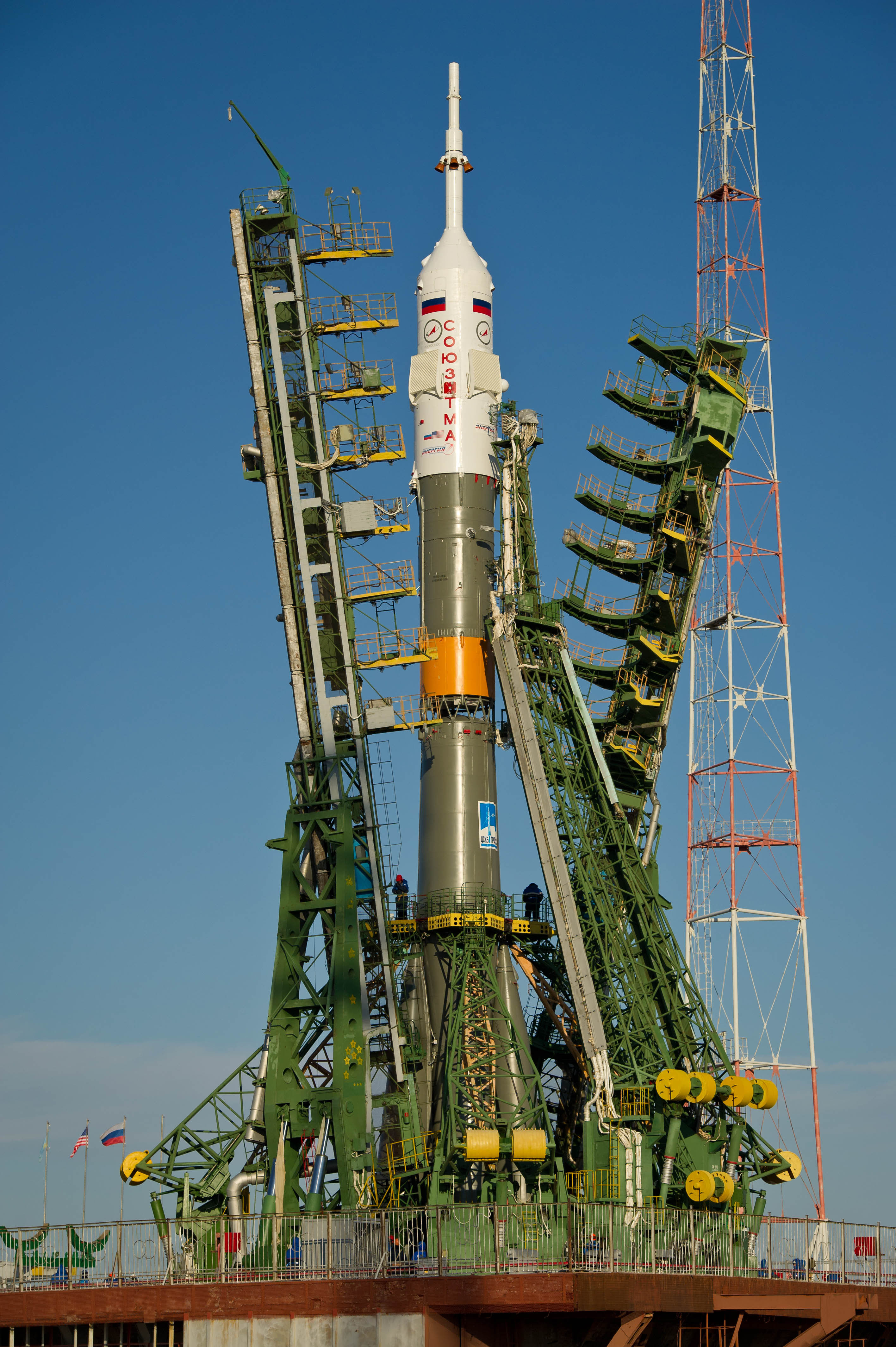
Here you can see it better, the blue cabin left of the left worker.
Last edited:
Interceptor
Well-known member
AH,Ok,thank you very much for pointing that out,I always thought that they went up in the elevator after the two tower structures were lowered first.

EVA and Mission Control Center : who was in charge before the Shuttle ?
Hello, :hello:
A small question about Mission Control Center positions.
Since the Shuttle has been flying, the EVA are monitored by a specific personel, the EVA Officer.
But who was taking care of that during Gemini and Apollo ?
Amongst the best suspects I can find FAO, the Flight Activities Officer, but I'm not sure. Maybe EECOM or PROCEDURES ? I can't find anything on that, so if someone knows, thank you very much.

Hello, :hello:
A small question about Mission Control Center positions.
Since the Shuttle has been flying, the EVA are monitored by a specific personel, the EVA Officer.
But who was taking care of that during Gemini and Apollo ?
Amongst the best suspects I can find FAO, the Flight Activities Officer, but I'm not sure. Maybe EECOM or PROCEDURES ? I can't find anything on that, so if someone knows, thank you very much.
- Joined
- Feb 6, 2008
- Messages
- 38,938
- Reaction score
- 3,937
- Points
- 203
- Location
- Wolfsburg
- Preferred Pronouns
- Sire
Amongst the best suspects I can find FAO, the Flight Activities Officer, but I'm not sure. Maybe EECOM or PROCEDURES ? I can't find anything on that, so if someone knows, thank you very much.
Sure not PROCEDURES. This position is more responsible for briefing the rest of the flight controllers of the next operations.
For Apollo it was TELMU, but that position did not exist for Gemini (TELMU is the equivalent to EECOM, for the LM)
But remember also some differences between Gemini and Apollo that might bring some light:
The astronaut on EVA was technically still connected to the spacecraft and supplied by the respective spacecraft systems. So EECOM was still responsible for his life support.
Similar threads


- Replies
- 3
- Views
- 3K

- Replies
- 0
- Views
- 2K
- Replies
- 0
- Views
- 105