

- Joined
- Feb 13, 2008
- Messages
- 5,398
- Reaction score
- 8
- Points
- 0
- Location
- Khimki
- Website
- tigerofsiberia.livejournal.com
A summary from Anatoly Zak's website and a poster published by Roscosmos a year ago, marked up by Zak where the real outcomes differ from originally planned activities.
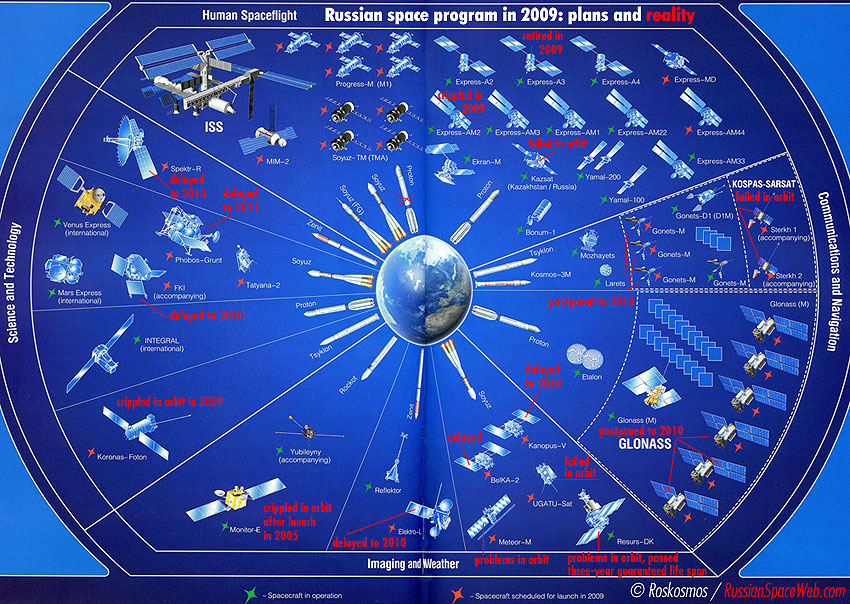
Above: Despite the world economic crisis, Russia continued efforts to re-emerge as a space power during 2009. Russian space agency, Roskosmos, promised to conduct from 39 to 44 launches in 2009, versus 27 missions in 2008. In reality, Russia would launch 31 space missions, counting a Proton launch scheduled for Dec. 29. The nation's manned space program was responsible for the increase, as a result of doubling of Russian transport vehicles heading to a nearly completed International Space Station. Even with a number of satellite launches postponed to 2010, Russia conducted more space shots than any other country in the world.
So far, all passengers and payloads of Russian rockets made it to space without problems, for the exception of a Meridian-2 satellite, which ended up in a lower-than-expected orbit due to the underperformance of the Fregat upper stage.
As soul searching within the American space program reached its climax in 2009, Russia, China and India continued solidifying their future plans in space. After several years of behind-the-scene studies, Russian space agency finally felt compelled to publicize its vision in space, with a nuclear-powered space tug at its center. China continued its slow but steady advance toward independent space station and India moved forward with its plans for a domestically built manned spacecraft.
Above: Despite the world economic crisis, Russia continued efforts to re-emerge as a space power during 2009. Russian space agency, Roskosmos, promised to conduct from 39 to 44 launches in 2009, versus 27 missions in 2008. In reality, Russia would launch 31 space missions, counting a Proton launch scheduled for Dec. 29. The nation's manned space program was responsible for the increase, as a result of doubling of Russian transport vehicles heading to a nearly completed International Space Station. Even with a number of satellite launches postponed to 2010, Russia conducted more space shots than any other country in the world.
So far, all passengers and payloads of Russian rockets made it to space without problems, for the exception of a Meridian-2 satellite, which ended up in a lower-than-expected orbit due to the underperformance of the Fregat upper stage.
As soul searching within the American space program reached its climax in 2009, Russia, China and India continued solidifying their future plans in space. After several years of behind-the-scene studies, Russian space agency finally felt compelled to publicize its vision in space, with a nuclear-powered space tug at its center. China continued its slow but steady advance toward independent space station and India moved forward with its plans for a domestically built manned spacecraft.


