
Red giant star Betelgeuse mysteriously shrinking

SiberianTiger

News Sifter
News Reporter
Donator
Joined
Feb 13, 2008
Messages
5,398
Reaction score
8
Points
0
Location
Khimki
Website
tigerofsiberia.livejournal.com
BERKELEY — The red supergiant star Betelgeuse, the bright reddish star in the constellation Orion, has steadily shrunk over the past 15 years, according to University of California, Berkeley, researchers.

Long-term monitoring by UC Berkeley's Infrared Spatial Interferometer (ISI) on the top of Mt. Wilson in Southern California shows that Betelgeuse (bet' el juz), which is so big that in our solar system it would reach to the orbit of Jupiter, has shrunk in diameter by more than 15 percent since 1993.


Full Story at: http://berkeley.edu/news/media/releases/2009/06/09_betelim.shtml


BTW...
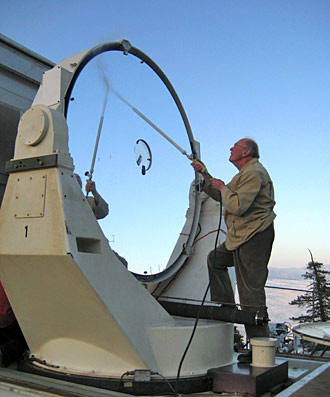
mirror-townes.jpg


I'm a little shocked how they are handling the sensitive optics - like if it's the windshield of this guy's car!
 
Could it be a problem with human glasses?
Or is it that it prepares itself to become supernova?
With only 470 light-years of distance, if we get to see it it would mean it exploded years ago and the radiation shockwave could kill us, by the time we get to see it, if I understand correctly.
 
This could be the Great Filter. The reason we don't see evidence of interstellar civilizations. And the reason no one will ever see us. Now if one of you guy has a prototype warp drive sitting around your basement, now's the time to speed things up a bit.
 
Now if one of you guy has a prototype warp drive sitting around your basement, now's the time to speed things up a bit.
What about the laws and idiots? Former will help the latter get the drive, and the latter will split planets with it.
Better die from a supernova.
 
Doesn't that mean that it will collapse in a few years already? 15% in 16 years is pretty fast for such a time frame. 15% more distance in such a sort time is rather unlikely.
 
Doesn't that mean that it will collapse in a few years already? 15% in 16 years is pretty fast for such a time frame. 15% more distance in such a sort time is rather unlikely.

There's still hope that the old B does so all the time through and it will wobble out again, soon. It's strange that such compression does not make luminocity increase, though. Or, at least, a detectable change.

An extra knowledge produces extra worries.

---------- Post added at 06:57 ---------- Previous post was at 06:35 ----------

BTW, Amundsen-Scott Antarctic station looks like the only safe place on Earth in case Betelgeuse actually goes off. :lol:
 
Why is this star so dangerous? Doesn't the axis of this thing's rotation point away from us such that any GRB would head away? I know it's close, but that's 470 light years of diffusion any radiation has to go through. Not much in the grand cosmic scale of things, I grant you, but unless we're in the laser-like path of a GRB shouldn't we be fine?
 
470 Light Years away, No need to worry yet, got plenty of time.
 
Maybe the Mayans were right after all...
 
or we'll just get a pretty fireworks display and possily a few nights where it doesn't actually get dark.
 
or we'll just get a pretty fireworks display and possily a few nights where it doesn't actually get dark.
I think you underestimate the magnitude of this kind of event...
 
oh i'm aware its a massive event. i just think that there isn't going to be a massive surge of radiation that wipes out all life on earth.

it also isn't going to kncok earth out of orbit.

i think people are overestimating the effects it will have on life is all.
 
oh i'm aware its a massive event. i just think that there isn't going to be a massive surge of radiation that wipes out all life on earth.

it also isn't going to kncok earth out of orbit.

i think people are overestimating the effects it will have on life is all.
The fact that you think it will last only "a few nights" shows that you have no idea how massive the event would be.
 
There's still hope that the old B does so all the time through and it will wobble out again, soon. It's strange that such compression does not make luminocity increase, though. Or, at least, a detectable change.

An extra knowledge produces extra worries.

Well, 15% is a bit more than the normal wobbles expected, Either it is more instable than previously known (and it was already known to be very instable) or already beyond stability.
 
Back
Top