
- Joined
- May 30, 2008
- Messages
- 5,580
- Reaction score
- 2
- Points
- 0
So I was testing out the Surface MFD to make sure that the version I make for my simpit will be at least as capable. I was working on the atmospheric data section, and noticed that the pressures (STP/DNP) had their units scale similar to the way distances/velocities in the HUD do (ie, Pa->kPa when more than 1000 Pa). So naturally, I wanted to see just how far the scaling would go--would it continue to scale properly into mega pascals, which would not be encountered normally?
One very-high altitude dive later, I had ended managed to display in units of MPa. Now of course, the question becomes: what happens when I reach 1000 MPa? Does it go to GPa (gigapascals?) So of course I had to try it.
Using the Shuttle-A and unlimited fuel, I made a dive into the Jovian atmosphere from approximately 100 Jovian radii out.
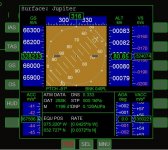
Peak velocity by Mach was about 2600, and I did indeed acquire a dynamic pressure of over 1000 MPa. However, to my surprise, it's not GPa -- it's AUPa!
That is, whatever scaling is used by distances/velocities (which switches to fractions of an AU when over 1000 Mega) is also used by the pressures. I have for your viewing pleasure photographic proof, attached to this message.
Now, the real question is: can you reach a parsecpascal, which I assume is what comes after an AUpascal? That's 10,000 times the dynamic pressure I managed, and I don't think it would be possible without specifically definining a planet for it (ie, with an atmosphere thick enough that you can dive in at several million m/s and not hit the surface in the first frame).
One very-high altitude dive later, I had ended managed to display in units of MPa. Now of course, the question becomes: what happens when I reach 1000 MPa? Does it go to GPa (gigapascals?) So of course I had to try it.
Using the Shuttle-A and unlimited fuel, I made a dive into the Jovian atmosphere from approximately 100 Jovian radii out.
Peak velocity by Mach was about 2600, and I did indeed acquire a dynamic pressure of over 1000 MPa. However, to my surprise, it's not GPa -- it's AUPa!
That is, whatever scaling is used by distances/velocities (which switches to fractions of an AU when over 1000 Mega) is also used by the pressures. I have for your viewing pleasure photographic proof, attached to this message.
Now, the real question is: can you reach a parsecpascal, which I assume is what comes after an AUpascal? That's 10,000 times the dynamic pressure I managed, and I don't think it would be possible without specifically definining a planet for it (ie, with an atmosphere thick enough that you can dive in at several million m/s and not hit the surface in the first frame).


 .
.


