Question Writing fiction, need basic advice

Richy

VTOL craft Pilot
Joined
Nov 11, 2009
Messages
322
Reaction score
1
Points
0
Location
ZG
Website
www.richmans-maps.ch.vu
He there

I recently got up with the idea, of writing some adventures which originated in orbiter to paper. It startet as a small project, and now is going bigger an bigger.
But I actually don't have any experience in writing - even reading - science fiction. I heard here on the forums are a lot of peaple, who have read a lot of SF literature, and even some who wrote.
I started writing from a first person perspective of the mission commander in present, but what I read so far, is in past from an observers view. Now I'm not sure, if this is really a good idea for a readable story, and hoping not to do some beginners mistake, I'm hoping for advice, or even opinions.

Thanks for helping me with a really silly question, but I'm a perfectionist, sorry. ;)

May the :probe: bless all of us!
 
First of all, may the almighty :probe: help you in your great work of art!

And second, I absolutely hate SF that has no real scientific basis. You, being an orbinaut, know that you wouldn't make such a mistake, right? ;)
 
Writing and the Oral Tradition of Story Telling

Before you begin writing you need a good story that does more than address a plot. It needs to convey lessons that compel the listener or reader to think long after the book has been put down or the television is turned off. You need to identify who your audience will be (everyone, kids, teenagers, adults, elders, etc.), get your story together in outline form so you can tell it, and find those willing to sit down and let you tell it orally. Then ignore what they say. People lie when they're being polite. Learn to tune into unspoken communication like body language; eye behavior, breathing patterns, facial expressions, posture. Those cues are pictures that are worth far more than a thousand words. Then take the story telling experience and use it to revise your story to make it better. Learn to play on people's emotions as a story teller. Academy awards have been given for making people sad, happy, etc. Finally, I've considered using Orbiter as a way to storyboard a science fiction story for T.V. or Motion Picture. Good Luck
 
You should know how the story builds towards a climax. Start planning the story backwards then write it forwards.
Don't be kind to your fictional creations - make them suffer. That adds to the tension.
Don't think of it as a Sci-Fi story, but a human story set in the future.
As to the narrative style, I always prefer present tense. More immediate.

May I ask if you're writing the story in English or in your own language?
 
Train yourself to do a little bit each day.
 
Start planning the story backwards then write it forwards.
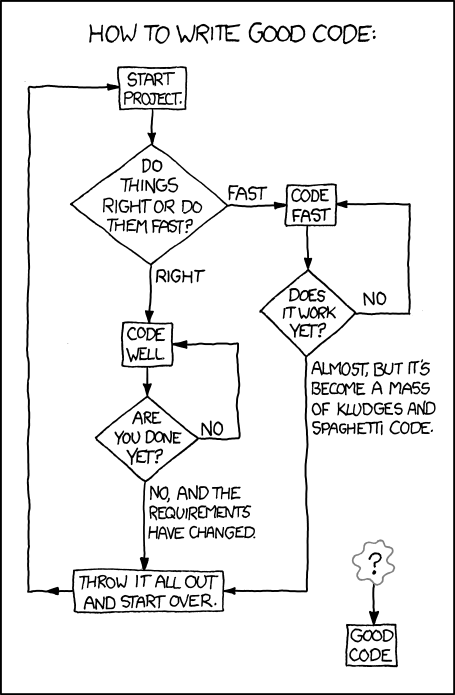
Not exactly. I build stories in much the same way code is written, IE: it's a nonlinear process that can go all over the place, but finally gets strung together into something coherent. :lol:

(IMO) Taking an overly structured approach always seems to end up giving a result comparable to this:
good_code.png
 
Last edited:
I would always recommend that you write your story in an outline. Know the structure of the story you want to tell (where it starts, where it ends, and a vague idea of how it gets there). All stories need some sort of conflict(s), so figure out what it is and what the resolution of conflict will look like. Choose a narrative voice and structure the style of the story around that voice.
 
I would always recommend that you write your story in an outline. Know the structure of the story you want to tell (where it starts, where it ends, and a vague idea of how it gets there). All stories need some sort of conflict(s), so figure out what it is and what the resolution of conflict will look like. Choose a narrative voice and structure the style of the story around that voice.

Good advice right there. Also, it helps to make graphs of other parts of the story, such as a list of characters and their relationships to others. The more organised you are in the beginning, the better.
 
Thanks for all the advice. Yes I do have an outline, and yes, I also hate SF with no real scientific base.
And for the fact, that nobody mentioned that I'm writing in present, from the missions commander as narrative voice, I think it isn't a bad choice.

I'm writing in german. I don't think am bad in english, but it's not enough for writing a story. Actually it's a typicall grand-tour story, where a small crew in the young 22th century travels around the solar system. Pepped with all sort of details like, economic reasons to go there, ship details, orbital mechanics, crew personality, etc.
If some one want to read what I have so far, send me a pm, but remember, it's german! :)
 
You might want to take a look at how Steve Pavlina does it.
Quite differently than what we were taught at school.

Depends on the length and the format though, since he approaches
a book more organized.
 
Some good reading here if you want an idea of how Astronauts behave; first hand accounts of experiences aboard Mir from a few crew members. Michael Foale's ''Foale on the collision'' is very interesting, it describes what was going on aboard Mir (and in his head) when a Progress vehicle managed to breach the hull of Spektre, causing depressurisation!

http://spaceflight1.nasa.gov/history/shuttle-mir/people/p-stories.htm
 
The main ingredient to fiction writing is IMO, momentum. I don't think it matters if the fiction turns out not so well written the first few times around, because once you start the ball rolling downhill your writing will just get better and better.

Although scientific base is good, try not to explain everything in too much detail, but give the reader hints as to how things work in your universe as the story unfolds.

It adds to the suspense and mystery of a future world. You can always hide hints here and there, make the reader guess.

That's because if I tried to document say, all the workings of a space warship's CIC and weapon systems in the first chapter, the opening chase would become so filled with technobabble you'd have to trash the thing.

In terms of that "flowing" style I recommend reading Arthur C Clarke for the realistic, gritty, yet mysterious feel, and H Beam Piper for a more "fantasy" setting that plays out in a quite true to life manner thanks to his well thought out far-future Terran culture. It's very indepth but based on current reality, and as aforesaid, he gives details in bite sized pieces as the drama plays out, no rush to explain the workings of technology all at once, when there's 200 odd pages to do so. There is something called aesthetic lack of detail and it plays with the mind, makes you want to fill in the details yourself, which makes the reading strangely collaborative in nature.

In fact Piper's fiction did spur other writers, long after his passing, to mimic his style. Long before the world knew about putting heavy weapons on cargo aircraft, H Beam Piper was using space freighters as gunships.

Another nice thing is that H. Beam Piper's fiction are usually very short. You could finish a book in a night.
 
Back
Top