Idea Space: 1982

Now, I'm no expert and no I did not stay at a Holiday Inn last night, BUT, atomic blasts do more damage when detonated aerially. The Chernobyl accident was in a semi hardened building close to the ground. Imagine if you will a garbage truck or two full of this crap going BOOM at 40k feet. Lets just say that while I don't “live” in Florida, I'm sure the people there would not appreciate it glowing for the next few millennia


Don't be silly. It's nuclear waste, not highly-enriched Uranium. It doesn't explode. Sheesh.
 
Are these LRBs engined with F1 engines? Are these the same LRBs that were discussed for use with uprated versions of Saturn?

Looking at things like the LRB'ed Shuttle-C with an 84 mT payload capacity are more reminders of the lost promise of STS.


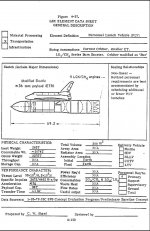
The following documentation might help. They are the two volumes of a 1976 engineering study into re-useable LRBs, for use as replacements for the SRBs. However the concept is not the clamshell design shown in the other documentation in this thread, but rather an F-1 based stage that was to be mounted to the base of the External Tank. The configuration is shown in the attached picture, which deals with a related concept.


EDIN design study alternate space shuttle booster replacement concepts. Volume 1: Engineering analysis

EDIN design study alternate space shuttle booster replacement concepts. Volume 2: Design simulation results
 

Attachments

  • Space Shuttle Derivative.jpg
    Space Shuttle Derivative.jpg
    122.3 KB · Views: 23
Last edited:
Sure, the waste can't cause a nuclear detonation. Haven't you ever heard of a "dirty bomb". Any explosion or rupture of the containment vessel would spread extremely toxic and highly radioactive waste for hundreds, possibly thousands, of miles if it happened at altitude.


Still, "off-planeting" nuclear waste does have it's attractions. Nuclear Waste remains deadly for thousands of years. Simply digging a hole doesn't guarantee safety. It can still leak out of it's container and leach into the groundwater no matter where you bury it. The government has a group of people who have been working for a couple decades now trying to figure out how to mark waste disposal sites. You can't count on people 30,000 years from now being able to read English (or any other existing language). There is also the concern that future people will disregard the warning thinking that it's a bluff - we hid something valuable and just want to scare people away. At least if we launch it we won't have that problem. I do, however, recommend sending it into the Sun. Then again, anyone with the technology needed for spaceflight would be able to detect the radiation and know to leave it alone, so a solar parking orbit would probably be as safe.
 
I do, however, recommend sending it into the Sun. Then again, anyone with the technology needed for spaceflight would be able to detect the radiation and know to leave it alone, so a solar parking orbit would probably be as safe.

Ironically one of the main concerns of the studies linked to on in my posts on the other page was that the containers in solar orbit would leak and the radioactive material would drift back to Earth on the solar wind!
 
You would probably want your waste to spend a while in a planetside storage facility before you sent it up, if you were going to send it up at all. The more potently radioactive isotopes tend to be the ones with shorter half-lives, so letting the stuff sit under Yucca mountain for a few years would give those isotopes a chance to decay. The stuff would still be radioactive, but it wouldn't be quite so much of a disaster if your launcher did a Challenger and scattered the stuff all over the Atlantic.
 
No time at the moment to dig up references but as I recall, there's been quite a bit of design work done on nukes that burn on the unused radioactives in today's spent fuel rods. There's two or three reactor types, I believe. End result, a lot less waste to deal with long term.

That would be a heck of a lot better than risking a launch accident or shipping the stuff off planet. The other winning side is that there's only 50-100 years of fissionables available if we seriously replace fossil fueled power generation with reactors. This could be significantly extended.

None of the other options come close to the power generation we'd need to keep up the current demands we're used to. I sure don't want to live in a world of rationed electricity and I want my kids to not have to face that prospect. It'll suck!
 
Back
Top