Updates Nasa's Interstellar Boundary Explorer (Ibex)

NASA To Reveal New Data On Conditions At Edge Of Solar System.

NASA will host a media teleconference at 1 p.m. EDT, on Wednesday, Sept. 29, to discuss new information about the boundary of our solar system obtained from the agency's Interstellar Boundary Explorer (IBEX) spacecraft.

The briefing participants are:
- Arik Posner, IBEX program scientist, Heliophysics Division, Science Mission Directorate, NASA Headquarters in Washington.
- Nathan Schwadron, IBEX science operations lead and associate professor at the University of New Hampshire in Durham.
- David McComas, IBEX principal investigator and assistant vice president of the Space Science and Engineering Division at Southwest Research Institute in San Antonio.
- Merav Opher, associate professor, George Mason University in Fairfax, Va.

Reporters can receive dial-in information by sending an email to JD Harrington at [email protected]. Requests must include reporter's name, affiliation, and telephone number.

Audio of the teleconference will be streamed live at:
www.nasa.gov/newsaudio

At the beginning of the briefing, related images will be available online at:
www.nasa.gov/ibex

---------- Post added 28th Sep 2010 at 09:24 PM ---------- Previous post was 27th Sep 2010 at 09:41 PM ----------

Comparisons of the Interstellar Magnetic Field Directions obtained from the IBEX Ribbon and Interstellar Polarizations.

Abstract: Variations in the spatial configuration of the interstellar magnetic field (ISMF) near the Sun can be constrained by comparing the ISMF direction at the heliosphere found from the Interstellar Boundary Explorer spacecraft (IBEX) observations of a 'Ribbon' of energetic neutral atoms (ENAs), with the ISMF direction derived from optical polarization data for stars within ~40 pc. Using interstellar polarization observations towards ~30 nearby stars within 90 deg of the heliosphere nose, we find that the best fits to the polarization position angles are obtained for a magnetic pole directed towards ecliptic coordinates of lambda, beta 263 deg, 37 deg (or galactic coordinates of L,B 38 deg, 23deg), with uncertainties of +/- 35 deg, based on the broad minimum of the best fits and the range of data quality. This magnetic pole is 33 deg from the magnetic pole that is defined by the center of the arc of the ENA Ribbon. The IBEX ENA ribbon is seen in sightlines that are perpendicular to the ISMF as it drapes over the heliosphere. The similarity of the polarization and Ribbon directions for the local ISMF suggest that the local field is coherent over scale sizes of tens of parsecs. The ISMF vector direction is nearly perpendicular to the flow of local ISM through the local standard of rest, supporting a possible local ISM origin related to an evolved expanding magnetized shell. The local ISMF direction is found to have a curious geometry with respect to the cosmic microwave background dipole moment.

Download here.
 
NASA Reschedules Teleconference On IBEX Spacecraft Findings.

NASA has rescheduled the media teleconference to discuss new information about the boundary of our solar system obtained from the agency's Interstellar Boundary Explorer (IBEX) spacecraft. The telecon now is set for noon EDT, on Thursday, Sept. 30.

The briefing participants are:
- Arik Posner, IBEX program scientist, Heliophysics Division, Science Mission Directorate, NASA Headquarters in Washington
- Nathan Schwadron, IBEX science operations lead and associate professor at the University of New Hampshire in Durham
- David McComas, IBEX principal investigator and assistant vice president of the Space Science and Engineering Division at Southwest Research Institute in San Antonio
- Merav Opher, associate professor, George Mason University in Fairfax, Va.

To participate in the teleconference, reporters should e-mail JD Harrington at: [email protected]

Audio of the teleconference will be streamed live at:
www.nasa.gov/newsaudio

At the beginning of the briefing, related images will be available online at:
www.nasa.gov/ibex
 
NASA:
NASA Mission Shows Evolution Of Conditions At Edge Of Solar System

WASHINGTON -- New data from NASA's Interstellar Boundary Explorer, or IBEX, spacecraft, reveal that conditions at the edge of our solar system may be much more dynamic than previously thought. Future exploration missions will benefit in design and mission objectives from a better understanding of the changing conditions in this outer region of our solar system.

The IBEX has produced a new set of "all-sky" maps of our solar system's interaction with the galaxy, allowing researchers to continue viewing and studying the interaction between our galaxy and sun. The new maps reveal changing conditions in the region that separates the nearest reaches of our galaxy, called the local interstellar medium, from our heliosphere -- a protective bubble that shields and protects our solar system.

In October 2009, scientists announced that the first map data produced by IBEX revealed an unpredicted bright ribbon of energetic neutral atoms emanating toward the sun from the edge of the solar system. This discovery was unexpected to scientists, because the ribbon of bright emissions did not resemble any previous theoretical models of the region.

The IBEX spacecraft creates sky maps by measuring and counting particles referred to as energetic neutral atoms that are created in an area of our solar system known as the interstellar boundary region. This imaging technique is required since this region emits no light that can be collected by conventional telescopes. This interstellar boundary is where charged particles from the sun, called the solar wind, flow outward far beyond the orbits of the planets and collide with material between stars. These collisions cause energetic neutral atoms to travel inward toward the sun from interstellar space at velocities ranging from 100,000 mph to more than 2.4 million mph.

This second set of all-sky maps, created using data collected during six months of observations, show the evolution of the interstellar boundary region. The maps help delineate the interstellar boundary region, the area at the edge of our solar system that shields it from most of the dangerous galactic cosmic radiation that would otherwise enter from interstellar space. The new findings were published this week in the Journal of Geophysical Research - Space Physics, a publication of the American Geophysical Union.

"Our discovery of changes over six months in the IBEX ribbon and other neutral atoms propagating in from the edge of our solar system show that the interaction of our sun and the galaxy is amazingly dynamic," said David J. McComas, IBEX principal investigator and assistant vice president of the Space Science and Engineering Division at Southwest Research Institute in San Antonio. "These variations are taking place on remarkably short timescales."

The IBEX spacecraft was launched in October 2008. Its science objective was to discover the nature of the interactions between the solar wind and the interstellar medium at the edge of our solar system.

"This situational awareness provided by IBEX shows our place in space is not constant," said Dick Fisher, director of the Heliophysics Division in NASA's Science Mission Directorate at the agency's Headquarters in Washington. "Better understanding of the dynamic environment of space is vital for successful planning for future exploration." The goal of the Heliophysics Division is to understand the sun and its interactions with Earth and the solar system.

The Southwest Research Institute developed and leads the IBEX mission with a team of national and international partners. The spacecraft is one of NASA's series of low-cost, rapidly developed missions in the Small Explorers Program. NASA's Goddard Space Flight Center in Greenbelt, Md., manages the program for the agency's Science Mission Directorate.

IBEX Media Teleconference: Visuals


--------------------
NASA:
IBEX Finds Surprising Changes at Solar Boundary

When NASA launched the Interstellar Boundary Explorer (IBEX) on October 19, 2008, space physicists held their collective breath for never-before-seen views of a collision zone far beyond the planets, roughly 10 billion miles away. That’s where the solar wind, an outward rush of charged particles and magnetic fields continuously spewed by the Sun, runs into the flow of particles and fields that permeates interstellar space in our neighborhood of the Milky Way galaxy.

No spacecraft had ever imaged the collision zone, which occurs in a region known as the heliosheath, because it emits no light. But the two detectors on IBEX are designed to “see” what the human eye cannot. The interaction of the solar wind and interstellar medium creates energetic neutral atoms of hydrogen, called ENAs, that zip away from the heliosheath in all directions. Some of these atoms pass near Earth, where IBEX records their arrival direction and energy. As the spacecraft slowly spins, the detectors gradually build up pictures of the ENAs as they arrive from all over the sky.

Mission scientists got their first surprise six months after launch, once the spacecraft had scanned enough overlapping strips of sky to create a complete 360° map. Instead of recording a relatively even distribution all the way around, as expected, IBEX found that the counts of ENAs — and thus the strength of the interaction in the heliosheath — varied dramatically from place to place. The detectors even discovered a long, enhanced “ribbon,” accentuated by an especially intense hotspot or “knot,” arcing across the sky. (IBEX Explores Galactic Frontier, Releases First-Ever All-Sky Map)

Now scientists have finished assembling a second complete sweep around the sky, and IBEX has again delivered an unexpected result: the map has changed significantly. Overall, the intensity of ENAs has dropped 10% to 15%, and the hotspot has diminished and spread out along the ribbon. Details of these findings appear in the September 27th issue of Journal of Geophysical Research (Space Physics).

“We thought we might detect small changes occurring gradually throughout the Sun’s 11-year-long activity cycle, but not over just 6 months,” notes David McComas (Southwest Research Institute), principal investigator for the IBEX mission and the paper’s lead author. “These observations show that the interaction of the Sun with the interstellar medium is far more dynamic and variable than anyone envisioned.”

In the past, space physicists had little notion of what to expect along the boundary where the Sun’s own magnetic bubble, the heliosphere, meets interstellar space. Even though the solar wind travels outward at roughly a million miles per hour, it still takes about a year to reach the heliosphere’s edge. Also, the encounter zone within the heliosheath is believed to be several billion miles thick (roughly Pluto’s distance from the Sun). Finally, the ENAs take another six months to many years to complete the return trip back to Earth, depending on their direction and energy.

With ENAs starting out from such a wide range of distances and traveling back toward Earth at different speeds, IBEX mission scientists had expected that any highs and lows in intensity arising within the heliosheath would be hopelessly smeared out in the spacecraft’s all-sky maps. So they’re elated by the variations and changes seen so far by IBEX. These early results hint that the solar wind and the interstellar flow might be interacting in a thinner layer than many researchers had imagined possible.

McComas says the dropoff in intensity between the two all-sky maps perhaps makes sense, because the Sun is only now emerging from an unusually long period of very low activity and a correspondingly weak solar wind. The fewer the solar-wind particles that reached the heliosheath in recent years, the fewer the ENAs that got created. “We didn’t plan it this way,” says McComas, “but it’s an almost perfect situation, in that we’re seeing the interaction in its simplest state — before trying to interpret what turns out to be a much more complicated interaction than anticipated.”

“The surprising results from IBEX show that there is still exciting science that can be done with small missions,” comments Eric Christian, a member of the spacecraft’s research team and the program’s Deputy Mission Scientist at the Goddard Space Flight Center. “This is clearly a huge success for the Explorer program.” IBEX is one of a dozen Explorer-class missions operated by NASA’s Science Mission Directorate.

“The public might think that scientists make measurements and instantly know what’s going on, but that is not how science really works,” McComas observes. “We thought the outer heliosphere would be stable over time — and IBEX is showing us that it’s not. This is changing the game completely.”


J. Kelly Beatty
NASA's Goddard Space Flight Center


--------------------

Astronomy Now: IBEX reveals dynamic Solar System edge:
A new set of all-sky maps from NASA’s Interstellar Boundary Explorer (IBEX) shows that conditions at the edge of our Solar System are more dynamic than first thought.

...

“Our discovery of changes over six months in the IBEX ribbon and other neutral atoms propagating in from the edge of our Solar System show that the interaction of our Sun and the galaxy is amazingly dynamic,” says McComas. “These variations are taking place on remarkably short timescales.”

[table="width=400"]
ribbon.jpg
|
ibex.jpg


Click here for visualization to show the ribbon-like structure untangling over time. Image: IBEX Science Team/Goddard Scientific Visualization Studio/ESA.|Click here for a comparison of IBEX's first and second all-sky maps. Image: IBEX Science Team/Goddard Space Flight Center.[/table]​
 
NASA TV Video: NASA Spacecraft Reveals Changes at Solar System's Edge.​
 
Southwest Research Institute News:
IBEX spacecraft makes first-ever images of magnetotail structures, dynamic interactions occurring in the invisible space around Earth

San Antonio — Dec. 14, 2010 — Invisible to the naked eye, yet massive in structure around the Earth is the magnetosphere, the region of space around the planet that ebbs and flows in response to the million-mile-per-hour flow of charged particles continually blasting from the Sun. NASA's Interstellar Boundary Explorer (IBEX) spacecraft, designed to image the invisible interactions occurring at the edge of the solar system, captured images of magnetospheric structures and a dynamic event occurring in the magnetosphere as the spacecraft observed from near lunar distance.

The data provides the first image of the plasma sheet, a component of the magnetosphere made up of magnetic field lines that attach to the Earth at both ends, bottling up denser plasma (ionized gas), within the magnetotail, the trailing portion of the magnetosphere stretching backwards away from the Sun by the force of the solar wind. The image shows the plasma sheet and magnetotail in profile.

[table="head;width=500"]{colsp=2}
Click on images to view larger versions​

|

This image shows the first-ever view of the magnetospheric plasma sheet in profile, as seen by the Interstellar Boundary Explorer (IBEX) from outside the magnetosphere. It shows the densest portions of the plasma sheet, largely following the modeled magnetic structure. Image courtesy of NASA/IBEX Science Team| IBEX observed an energetic neutral atom (ENA) flux enhancement that appears to be caused by plasma sheet disconnection occurring further down the magnetotail. A "plasmoid" — a dynamic event in which the magnetic fields "reconnect" across the plasma sheet — is one of several possible explanations. Image courtesy of NASA/IBEX Science Team

{colsp=2}
Click on the image below to download movie (mpg)​


{colsp=2}

{colsp=2}In this movie, compiled from sequential IBEX images, is what appears to be the first dynamic plasma sheet event ever imaged. While a plasmoid is one explanation for the event, other possibilities include acceleration of ions from compression of the plasma sheet or an injection of new plasma caused by a reconnection event further back in the tail, with particles streaming back toward Earth. IBEX’s vantage point in space provides twice yearly (spring and fall) seasons for viewing the magnetosphere. Courtesy of NASA/IBEX Science Team[/table]​


"The image alone is remarkable and would have made a great paper in and of itself because it's the first time we've imaged these important regions of the magnetosphere," says Dr. David McComas, principal investigator of the IBEX mission and assistant vice president of the Space Science and Engineering Division at Southwest Research Institute.

However, a closer look at the various images produced by multiple IBEX orbits revealed what appeared to be a piece of the plasma sheet being bitten off and ejected down the tail. This magnetic disconnection phenomenon — a dynamic event where the magnetic fields "reconnect" across the plasma sheet, producing what is known as a plasmoid, is one explanation for what could be occurring in the series of images, which has never directly been seen before.

"Imagine the magnetosphere as one of those balloons that people make animals out of. If you take your hands and squeeze the balloon, the pressure forces the air into another segment of the balloon," says McComas. "Similarly, the solar wind at times increases the pressure around the magnetosphere, resulting in a portion of the plasma sheet being pinched away from the rest of the plasma sheet and forced down the magnetotail."

Because researchers believe this phenomenon generally occurs deeper in the magnetotail, the IBEX team is considering other explanations for the event, as well. Other possibilities include acceleration of ions from compression of the plasma sheet or an injection of new plasma caused by a reconnection event further back in the tail, with particles streaming back toward Earth.

"To actually be able to observe and image the plasma sheet and magnetotail for the first time, and especially to be able to see their dynamic variations, is extremely exciting," McComas continues.

While not specifically designed to observe the magnetosphere, IBEX's vantage point in space provides twice yearly (spring and fall) seasons for viewing from outside the magnetosphere. Previous images of the magnetosphere have been taken by other satellites from within. Future IBEX images of the magnetosphere are expected to provide additional data to compare with local measurements inside the magnetosphere and build on current theories.

{...}
 
University of New Hampshire: IBEX Scientists Isolate Mysterious "Ribbon" of Energy and Particles that Wraps Around Solar System Boundary:
March 30, 2011

DURHAM, N.H. – In a paper to be published in the April 10, 2011, issue of The Astrophysical Journal, scientists on NASA’s Interstellar Boundary Explorer (IBEX) mission, including lead author Nathan Schwadron and others from the University of New Hampshire, isolate and resolve the mysterious “ribbon” of energy and particles the spacecraft discovered in the heliosphere – the huge bubble that surrounds our solar system and protects us from galactic cosmic rays.

The finding, which overturns 40 years of theory, provides insight into the fundamental structure of the heliosphere, which in turn helps scientists understand similar structures or “astrospheres” that surround other star systems throughout the cosmos.

The ribbon of energy was captured using ultra-high sensitive cameras that image energetic neutral atoms (instead of photons of light) to create maps of the boundary region between our solar system and the rest of our galaxy.

{...}
 
NASA:
  • RELEASE : 11-036 - NASA Spacecraft Reveals New Observations of Interstellar Matter:
    Jan. 31, 2012

    WASHINGTON -- NASA's Interstellar Boundary Explorer (IBEX) has captured the best and most complete glimpse yet of what lies beyond the solar system. The new measurements give clues about how and where our solar system formed, the forces that physically shape our solar system, and the history of other stars in the Milky Way.

    The Earth-orbiting spacecraft observed four separate types of atoms including hydrogen, oxygen, neon and helium. These interstellar atoms are the byproducts of older stars, which spread across the galaxy and fill the vast space between stars. IBEX determined the distribution of these elements outside the solar system, which are flowing charged and neutral particles that blow through the galaxy, or the so-called interstellar wind.

    {...}

  • IBEX: Glimpses of the Interstellar Material Beyond our Solar System:
    Jan. 31, 2012

    {...}

    In a series of science papers appearing in the Astrophysics Journal on January 31, 2012, scientists report that for every 20 neon atoms in the galactic wind, there are 74 oxygen atoms. In our own solar system, however, for every 20 neon atoms there are 111 oxygen atoms. That translates to more oxygen in any given slice of the solar system than in the local interstellar space.

    [table="head;width=450"]{colsp=2}
    Click on images to enlarge​

    |

    NASA's Interstellar Boundary Explorer (IBEX) has found that there's more oxygen in our solar system than there is in the nearby interstellar material. That suggests that either the sun formed in a different part of the galaxy or that outside our solar system life-giving oxygen lies trapped in dust or ice grains unable to move freely in space.
    Credit: NASA/Goddard​
    |The galactic wind streams toward the sun from the direction of Scorpio and IBEX has found that it travels at 52,000 miles an hour. The speed of the galactic wind and its subsequent pressure on the outside of the solar system's boundary affects the shape of the heliosphere as it travels through space.
    Credit: NASA/Goddard Scientific Visualization Studio​
    [/table]​


    "Our solar system is different than the space right outside it and that suggests two possibilities," says David McComas the principal investigator for IBEX at the Southwest Research Institute in San Antonio, Texas. "Either the solar system evolved in a separate, more oxygen-rich part of the galaxy than where we currently reside or a great deal of critical, life-giving oxygen lies trapped in interstellar dust grains or ices, unable to move freely throughout space." Either way, this affects scientific models of how our solar system – and life – formed.

    Studying the galactic wind also provides scientists with information about how our solar system interacts with the rest of space, which is congruent with an important IBEX goal. Classified as a NASA Explorer Mission -- a class of smaller, less expensive spacecraft with highly focused research objectives -- IBEX's main job is to study the heliosheath, that outer boundary of the solar system's magnetic bubble -- or heliosphere -- where particles from the solar wind meet the galactic wind.

    {...}

SPACE.com: NASA Probe Discovers 'Alien' Matter From Beyond Our Solar System

Universe Today: IBEX Captures ‘Alien” Material From Beyond Our Solar System
 
There was also an information obtained from IBEX saying that our Solar System's velocity relative to the interstellar medium has significantly decreased (from 26.3 km/s down to 22.8 km/s) compared to readings taken by the Ulysses. It hasn't been properly explained yet.
 
NASA:
IBEX Reveals a Missing Boundary At the Edge Of the Solar System

[table="width=300"]

› Download video
IBEX studies the outer reaches of the solar system by observing neutral atoms that cross or bounce off of its boundaries. Credit: NASA/Goddard Space Flight Center​
[/table]​


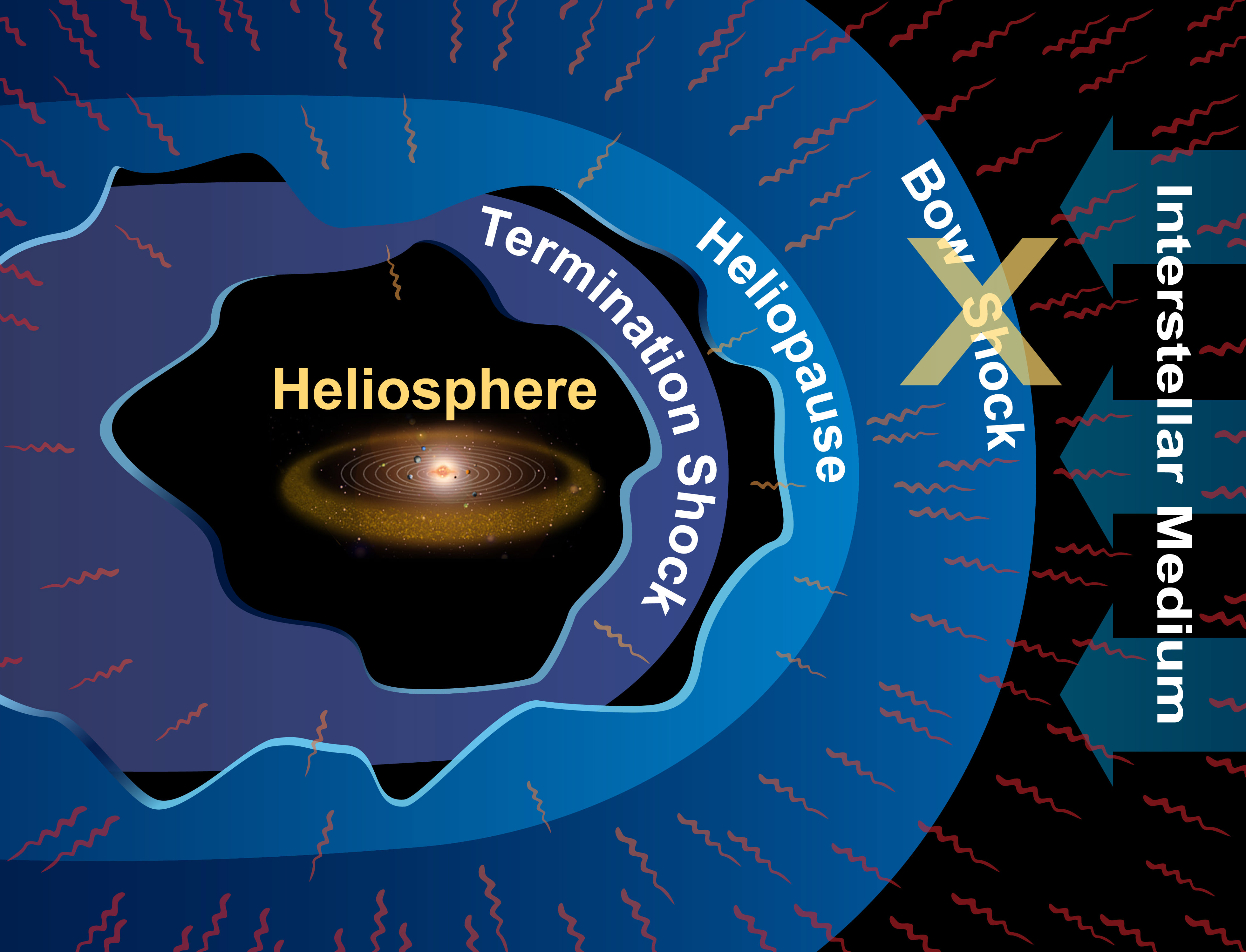
For the last few decades, space scientists have generally accepted that the bubble of gas and magnetic fields generated by the sun – known as the heliosphere – moves through space, creating three distinct boundary layers that culminate in an outermost bow shock. This shock is similar to the sonic boom created ahead of a supersonic jet. Earth itself certainly has one of these bow shocks on the sunward side of its magnetic environment, as do most other planets and many stars. A collection of new data from NASA's Interstellar Boundary Explorer (IBEX), however, now indicate that the sun does not have a bow shock.

In a paper appearing online in Science Express on May 10, 2012, scientists compile data from IBEX, NASA's twin Voyager spacecraft, and computer models to show that the heliosphere just isn't moving fast enough to create a bow shock in the tenuous and highly magnetized region in our local part of the galaxy.

[table="width=400"]
646984main_TA007685_full.jpg

The heliosphere surrounding our solar system is buffeted by strong magnetic fields, shown here as the black, diagonal, upward-pointing arrows. The heliosphere and the interstellar material of the local cloud pass by each other at a speed of 52,000 miles per hour, as shown by the blue arrow. The density of the material and the ramming pressures of the magnetic field coupled with the relatively slow speed of the heliosphere add up to indicate that there is no bow shock at the front of the heliosphere.
Credit: SWRI​
[/table]​

"IBEX gives a global view. It shows the whole of this region," says Eric Christian who is the mission scientist for IBEX at NASA's Goddard Space Flight Center in Greenbelt, Md. and who was formerly the program scientist for Voyager. "At the same time the Voyager spacecraft are actually there, in situ, measuring its environment at two locations. The combination of IBEX and Voyager gives you great science and now the new IBEX results strongly indicate that there is no bow shock."

Since the 1980s, the boundaries of the heliosphere have largely been assumed to be a series of three. The first is a fairly spherical boundary called the termination shock -- the point where the solar wind streaming from the sun slows down below supersonic speeds. From there the wind continues more slowly until it collides with the material in the rest of the galaxy and is pushed back, deflecting around the outskirts of the heliosphere, streaming back toward the tail of the moving bubble. This second boundary is called the heliopause. The third boundary was thought to be the bow shock, formed as the heliosphere plowed its way through the local galactic cloud the same way a supersonic jet pushes aside the air as it moves.

The two Voyager spacecraft have confirmed the existence of the first boundary, and have seen evidence for the second as they move toward it. However, each Voyager spacecraft has seen different things on their respective trips – one moving in a more northerly direction, one moving more to the south. They've encountered different regions at different distances from the sun, suggesting the very shape of the heliosphere is squashed and asymmetrical. Scientists believe this asymmetry is caused by the force and direction of magnetic fields ramming into the heliosphere from outside, the same way a hand pushing on a balloon will force it out of shape. This was the first clue that there's a strong magnetic field exerting pressure on the outskirts of the solar system. Independently, IBEX has seen a well-defined band, or ribbon, at the edge of the heliosphere, believed to be defined by this external magnetic field. Other studies from IBEX have helped quantify the magnitude of the magnetic field, showing that it is on the strong end of what was previously thought possible.

"We've seen one after another signature of a very strong magnetic field in the galactic environment," says Nathan Schwadron, a space scientist at the University of New Hampshire in Durham who is one of the authors on the paper. "That magnetic field influences the structure of the heliosphere and the boundaries themselves. That leads to a whole new paradigm."

Along with increased evidence for a strong external magnetic field, IBEX has also provided a new measurement for the speed of the heliosphere itself with respect to the local cloud.

"We recently analyzed two years worth of IBEX data, and they showed that the speed of the heliosphere – with respect to the local cloud of material – is only 52,000 miles per hour, instead of the previously believed 59,000," says David McComas at the Southwest Research Institute in San Antonio, Texas, who is first author on this paper and also the principal investigator for IBEX. "That might not seem like a huge difference, but it translates to a quarter less pressure exerted on the boundaries of the heliosphere. This means there's a very different interaction, a much weaker interaction, than previously thought."

In essence, it means that, like an airplane going too slowly to produce a sonic boom, the heliosphere isn't moving fast enough to create a bow shock, given the density and pressures of the material its moving through.

The heliosphere's boundaries lie roughly 10 billion miles away from Earth, but are nonetheless crucial for understanding our place in the universe. Indeed, the heliopause provides some protection for our solar system from the harsh, radiation environment surrounding it. By knowing the nature of these boundaries, scientists can start to better understand the propagation of particles that do have enough energy and speed to make it into our environment.

As scientists incorporate this substantive new understanding into their physical models, they will also be waiting for more evidence from both IBEX and the Voyagers, which they hope will continue to send back observations for many years to come.

"Imagine the point at which Voyager crosses the threshold of the heliopause and either does or does not see what IBEX is predicting," says Schwadron. "There will be enormous opportunities for scientific advancement."

{...}


Southwest Research Institute: New IBEX data show heliosphere's long-theorized bow shock does not exist

SPACE.com: Our Sun Is Moving More Slowly Than Thought

Discovery News: Sun Leaves No Shock Wave in its Wake

Universe Today: Surprise! IBEX Finds No Bow ‘Shock’ Outside our Solar System

heliosphere-nobowshock.jpg

New data from NASA's Interstellar Boundary Explorer (IBEX) shows that the heliosphere moves through space too slowly to form a bow shock. Credit: Southwest Research Institute.​
 
NASA: Five Years of Great Discoveries for NASA's IBEX


[table="head;width=450"]{colsp=2}
Click on images to enlarge​

|

IBEX discovered a giant ribbon at the edge of the solar system, an anomaly that has now been determined to be a reflection where solar wind particles heading out into interstellar space are reflected back into the solar system by a galactic magnetic field.
Image Credit: NASA/IBEX​
|IBEX found that Energetic Neutral Atoms, or ENAs, are coming from a region just outside Earth's magnetopause where nearly stationary protons from the solar wind interact with the tenuous cloud of hydrogen atoms in Earth's exosphere.
Image Credit: NASA's Goddard Space Flight Center​

|

A recent mapping of the heliotail shows it has two lobes of slower particles on the sides, faster particles above and below, with the entire structure twisted, as it experiences the pushing and pulling of magnetic fields outside the solar system.
Image Credit: NASA's Goddard Space Flight Center​
|IBEX has found that there's more oxygen in our solar system than there is in the nearby interstellar material.
Image Credit: NASA's Goddard Space Flight Center​
[/table]​
 
Back
Top