Updates NASA New Horizons Mission Updates

So, to answer the previous question, it would take about 15 years to launch another Pluto mission should NH fail, plus a decade for it to get there.

While it's still hopefully within our lifetimes, these programmers at NASA better not brick the probe now.
 
Here is the (current?) fly by scenario animation:

[Edit]

I just downloaded this NASA app "EYES ON SOLAR SYSTEM"
I never heard about it...

On this link, you can download the App and the Pluto fly by sequence:
http://eyes.nasa.gov/eyes-on-pluto.html
 
Last edited:
Speaking of being the fastest probe out there....just read that this thing reached Jupiter in one year. ONE YEAR :hailprobe: .Sheesh, that's fast. Imagine if we had manned spacecraft with such capabilities, complete with return capability :cheers:
 
It's gonna be a busy time for New Horizons, but it looks like it'll be focused mainly on Pluto, a bit on Charon, but it'll almost ignore the other moons.
 
Now THAT's a flyby! It really is just flying by!
 
It's still hard to believe we spent billions of dollars and careers of scientists on a few hours worth of fun. Who says we as a species don't know how to party? :P
 
It's still hard to believe we spent billions of dollars and careers of scientists on a few hours worth of fun. Who says we as a species don't know how to party? :P

I like to SCUBA dive, used to do it more often. We used to joke about spending hundreds of dollars, driving for 8-10 hours, fighting seasickness on a boat for 3 more hours, and diving to the edge of our safety envelope just to go look at a shipwreck for 15 minutes. :lol:

This mission is just a dive trip scaled up massively. Humans are curious animals.
 
nh-7-10-15_pluto_image_nasa-jhuapl-swri_0.png

mh-07-10-15_puto_image_annotated.jpg


It began as a point of light. Then, it evolved into a fuzzy orb. Now – in its latest portrait from NASA’s New Horizons spacecraft – Pluto is being revealed as an intriguing new world with distinct surface features, including an immense dark band known as the “whale.”

http://www.nasa.gov/feature/new-image-of-pluto-houston-we-have-geology
 
That's getting much better than Luna 3 (:hailprobe:). Good. :thumbup:

Luna_3_moon.jpg


The only far side view of our own Moon (less than 400,000 km away) in 1959. And now we're getting better than that on Pluto, an insanely far away and remote iced rock. That's already a very nice achievement, and it's far from being over ! :cheers:

:hailprobe:
 
Last edited:
Do any of us think well ever live to see a upclose sedna image?
 
Do any of us think well ever live to see a upclose sedna image?

Unlikely. Its perihelion occurs in 2075, and even then it is 76 AU away (Pluto orbits between 30 and 50 AU). A flyby mission might be possible, but I believe most of us will have shuffled off our mortal coils by then.
 
Unlikely. Its perihelion occurs in 2075, and even then it is 76 AU away (Pluto orbits between 30 and 50 AU). A flyby mission might be possible, but I believe most of us will have shuffled off our mortal coils by then.

Yeah that would be cool to see that though... By the 2070s launching probes will probably cheaper. We could probably send something the mass of Cassini there within 20 years. The whole mission being a flyby with like 20 cubesats flying in wide formation linked up to laser transmitter.:hailprobe:

The Pluto images are turning out to be exciting imagine Sedna.
 
The whole mission being a flyby with like 20 cubesats flying in wide formation linked up to laser transmitter.

But don't forget that the Sun looks like a bright star amongst others there. Solar panels that work perfectly in LEO are completely useless in those remote regions. It would be like a RTG per cubesat, maybe more if you want to use power-consuming stuff like laser transmission.

So really, power supply is a serious problem there, as you can't rely on light. The other sources of power we have currently are chemical/combustion (from fuel cells to any monopropellant or fuel/oxydizer combo) and radioactive decay (RTGs, nuclear fission reactors) that is converted into heat which is converted into usable electrical power.

Even if we manage to control and use fusion for rocket propulsion, that would be the end of small probes for such long-range missions. Such a reactor would probably be massive, and if we could put that in LEO we could also build a crewed long-range cruiser to house it.

Or maybe we could miniaturize to the extreme a probe, and fire with an orbital railgun at an extreme velocity. But don't expect it to send more than a few pics of the flyby then.

:hmm:
 
Last edited:
It's gonna be a busy time for New Horizons, but it looks like it'll be focused mainly on Pluto, a bit on Charon, but it'll almost ignore the other moons.
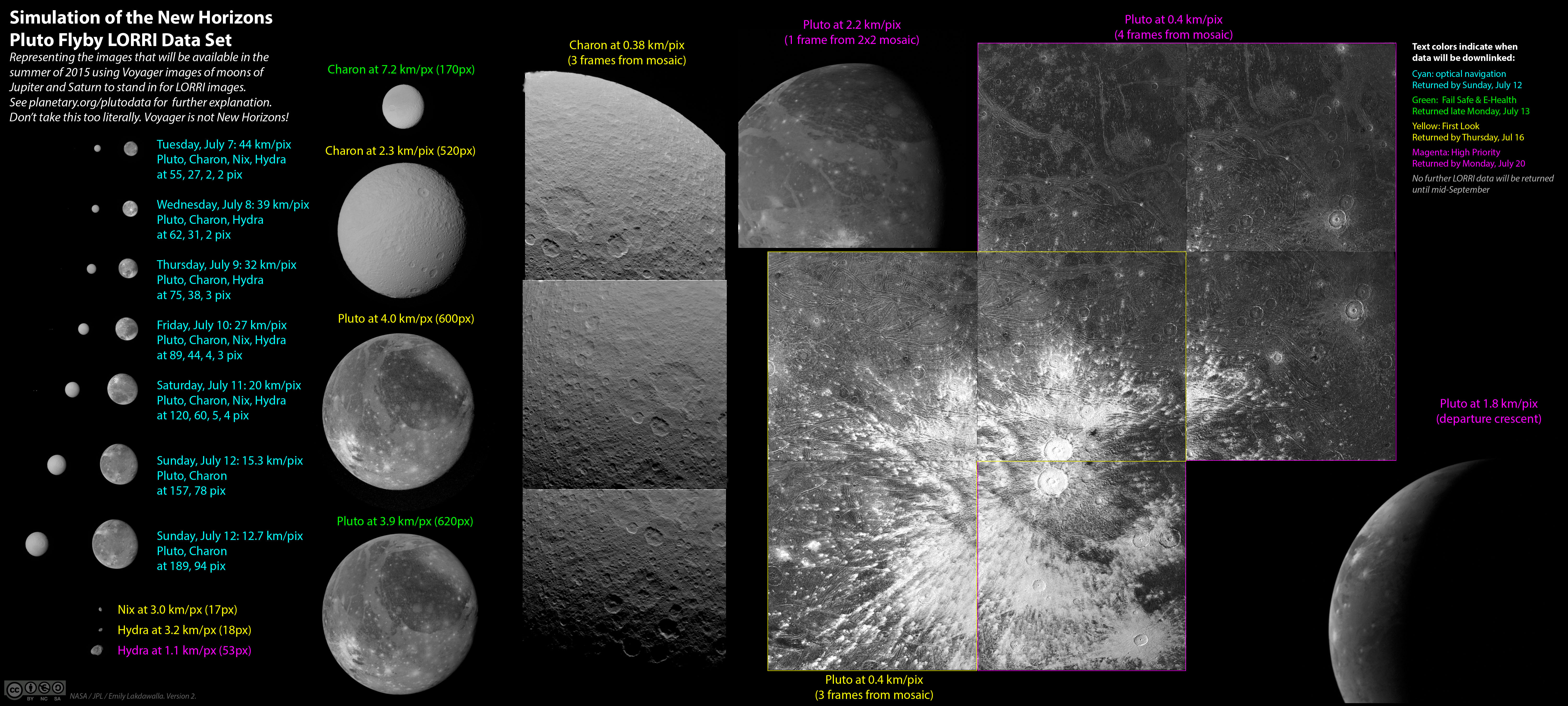
I don't think the Eyes on the Solar System simulation is entirely accurate. New Horizons will get plenty of data during closest approach from the smaller moons. We can also expect a mosaic of Charon that's slightly higher resolution than Pluto's in the next few days.

20150623_voyager_simulations_nep_data_ver2.jpg

A timeline of the first downlinked data through the flyby is here. I don't see any mention of Pluto's two smallest known moons. They were only discovered very recently.
 
Charon

charon_annotated.jpg

071215_charon_alone.png

New Horizons’ newest images reveal Pluto’s largest moon Charon to be a world of chasms and craters. The most pronounced chasm, which lies in the southern hemisphere, is longer and miles deeper than Earth’s Grand Canyon, according to William McKinnon, deputy lead scientist with New Horizon’s Geology and Geophysics investigation team.

http://www.nasa.gov/feature/charon-s-chasms-and-craters

---------- Post added at 09:15 PM ---------- Previous post was at 08:40 PM ----------

071215_pluto_alone_0.png

pluto-annotated.jpg
 
Wow, even Charon is cool, tiny as it is!

Oh if only we had been now where we thought we'd be when I was a child, to jet across the Solar System and see these things with my own eyes...
 
Back
Top