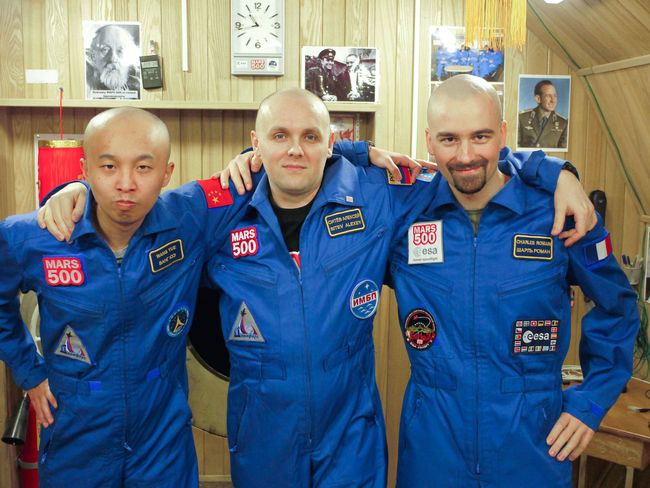
Updates Mars500 Updates

I still don't understand the purpose of an experiment that is quite similar to Big Brother (whilst the interior of the modules looks like a basement bar or like a finished garret; nice wood though). It has almost nothing in common with a mission to Mars, during which the crew would experience totally different physical and psychological impressions. Not to mention being on the surface of Mars, month away from the Earth in 1/3 of the earths gravity.
 
Last edited:
The experiment enviroment could be a lot better simulated.

For example windows with space views. better decoration, less wood and more white metal, like a real spacecraft, and when they "arrive" to mars , be transfered to hab in a stadium with red sand,rocks ,and seats covered with red canvas .

the reentry in mars could be the transport from the modules to the stadium in a capsule, or tranported by helicopter, like a real landing :lol:
 
I must say I'm very sceptical about this "experiment".

Let's rather spend that money in developping plasma engines : 40 days for Earth->Mars + 30 days on Mars + 40 days for Mars->Earth = 110 days, no more...

Anyway, as long as it draws some interest on spaceflight, there's some good on it...

Studying the crew of a nuclear-powered submarine might have been more realistic ;)
 
Mars500 video diary 3 - a dirty job but someone's gotta do it!​
 
Mars500 video diary 4 - it's housecleaning day!​
 
I think it is a myth that sex is necessary for optimum health and morale. And I don't think that any astronaut ever had sex aboard the ISS for example (but also not immediately if they return home, since they first have to become "fit" again, which takes some more additional time). A mission to Mars does not mean to have no sex anymore. But you can live without it for a few years without any problem. I do so since 2003, which already exceeded a duration of a Mars mission. And believe me, I'm rather fine and I don't feel any different since then. It is definitely not limiting my life and health. And if this is the case for me already, it also is the case for astronauts more than ever.

I think the best forms for stress relief in space flight is sport or if you do something you really like, but which does not contain social risks. Sex is one of the most riskiest things you can do on a mission to Mars. It contains social risks, even more if you take couples on a way to Mars. And I don't think any serious agency or government would send a kind of swingerclub up there. Space flight is not fun. It's hard work and requires astronauts who have A LOT of discipline and a strong psyche. If they don't have so, you can forget a manned mission to Mars.


The question, Moonwalker, is "Are you married"? If you are, then I think that you would find your answer to be very different indeed. Once you have become "mated" per se, sexual activity does become a significant part of both your physical AND mental health. NASA has a history of choosing married men (and women) for their space flight program because a person with those kind of attachments is going to be more likely to act reasonably and responsibly (ie, not take unnecessary risks) and is going to have a more vested interest (more than survival of self) in making sure that the mission is successful and returns home safely.
 
The question, Moonwalker, is "Are you married"? If you are, then I think that you would find your answer to be very different indeed. Once you have become "mated" per se, sexual activity does become a significant part of both your physical AND mental health. NASA has a history of choosing married men (and women) for their space flight program because a person with those kind of attachments is going to be more likely to act reasonably and responsibly (ie, not take unnecessary risks) and is going to have a more vested interest (more than survival of self) in making sure that the mission is successful and returns home safely.

Choosing older people (40-50 +) for a mission, who tend to be less interested in "mating" :), might alleviate the potential relationship problems. They would also be too busy with chores and coping with nausea to be worried about intimate activities!

I am still annoyed that a woman was not included in the Mars-500 crew; it would make the experiment more relevant to the other half of the population!


There is also a fiction story being posted, a chapter each week, by Russian sci-fi authors; unfortunately there is only an almost-unreadable computer translation for English readers.
 
Last edited:
The question, Moonwalker, is "Are you married"? If you are, then I think that you would find your answer to be very different indeed. Once you have become "mated" per se, sexual activity does become a significant part of both your physical AND mental health. NASA has a history of choosing married men (and women) for their space flight program because a person with those kind of attachments is going to be more likely to act reasonably and responsibly (ie, not take unnecessary risks) and is going to have a more vested interest (more than survival of self) in making sure that the mission is successful and returns home safely.
As a decidedly single (permanently) individual I strongly disagree. I have no desire for either marriage or sex, but I don't see any indication that I am weak or unwell mentally or physically (well, physically yes but for completely unrelated reasons :() as a result.
 
There were two birthdays aboard the experimental "spaceship" recently. Roman Charles' on July, 12 and Sukhrob Kamolov's on July, 14th. Their friends and ralatives attended the comms room and talked to the birthday guys:

Lise-Loup Antoniadis, friend of Roman Charles.
0002.jpg


Sukhrob Kamolov's family:
0008.blog.jpg


---------- Post added at 09:23 ---------- Previous post was at 09:21 ----------

As a decidedly single (permanently) individual I strongly disagree. I have no desire for either marriage or sex, but I don't see any indication that I am weak or unwell mentally or physically (well, physically yes but for completely unrelated reasons :() as a result.

Come on, we are on a forum for geeks. What one would expect from geeks? :lol:
 
As a decidedly single (permanently) individual I strongly disagree. I have no desire for either marriage or sex, but I don't see any indication that I am weak or unwell mentally or physically (well, physically yes but for completely unrelated reasons :() as a result.
Wait, serious?!
...Well, you're welcome here! :)

Also, it looks like my murderous OFMM promotional wallpaper has suddenly become very relevant...
attachment.php

Incidentally, the next one has to do with marriage. :)
 
...

Come on, we are on a forum for geeks. What one would expect from geeks? :lol:

Hum.. It is possible to find a geek girlfriend :thumbup:
Trust me... they exist and use pictures of Soyuz as a desktop background.

As for sex/no sex... I always wonder how the 15th/16th century sailors managed during many months or years at sea....
 
Since July 26th, Mars-500 crew will stop communicating with outside world real-time and will switch to batch audio transmission with steady increase of artificial delay to simulate the comms delay that would be there during an actual Mars mission. In addition, email channels will remain available.

Also today was a birthday of Chinese experiment participant, Wang Yue. The rest of the crew congratulated him with a celebrational writing in Chinese:

0007.jpg


Also, mission CDR Alexei Sitev recorded a conrgatulatory message to all sailors of Russian Navy on the Navy Day (being a naval officer himself).
 
Roscosmos PAO: "Fyodor Yurchikhin Advises Mars-500 Participants from the ISS".
Flight Engineer of the International Space Station Fyodor Yurchikhin advised participants of the Mars-500 simulation, answering the question he received through ISS Mail Box which works in Memorial Space Museum of Moscow with support of Roscosmos PAO and Moscow's Department of Culture. Yurchikhin says joint resolution of the problem shall help the crew involved in the simulated mission to Mars to develop their own microclimate in the facility.
"The heritage shows that all the family problems begin at the kitchen… Minor problem shall be solved first, and this will help you to achieve the goal, to complete the mission successfully", Yurchikhin says.
He added that it would be useful to get together to have meals in the evening, to discuss news, sport and other topics, but to avoid talking about work.
"It is easy to give advice, but it is hard to follow it. I wish you success and patience", Yurchikhin concluded.
 
Mars500 video diary 5 - Romain Charles is collecting air samples.
 
Mars500 video diary 6 - How supplies are rationed.​
 
ESA: "Science and thoughts of Chilean miners".

In this newest diary entry from the Mars500, Romain writes about cognitive experiments, describes how to do EEG measurements and sends his best regards to the 33 miners trapped beneath the ground in Chile.

When you are in isolation you tend to feel closer to all the other people who are living, or who have lived, the same kind of experience. From a former colleague who sailed on submarines to our fellow Mars500 colleagues Oliver Knickel and Cyrille Fournier, I have received a lot of advice to help me cope with the isolation. I really appreciate and understand them now. The main advice that I hear from everybody is “stay busy, be careful with your health and keep a normal day-night schedule”.

This advice I would like to share with all the people who are in isolation. In particular, all our thoughts go to the 33 miners in Chile who are trapped beneath the ground. Their living conditions are really tough and I hope that our message, which Diego kindly translated into Spanish, will reach them.

Now I will come back to our day-to-day life in our modules and for this diary I want to talk about one experiment. As you may know, my background is in the automotive industry and more specifically, quality control. For several years I studied, wrote and validated many work instructions as part of my job.

Coming back to Mars 500, we have roughly 100 experiments to perform during this isolation study and each one of them has instructions. I won’t enter into too much detail because it could become boring but trust me when I say that there are huge differences between all these instructions.

To show you a typical experiment, I will focus on one good example involving Electro-Encephalo-Graphy (EEG): exercise as a countermeasure to psycho-physiological deconditioning during long-term confinement. The scientists behind this were able to transform this complex and unfriendly title into an actually easy and visually attractive experiment.

This experiment involves an EEG and cognitive tests before and after exercise, to see how exercise can help us cope with the psychological problems of isolation.

Unless you are a doctor or a nurse, probably you have never performed an EEG. The basic idea of this technique is to record the electrical activity of the subject’s brain. We are the subjects here. To have a good signal, each electrode must be connected to the skull. Don’t be afraid, we connect them with a gel. For all our EEGs, we have to validate that each electrode has good connectivity.

The nice thing about this experiment is that a tiny colored light bulb is on the electrode and it appears red (if the connectivity is not good) or green (if everything is all right). For the setup of the EEG for other experiments we have to refer to a software, which is less efficient. We have also discovered another use for these red and green lights: Xmas lights! Now we just have to find an Xmas tree before December.

The cognitive performance tests are widely used in our 100 experiments. We have to count, to estimate time, to react to visual stimuli or do all these things at once while playing some ’stressful’ games (I mean it, sometimes I think the goal of some of these games is to stress us!).

The clever idea of the scientists for this experiment was to use off-the shelf ’edutainment’ games; just like the ones those of you who like to spend a few minutes everyday playing on your smartphones use. We use an iPod Touch with cognitive tests, three of them. As we can look at the best scores there is a kind of competition between us and each time we try to perform the best we can. The data retrieved by the scientists will then be more consistent and meaningful.

One last point that I want to stress is the storage of this experiment. Generally big boxes are used and we have to spend some minutes looking for a device that is hidden inside. As you can see on the picture, this EEG experiment has everything in one suitcase. When you open it everything is attached and has its own place. Some may recognise a successful ’5S’ in this picture. “There is a place for everything and everything is in its place”.

I hope that you get a better understanding of our experiments through the description of this one. We will continue to give you an insight into some of the many experiments we are executing on behalf of the scientists involved in Mars500.
 
Last edited:
ESA: "105 days in isolation – and counting – for 400 more".

Sailing now in interplanetary space on their simulated mission towards the ‘Red Planet’, the Mars500 crew has entered in a new phase of their isolation. The previous mission endured 105 days in 2009 and from now on, everything in this experiment is new.

The six crewmembers of Mars500, safely locked in their facility in Moscow, have been cruising virtually towards Mars since 14 June, when their mission ‘departed’ from Earth’s orbit. The ‘launch’ occurred on 3 June when the hatch of their spacecraft-analogue facility was closed.

Since then, the crew has followed the timeline of the mission, reproducing as accurately as possible a potential mission to our planetary neighbour, complete with communication delays and daily routine similar to real space missions.

Right now the delay in communication – representing the distance of the craft from Earth – is two minutes in each direction, making direct communication impossible. As the simulation goes on, the delay will increase to 20 minutes.

Next major milestone will be a ‘landing’ on Mars, planned now for 10 February 2011. The entire ‘mission’ will last around 520 days, with the expected ‘splashdown’ back on Earth in early November 2011.

Day by day.

“It is difficult to think that in a year’s time we’ll still be here in the modules,” says Romain Charles, one of the ESA-selected crewmembers. “We just try to take every day as it comes and make the best out of that. This has worked fine for 105 days, and it will work for the more than 400 days left.”

With more than 100 scientific experiments to conduct, the Mars500 crew has no danger of having nothing to do. Crew time is packed with entertainment and personal projects, in addition to continuing maintenance and daily tasks in their ‘spacecraft’. They exercise for several hours a day to make up for their limited amount of natural physical activity.

“It has already been a long time, and at this phase of the mission the previous crew would have been excited, as they were looking forward to ending their isolation,” laughs Diego Urbina, the other European aboard. “We don’t have that luxury. We just have to keep our minds as steady as possible – for what will be a very long time.”

Keep the daily routine!

Both of the European ‘marsonauts’ are sending their best regards to Cyrille Fournier and Oliver Knickel, the ESA-selected members of the 105-day-long precursor mission.

“We could have continued easily our mission,” says Cyrille Fournier, one of the two European crew members in 105-day-study. “The motivation is the key issue. It is also important to do always something. I had too much to do in the facility - I didn’t have any time to wander around and watch time passing. Another important thing is daily routine. When you are following that, you can basically just go on, almost indefinitely.”

“Of course we had highs and lows during the mission,” continues Oliver Knickel, other European 105-day crewmember. “In the beginning we were very enthusiastic and then again in the end, when only few days were remaining.”

The most difficult moments during their isolation were in the middle, about six to eight weeks from the beginning. “You can go over these phases and have a successful mission only as a crew. So, my advice to the current team is simple: think what you can do for your crewmates,” states Oliver.

“During the mission, you’re colleagues and everybody is acting professionally, but afterwards you’re friends,” Cyrille concludes. “We’re all still very close now as friends. It was a great experience! I wish all the best for the new crew inside the ‘spacecraft’”

 
Last edited:
Back
Top