

Welcome to this episode of "Spaceflight Russian Roulette". I am Cosmic Penguin, today's host. We have two guests here today waiting for their fate....
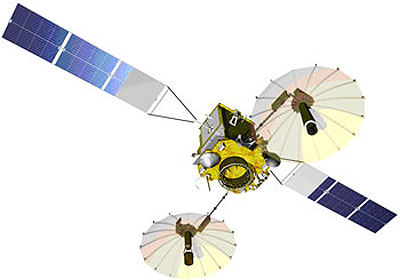
..the first one is Luch-5B, the second of three GEO spacecraft (along with Luch-5A, now under testing in orbit, and Luch-5V, slated to launch late next year) that are to form the Russian analog of the American TDRS or Chinese Tian Lian systems. They will perform tracking and data relay for satellites, manned spaceships in LEO, launch vehicles and their upper stages. It will restore data and command relaying functionality that had previously been carried out by the Altair and first generation Luch satellites launched in the second half of the 80's and first half of the 90's (later all these satellites deteriorated and stopped working). Luch's primary bands will be Ku and S beaming with 7 standard transponders and two high-gain tracking antennae.....
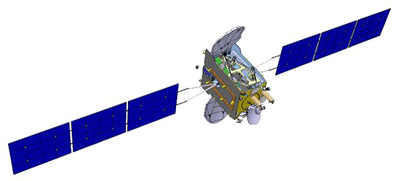
....and our second guest is Yamal-300K, a telecommunications satellite built by Russia's Reshetnev Information Satellite Systems Co. for a division of one of Russia's largest corporation, Gazprom Space Systems (owned by Gazprom, the Russian natural gas and oil supergiant). The spacecraft will provide much-needed expansion of the company's telecommunication services across Russia and northern Asia from its orbital slot of 90 degrees East with 8 C-band and 18 Ku-band transponders.....
....and now their fate seals on the Proton rocket and, more importantly, the Briz-M upper stage, which has caused the loss of nine satellites during the past six years. In fact today's trip is not that much different from the last Russian-built duo launch, which went completely wrong after launch in early August. Thanks to several problems with quality control at Khrunichev for the past few years, the workers there are still in :facepalm: mode and did not even advertise the launch before hand (this was done by the others though). So where will they end up, their office or the orbital graveyard or atmospheric hell? Stay tuned at 21:00 GMT today here!


Launch location:
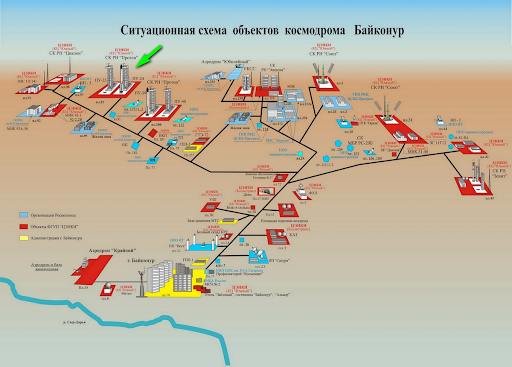
Baikonur Launch pad no. 81/24 46° 4'15.38"N, 62°59'5.11"E
Launch dates and times:
[table="head"]{colsp=6}Launch times
Time Zone|
{colsp=6}
{colsp=6}
{colsp=6}
Live Coverage Of The Launch:
PAYLOAD 1
Luch-5B (pronounced like "Lootch", means a beam, a ray) tracking, telemetry and data relay satellite:

Mission Summary
[table="head"]{colsp=2}Summary
Parameter|Value
[/table]
Luch-5B is an element of the Luch multi-purpose data relay system developed for the Russian space agency, Roscosmos, under the nation's Federal Space Program.
The new relay satellite is designed and manufactured by Reshetnev Information Satellite Systems Co. in collaboration with the Russian space industry and foreign partners.
Luch-5B will retransmit data from low-flying spacecraft in altitudes of 2,000 kilometers above Earth's surface or lower, including the International Space Station and primarily the lab's Russian segment, as well as other space objects such as launch vehicles and upper stages.
The satellite will track its targets during their powered and coast flight phases that cannot be monitored from Russia and then make online transmissions to Russia's receiving stations.
With its two large S-band and Ku-band high-gain antennas, Luch-5A will accurately pinpoint and track low-flying objects. The satellite carries seven S-band and 1 Ku-band transponders and can transmit commands to tracking spacecraft.
Also, Luch-5B is capable of receiving COSPAS-SARSAT signals and relaying them to ground stations. The satellite will transmit GLONASS positioning corrections, boosting the navigation system's accuracy.
Additionally, it also have a laser communication device for in-orbit testing.
Russia has registered three orbital locations for its Luch data relay constellation - 16° West over the Atlantic (the place it is heading for today), 95° East over the Indian Ocean (now occupied by Luch-5A), and 167° East over the Pacific (to be filled in by Luch-5V).
Weighing approximately 950 kilograms, Luch-5B is built on Reshetnev's Express-1000N unpressurized platform.
The satellite's two 4.2 meter umbrella-shaped antennas are comprised of composite spikes covered with gold-plated flywire and fitted with precision tracking electromechanical actuators.
The Luch-5B spacecraft is based on new technical solutions introduced by Reshetnev ISS and its partners. They are:
Thales Alenia Space contributed with their power amplifier units for transponders.
Sumitomo/NEC provided low noise amplifiers and Mayak system transmitters.
Coverage Map

(note that Luch-5A and Luch-5B have swapped their in orbit positions since the diagram was drawn)
[table="head"]Characteristics|
|
 [/table]
PAYLOAD 2
Yamal-300K communications satellite:

Mission Summary
[table="head"]{colsp=2}Summary
Parameter|Value
[/table]
In January 2009 ordered the Yamal-300K communication satellite from ISS Reshetnev as a replacement for the much cancelled Yamal 301 and Yamal 302 satellites. The satellite will be based on the Ekspress-1000N bus and is planned to be launched in 2010.
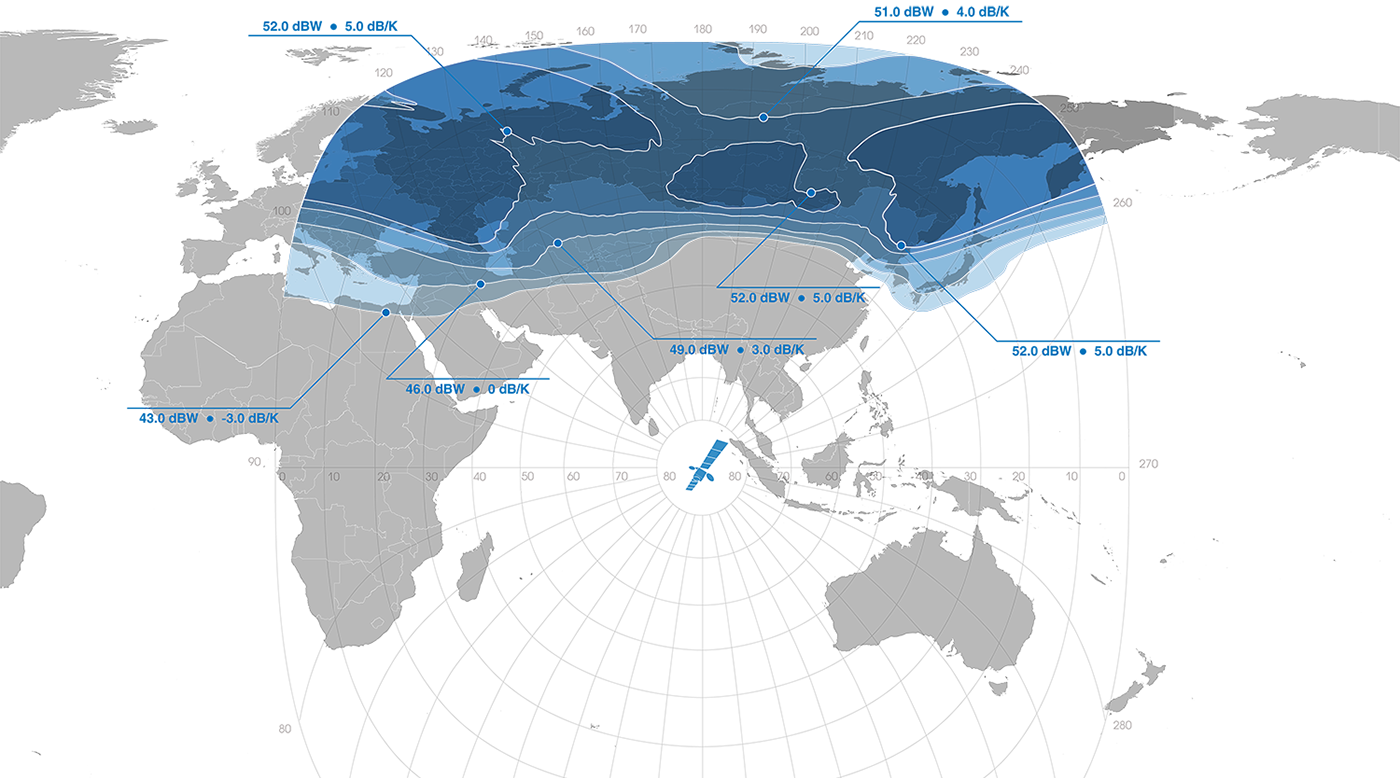
The Yamal-300K satellite will be launched to the 90E orbital slot, where it will work together with the Yamal-201 satellite.
The satellite is fitted with a combined payload including eight active 72 MHz transponders in C-band and eighteen active 72 MHz transponders in Ku-band.
Yamal-300K will be placed into orbit by a Proton-M Briz-M launch vehicle together with the Luch 5B satellite in 2012.
The main applications for C-band capacity will be traditional satellite services:
TV distribution,
Services for corporative networks VSAT, rural area networks (telephony, data transmission, Internet access),
Internet access (DVB-S),
Big communication flows transmission.
Coverage Map

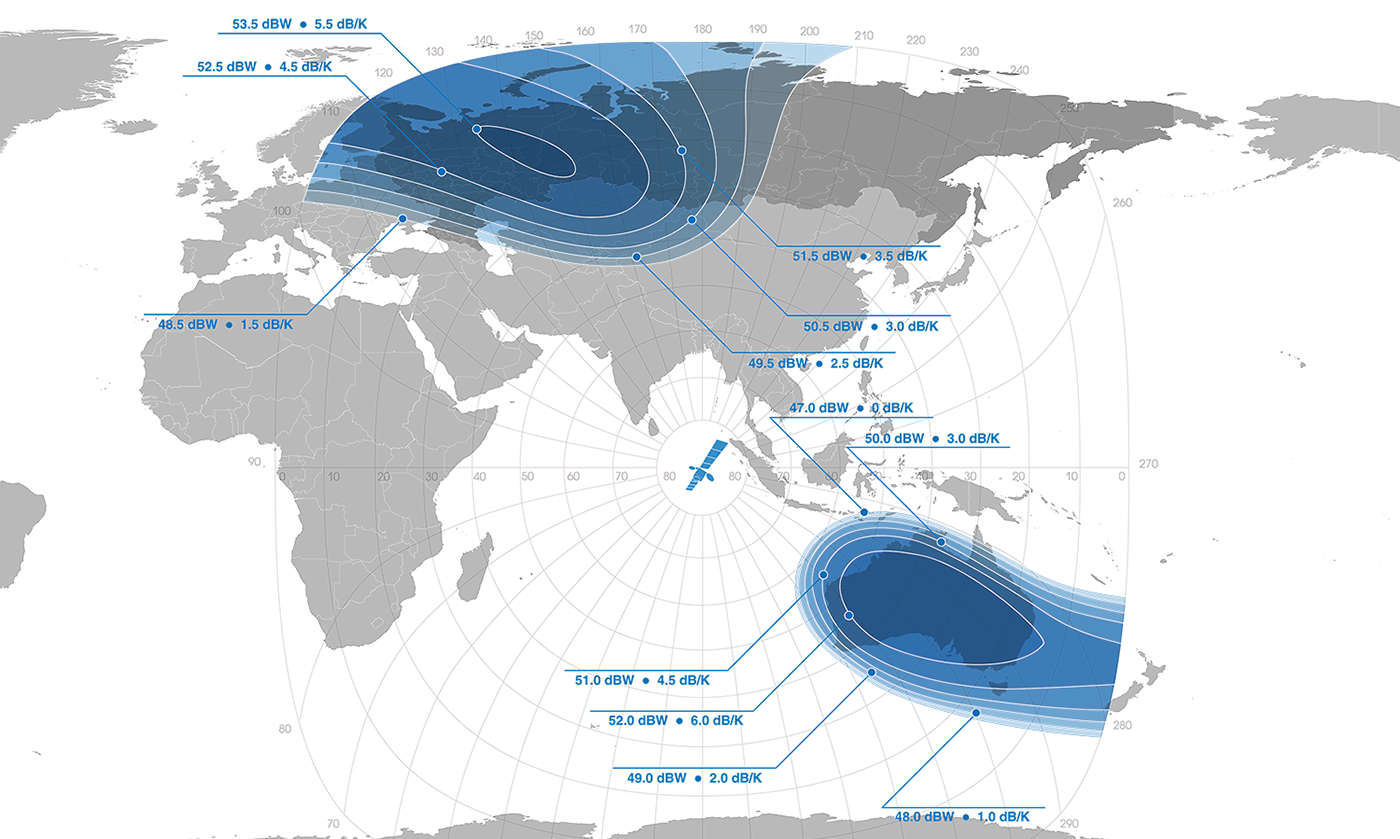
[table="head"]Characteristics|
|
 [/table]
Launch Vehicle:
[table="head"]{colsp=2}Characteristics
 |[table="head"]{colsp=2}

[/table]
[/table]
The vehicle's reliability statistics according to http://www.spacelaunchreport.com/log2011.html#rate:
Luch-5B and Yamal-300K Ascent Timeline
Total payload stack mass = 2922 kg

[TABLE="head"]Event|Time rel lift-off|Time Moscow|Time UTC|Comment
Lift-off|00:00:00|01:04:00|21:04:00|
1st/2nd Stage Separation|00:02:06|01:06:06|21:06:06|
2nd/3rd Stage Separation|00:05:34|01:09:34|21:09:34|
Payload Fairing Separation|00:05:47|01:09:47|21:09:47|
3rd Stage/Breeze M Separation|00:09:42|01:13:42|21:13:42|
1st Burn Ignition|00:11:16|01:15:16|21:15:16|
1st Burn Shutdown|00:15:22|01:19:22|21:19:22|1st Burn's Duration 00:04:06
2nd Burn Ignition|01:07:28|02:11:28|22:11:28|
2nd Burn Shutdown|01:25:10|02:29:10|22:29:10|2nd Burn's Duration 00:17:42
3rd Burn Ignition|03:28:57|04:32:57|00:32:57|
3rd Burn Shutdown|03:46:49|04:50:49|00:50:49|3rd Burn's Duration 00:17:52
Separation of APT|03:48:10|04:52:10|00:52:10|
4th Burn Ignition|08:48:17|09:52:17|05:52:17|
4th Burn Shutdown|09:01:40|10:05:40|06:05:40|4th Burn's Duration 00:13:23
Separation of Yamal-300K|09:14:00|10:18:00|06:18:00|in GEO
Separation of Luch-5B|09:29:00|10:33:00|06:33:00|in GEO
[/TABLE]
Weather forecast for Baikonur, Kazakhstan on November 3, 2012 (1 a.m.)
Partly cloudy. Low of 4C. Winds less than 5 km/h.
References
http://www.federalspace.ru
http://tvroscosmos.ru
http://www.khrunichev.ru
http://tihiy.fromru.com/Rn/RN_Proton.htm
http://space.skyrocket.de/doc_sdat/yamal-300k.htm
http://space.skyrocket.de/doc_sdat/luch-5b.htm
http://www.russianspaceweb.com/luch5a.html
http://www.mcc.rsa.ru/luch_5b.htm
http://www.gazprom-spacesystems.ru/en/new_projects/yamal_300/background/
http://kbhmisaeva.ru
http://cosmopark.ru
http://www.tsenki.com
http://forum.nasaspaceflight.com
http://www.novosti-kosmonavtiki.ru
http://www.spacelaunchreport.com
http://english.wunderground.com/cgi-bin/findweather/getForecast?query=zmw:00000.1.38062
Rant: I can't believe that Khrunichev is trying to make us think that this launch does not exist! :facepalm: On their live launch data page, there's no sign of this launch (the last one was Intelsat 23 in mid-October, and the next one listed is EchoStar 16 later this month), and thus no more launch timeline and orbit targets (ILS don't help because this launch was directly contracted to Khrunichev) are available. Had I did not ask on various spaceflight forums, these data will be buried forever. I know that the staff there must be working at high pressure (especially this being the "Russian RTF" of the Proton after three Proton launch failures on non-ILS missions), but how can a LAUNCH SERVICES COMPANY deals with a launch in such disregard compared with foreign launches via ILS? This speaks volumes of how deep the structural problem the Russian aerospace industry is facing. Unless I see other kinds of improvements, I don't see a very bright future for Russian spaceflight.:dry:
..the first one is Luch-5B, the second of three GEO spacecraft (along with Luch-5A, now under testing in orbit, and Luch-5V, slated to launch late next year) that are to form the Russian analog of the American TDRS or Chinese Tian Lian systems. They will perform tracking and data relay for satellites, manned spaceships in LEO, launch vehicles and their upper stages. It will restore data and command relaying functionality that had previously been carried out by the Altair and first generation Luch satellites launched in the second half of the 80's and first half of the 90's (later all these satellites deteriorated and stopped working). Luch's primary bands will be Ku and S beaming with 7 standard transponders and two high-gain tracking antennae.....
....and our second guest is Yamal-300K, a telecommunications satellite built by Russia's Reshetnev Information Satellite Systems Co. for a division of one of Russia's largest corporation, Gazprom Space Systems (owned by Gazprom, the Russian natural gas and oil supergiant). The spacecraft will provide much-needed expansion of the company's telecommunication services across Russia and northern Asia from its orbital slot of 90 degrees East with 8 C-band and 18 Ku-band transponders.....
....and now their fate seals on the Proton rocket and, more importantly, the Briz-M upper stage, which has caused the loss of nine satellites during the past six years. In fact today's trip is not that much different from the last Russian-built duo launch, which went completely wrong after launch in early August. Thanks to several problems with quality control at Khrunichev for the past few years, the workers there are still in :facepalm: mode and did not even advertise the launch before hand (this was done by the others though). So where will they end up, their office or the orbital graveyard or atmospheric hell? Stay tuned at 21:00 GMT today here!
Launch location:
Baikonur Launch pad no. 81/24 46° 4'15.38"N, 62°59'5.11"E
Launch dates and times:
[table="head"]{colsp=6}Launch times
Time Zone|
Australia - Sydney/AEDT
| Baikonur / UTC+6
| Moscow / UTC+4/
| Universal / UTC
| Washington / EDT
Launch time (Primary):
|08:04:00
|03:04:00
|01:04:00
|21:04:00
|17:04:00
on:
|Nov. 3, 2012
|Nov. 3, 2012
|Nov. 3, 2012
|Nov. 2, 2012
|Nov. 2, 2012
{colsp=6}
[highlight][eventTimer]2012-11-02 21:04:00?before|after;%dd% Days %hh% Hours %mm% Minutes %ss% Seconds %c%[/eventTimer] Luch-5B & Yamal-300K joint launch[/highlight]
{colsp=6}
[eventTimer]2012-11-03 06:18:00?before|after;%dd% Days %hh% Hours %mm% Minutes %ss% Seconds %c%[/eventTimer] Yamal-300K Separation From the Launch Vehicle
{colsp=6}
[eventTimer]2012-11-03 06:33:00?before|after;%dd% Days %hh% Hours %mm% Minutes %ss% Seconds %c%[/eventTimer] Luch-5B Separation From the Launch Vehicle
[/table]Live Coverage Of The Launch:
- TSENKI Video Streams: http://www.tsenki.com/broadcast/broadcast/ - coverage from 23:00 MSK (19:00 UTC) till 03:00 MSK (23:00 UTC)
Not available today (see rant at end of post)
[*]Khrunichev COOPI: http://coopi.khrunichev.ru/main.php?id=201
[*]Owners of PDA can watch the launch in test mode on: http://www.space-center.ru
PAYLOAD 1
Luch-5B (pronounced like "Lootch", means a beam, a ray) tracking, telemetry and data relay satellite:
Mission Summary
[table="head"]{colsp=2}Summary
Parameter|Value
Working Orbit:
|GEOOrbital Location:
|16° WestCoverage:
|Atlantic hemisphereInc at separation:
|0°[/table]
Luch-5B is an element of the Luch multi-purpose data relay system developed for the Russian space agency, Roscosmos, under the nation's Federal Space Program.
The new relay satellite is designed and manufactured by Reshetnev Information Satellite Systems Co. in collaboration with the Russian space industry and foreign partners.
Luch-5B will retransmit data from low-flying spacecraft in altitudes of 2,000 kilometers above Earth's surface or lower, including the International Space Station and primarily the lab's Russian segment, as well as other space objects such as launch vehicles and upper stages.
The satellite will track its targets during their powered and coast flight phases that cannot be monitored from Russia and then make online transmissions to Russia's receiving stations.
With its two large S-band and Ku-band high-gain antennas, Luch-5A will accurately pinpoint and track low-flying objects. The satellite carries seven S-band and 1 Ku-band transponders and can transmit commands to tracking spacecraft.
Also, Luch-5B is capable of receiving COSPAS-SARSAT signals and relaying them to ground stations. The satellite will transmit GLONASS positioning corrections, boosting the navigation system's accuracy.
Additionally, it also have a laser communication device for in-orbit testing.
Russia has registered three orbital locations for its Luch data relay constellation - 16° West over the Atlantic (the place it is heading for today), 95° East over the Indian Ocean (now occupied by Luch-5A), and 167° East over the Pacific (to be filled in by Luch-5V).
Weighing approximately 950 kilograms, Luch-5B is built on Reshetnev's Express-1000N unpressurized platform.
The satellite's two 4.2 meter umbrella-shaped antennas are comprised of composite spikes covered with gold-plated flywire and fitted with precision tracking electromechanical actuators.
The Luch-5B spacecraft is based on new technical solutions introduced by Reshetnev ISS and its partners. They are:
- the craft's honeycomb structure has built-in heat pipes;
- thermal control via heat pipes;
- solar arrays with gallium arsenide multi-junction cells;
- static Earth orientation instrument;
- high-precision star sensor.
Thales Alenia Space contributed with their power amplifier units for transponders.
Sumitomo/NEC provided low noise amplifiers and Mayak system transmitters.
Coverage Map
(note that Luch-5A and Luch-5B have swapped their in orbit positions since the diagram was drawn)
[table="head"]Characteristics|
Luch-5B
Customer:
|- Roscosmos
Prime contractor:
|- JSC "Information Satellite Systems" Reshetnev Company

Platform:
|- Express-1000 (unpressurized, 3-axis stabilized)
Mass at Separation:
|- 1282 kg
Dry Mass:
|- 950 kg
Dimensions (deployed):
|- 6.212 x 20.821 x 11.670 m
Payload:
|- 7 transponders: Ku, S, L, P, with 23-59.6 dBW EIRP
Antennas:
|- umbrella high-gain, steerable and omnidirectional, one antenna is Ku band (throughput 150 Mbit/s), another is S-band (5 Mbit/s).
Power:
|- No less than 2200 W, out of which 1500 W are supplied to the payload.
Life time:
|- 10 years
|
PAYLOAD 2
Yamal-300K communications satellite:
Mission Summary
[table="head"]{colsp=2}Summary
Parameter|Value
Working Orbit:
|GEOOrbital Location:
|90° EastCoverage:
|Russia, East Europe, Northern AsiaInc at separation:
|0°[/table]
In January 2009 ordered the Yamal-300K communication satellite from ISS Reshetnev as a replacement for the much cancelled Yamal 301 and Yamal 302 satellites. The satellite will be based on the Ekspress-1000N bus and is planned to be launched in 2010.
The Yamal-300K satellite will be launched to the 90E orbital slot, where it will work together with the Yamal-201 satellite.
The satellite is fitted with a combined payload including eight active 72 MHz transponders in C-band and eighteen active 72 MHz transponders in Ku-band.
Yamal-300K will be placed into orbit by a Proton-M Briz-M launch vehicle together with the Luch 5B satellite in 2012.
The main applications for C-band capacity will be traditional satellite services:
TV distribution,
Services for corporative networks VSAT, rural area networks (telephony, data transmission, Internet access),
Internet access (DVB-S),
Big communication flows transmission.
Coverage Map
[table="head"]Characteristics|
Yamal-300K
Customer:
|- Gazprom Space Systems (Russia)
Prime contractor:
|- JSC "Information Satellite Systems" Reshetnev Company
Platform:
|- Express-1000N (unpressurized, 3-axis stabilized)
Mass at Separation:
|- 1640 kg
Dry Mass:
|- ?
Dimensions (stowed):
|- ?
Payload:
|- C band: 8 x 72 MHz
- Ku band: 18 x 72 MHz
Power:
|- 5600 W
Life time:
|- 14 years
|
Launch Vehicle:
[table="head"]{colsp=2}Characteristics
Proton-M / Briz-M
Prime contractor:
|- Khrunichev Space Centre

GRAU Index:
|- 8K82KM
Height:
| 58.2 m with upper stage and payload fairingDiameter:
| max 7.4 mLiftoff mass:
| 705 metric tonnesPayload mass:
| ~22 tonnes at LEO1st stage:
|- 6 X RD-275 engines
- Empty 30.6 tonnes
- Propellants 419.41 tonnes (UDMH and NTO)
- Thrust in vacuum 1069.8 tonnes of force
- Thrust at sea level 971.4 tonnes of force
2nd stage:
|- 1 X RD-0211 engine 3 X RD-0210 engines
- Empty 11.4 tonnes
- Propellants 156.113 tonnes (UDMH and NTO)
- Thrust in vacuum 237.4 tonnes of force
3rd stage:
|- 1 X RD-0213 engine & 1 X RD-0214 vernier engine
- Empty 3.7 tonnes
- Propellants 46.562 tonnes (UDMH and NTO)
- Thrust in vacuum 59.36 (core) + 3.15 (vernier) tonnes of force
Upper Stage:
|
- GRAU Index: 14S43
- Common Name: Briz-M
- Designer & Manufacturer: Khrunichev Space Centre
- Dimensions: Length 2.654 m, Diameter 4 m
- Empty Mass 2.2 tonnes
- Propellants 6 660 kg UDMH + 13 260 kg N2O4
- Flight time: no less than 24 hours
- Main Engine: 1 X 14D30
- Thrust in vacuum 2.0 tonnes of force
- ISP 328.6 s
- Main engine restarts: up to 8 times
- Precision Manoeuvering Engines: 4 X 11D458
- Thrust in vacuum 400 N each
- ISP 252 s
- RCS Engines: 12 X 17D58E
- Thrust in vacuum 13.3 N each
- ISP 274 s
Payload Fairing:
|- Diameter 4.35 m
- Length 11.6 m
[/table]
[/table]
The vehicle's reliability statistics according to http://www.spacelaunchreport.com/log2011.html#rate:
Code:
================================================================
Vehicle     Successes/Tries Realzd Pred  Consc. Last     Dates
                             Rate  Rate* Succes Fail
================================================================
Proton-M/Briz-M  54    59    .92  .90      1    08/06/12 2001-
Luch-5B and Yamal-300K Ascent Timeline
Total payload stack mass = 2922 kg
[TABLE="head"]Event|Time rel lift-off|Time Moscow|Time UTC|Comment
Lift-off|00:00:00|01:04:00|21:04:00|
1st/2nd Stage Separation|00:02:06|01:06:06|21:06:06|
2nd/3rd Stage Separation|00:05:34|01:09:34|21:09:34|
Payload Fairing Separation|00:05:47|01:09:47|21:09:47|
3rd Stage/Breeze M Separation|00:09:42|01:13:42|21:13:42|
1st Burn Ignition|00:11:16|01:15:16|21:15:16|
1st Burn Shutdown|00:15:22|01:19:22|21:19:22|1st Burn's Duration 00:04:06
2nd Burn Ignition|01:07:28|02:11:28|22:11:28|
2nd Burn Shutdown|01:25:10|02:29:10|22:29:10|2nd Burn's Duration 00:17:42
3rd Burn Ignition|03:28:57|04:32:57|00:32:57|
3rd Burn Shutdown|03:46:49|04:50:49|00:50:49|3rd Burn's Duration 00:17:52
Separation of APT|03:48:10|04:52:10|00:52:10|
4th Burn Ignition|08:48:17|09:52:17|05:52:17|
4th Burn Shutdown|09:01:40|10:05:40|06:05:40|4th Burn's Duration 00:13:23
Separation of Yamal-300K|09:14:00|10:18:00|06:18:00|in GEO
Separation of Luch-5B|09:29:00|10:33:00|06:33:00|in GEO
[/TABLE]
Weather forecast for Baikonur, Kazakhstan on November 3, 2012 (1 a.m.)
Partly cloudy. Low of 4C. Winds less than 5 km/h.
References
http://www.federalspace.ru
http://tvroscosmos.ru
http://www.khrunichev.ru
http://tihiy.fromru.com/Rn/RN_Proton.htm
http://space.skyrocket.de/doc_sdat/yamal-300k.htm
http://space.skyrocket.de/doc_sdat/luch-5b.htm
http://www.russianspaceweb.com/luch5a.html
http://www.mcc.rsa.ru/luch_5b.htm
http://www.gazprom-spacesystems.ru/en/new_projects/yamal_300/background/
http://kbhmisaeva.ru
http://cosmopark.ru
http://www.tsenki.com
http://forum.nasaspaceflight.com
http://www.novosti-kosmonavtiki.ru
http://www.spacelaunchreport.com
http://english.wunderground.com/cgi-bin/findweather/getForecast?query=zmw:00000.1.38062
Rant: I can't believe that Khrunichev is trying to make us think that this launch does not exist! :facepalm: On their live launch data page, there's no sign of this launch (the last one was Intelsat 23 in mid-October, and the next one listed is EchoStar 16 later this month), and thus no more launch timeline and orbit targets (ILS don't help because this launch was directly contracted to Khrunichev) are available. Had I did not ask on various spaceflight forums, these data will be buried forever. I know that the staff there must be working at high pressure (especially this being the "Russian RTF" of the Proton after three Proton launch failures on non-ILS missions), but how can a LAUNCH SERVICES COMPANY deals with a launch in such disregard compared with foreign launches via ILS? This speaks volumes of how deep the structural problem the Russian aerospace industry is facing. Unless I see other kinds of improvements, I don't see a very bright future for Russian spaceflight.:dry:
Last edited:


