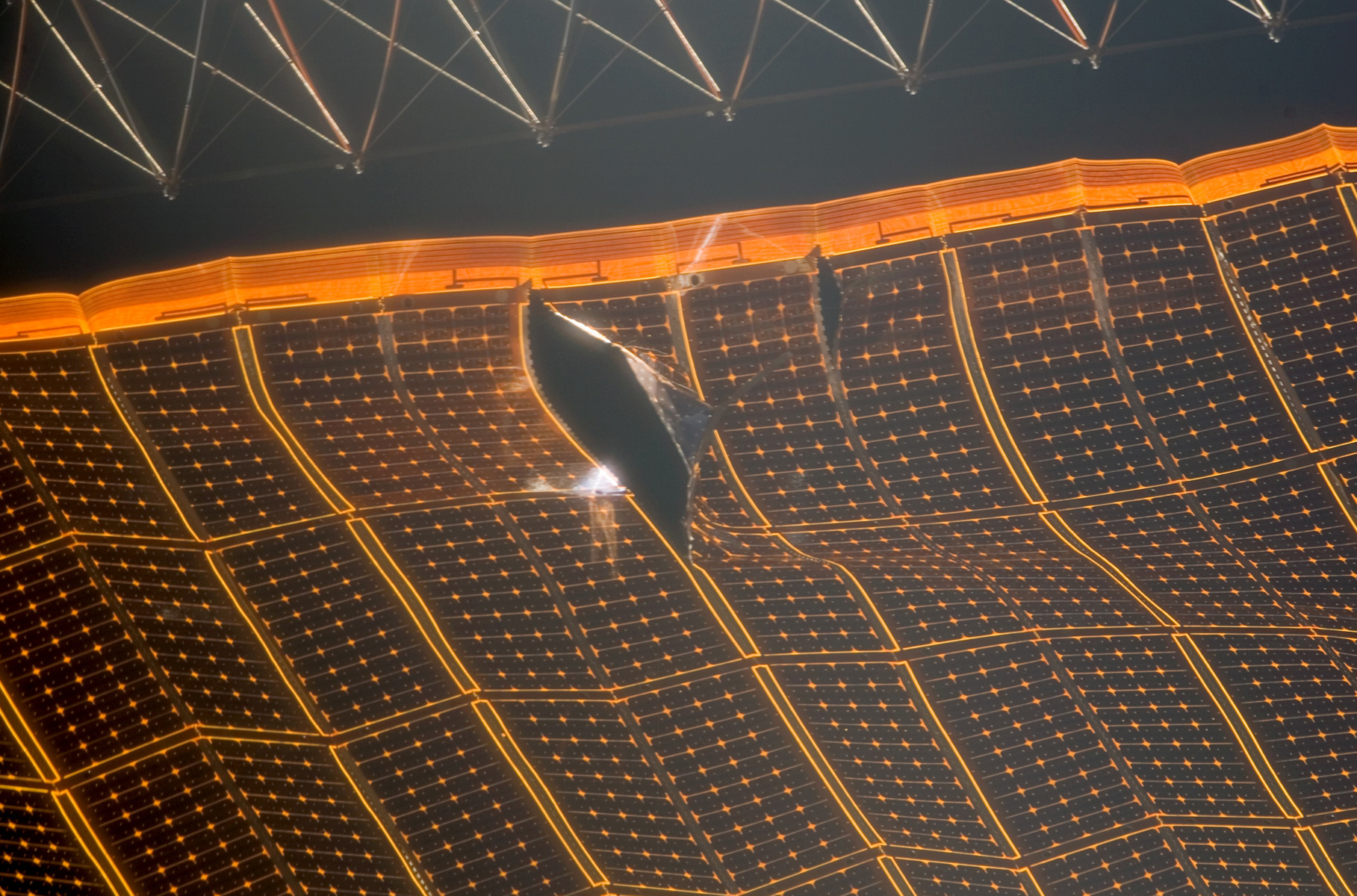
Actually, they're blue (at least the sides with the actual solar arrays are (like other solar arrays) darkish blue, but the undersides are somewhat orrange. From what I've seen on images and videos. Take a look at this:
http://www.nasa.gov/externalflash/ISSRG/ (click the 'how it works' icon or watch the introduction)
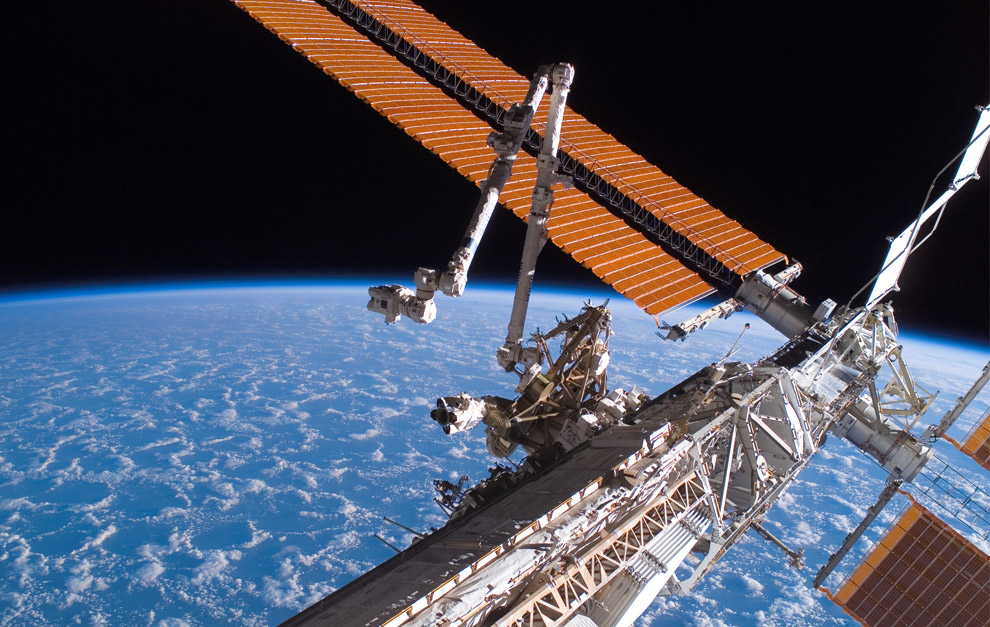
The ISS Solar Array Wings (SAW's) (the big, main, most recognizable arrays) have only 2 colours, Orange and Black. This is why. They are Silicon flexible thin-film module photovoltaic cells; they are made using Amorphous Silicon and that means that the active surface side is black. Pitch black. Now the orange colour comes from the circuitry, because they use flexible circuits. With copper as the conductive metal, encased in a protective layer giving it the orange colour. The arrays are arranged in such a way and designed with flexible circuitry so they can be folded, because they cover a HUGE surface area.
Each of the Solar Array Wings are 34 m (112 ft) long by 12 m (39 ft) wide, and are capable of generating nearly 32.8 kW of DC power.[4] They are split into two photovoltaic blankets, with the deployment mast in between. Each blanket has 16,400 silicon photovoltaic cells, grouped into 82 active panels, each consisting of 200 cells, and each cell is 8 cm² with 4,100 diodes.
Here are some super high res pictures;
Under Side:
Top (active) Side:
Underside, and top side in one view:
Complete full super high rez view of top of starboard side:
Super close up, super high res view of bottom side, so close you could lick it:
Super close up, high res view of top side
(makes awesome texture):
The Russian parts of the space station use a different kind of a solar array. They are a thick, solid rigid structure. Made of Gallium Arsenide and Crystalline Silicon multi-junction cells. This means that their surface can be anywhere from a deep dark purple (almost black) to a bright brilliant blue, depending on the angle you are looking from. This also gives them a very cool fractured crystalline look, having more than one colour, and having them change as your angle changes.
Here is a very high res example. All tough this one has some red paint in the middle for an unknown reason. Makes a great texture.
The four Photovoltaic Radiators (PVR) for the International Space Station are white in colour.
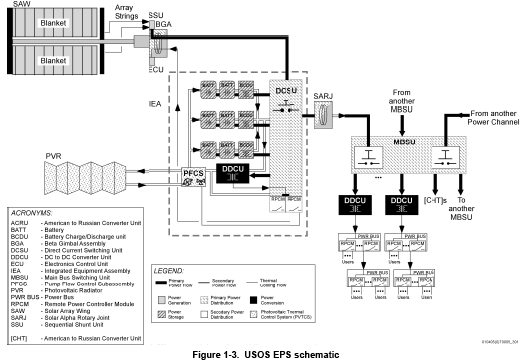
This is what you will need to model the ISS power system. For the rotation animation, electrics system, and computer control systems;
The solar arrays normally track the Sun, with the alpha gimbal used as the primary rotation to follow the Sun as the space station moves around the Earth, and the beta gimbal used to adjust for the angle of the space station's orbit to the ecliptic. Several different tracking modes are used in operations, ranging from full Sun-tracking, to the drag-reduction mode ("Night glider" and "Sun slicer" modes), to a drag-maximization mode used to lower the altitude
Far more detail here:
http://en.wikipedia.org/wiki/Night_Glider_mode
Here is a diagram you will need in order to properly model the rotation and electronics of the arrays.
Wow, thats a lot of info for one post. I think this is the longest one I have ever done. I learned all of this doing research for my Virtual ISS simulation program.
This is what the ISS looks like when viewed from the ground by a amature astronomer telescope:



![CBM hatch external side [ORIGINAL COPY].jpg](https://cdn.orbiter-forum.com/data/attachments/2/2538-d63102abd86ae0629eefdfef337aaee5.jpg?hash=1jECq9hq4G)


 .
. 


.jpg)
.jpg)