Hi! This is my first post in this forum, but I'm using this good simulator several years ago, I remember from 2016. English is not my native language (it is Catalan and Spanish), but I hope you understand me.
Orbiter uses n-body calculations to propagate orbital trajectories, this make it very difficult, but very realistic, challenging and entertaining. But there are some orbital trajectory perturbations that I don't understand.
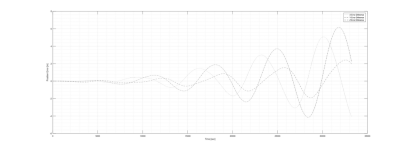
Suppose a trip from Earth to Jupiter. I use IMFD course program, it uses 2-body calculations, I know, so the initial trajectory need further corrections. If the ship passes near Mars the trajectory gets clearly perturbated and gets perturbated too by Jupiter itself when approaching. I understand these perturbations and I can do adequate corrections to solve them. But other times the ship is very far from Mars, Earth, Jupiter, Saturn... and there are perturbations too, I don't know why. I activate body vectors visual option to view forces actuating, the gravity is directed towards the Sun and is only 6 Newton, for an about 24,000 Kg ship, it's a very low force. Which force will be distant planets like Jupiter or Saturn? 0,001 N? Can this very very low force cause important perturbations? The perturbations are very strange, I zoom in the IMFD course program to view trajectory near Jupiter, one day it's to left of the planet and the other day it's to the right. This is an important perturbation in only one day. The perturbation is cyclic, it goes up and down, if I accelerate time it seems a sea wave. If the perturbation were caused by an alignment of planets (Mars, Earth, Venus), it should always be in the same way, and not one day in one way and other day the opposite. I suspect this is caused by integrator errors and correction. Well, the real life is very very complex, and even a very good simulator like Orbiter can only approximate to it. So AFAIK Orbiter integrators sometimes have errors and they are corrected, so probably this sea wave in the trajectory is caused by repeatedly errors and corrections. I've tried to set RK8 integrator for all time steps, in Configuration->Extra->Time propagation->Dynamic state propagators, but the result is nearly the same.
OK, IMFD course program is a 2-body tool only useful for initial burn, I need to use other tools. But I've tried TransX and IMFD Map program and doesn't work for long distances, trajectory prediction is changing every day. IMFD Map program works very well near a planet, even outside it's SOI (Sphere Of Influence), but I don't know if it can be configured correctly to work in long distances. I've tried different parameters, more accuracy, less accuracy, adaptative parameter... nothing works.
So, how do I travel to another planet? By trial and error. Because the perturbations are cyclic I try to guess the middle position, and then use IMFD Map to correct the trajectory. The prediction is changing every day, but the final trajectory generally is closer to the initial guess. But sometimes the cycle changes and need to make more corrections. I end up doing a lot of corrections. They are short corrections, using only RCS, but there are a lot.
Real space missions can go to planets with only few DSMs (Deep Space Maneuver), I do a lot. Yes, they can do better because they have more resources, more money, intelligent people, good software, the best computers. But I wish to do it better, in a more elegant manner other than trial and error.
Is there a good way to make precise trajectory predictions, needing only few corrections? Using native Orbiter tools? Or using external tools like NASA's GMAT software?
A little large first post. I'm starting strong.
Orbiter uses n-body calculations to propagate orbital trajectories, this make it very difficult, but very realistic, challenging and entertaining. But there are some orbital trajectory perturbations that I don't understand.
Suppose a trip from Earth to Jupiter. I use IMFD course program, it uses 2-body calculations, I know, so the initial trajectory need further corrections. If the ship passes near Mars the trajectory gets clearly perturbated and gets perturbated too by Jupiter itself when approaching. I understand these perturbations and I can do adequate corrections to solve them. But other times the ship is very far from Mars, Earth, Jupiter, Saturn... and there are perturbations too, I don't know why. I activate body vectors visual option to view forces actuating, the gravity is directed towards the Sun and is only 6 Newton, for an about 24,000 Kg ship, it's a very low force. Which force will be distant planets like Jupiter or Saturn? 0,001 N? Can this very very low force cause important perturbations? The perturbations are very strange, I zoom in the IMFD course program to view trajectory near Jupiter, one day it's to left of the planet and the other day it's to the right. This is an important perturbation in only one day. The perturbation is cyclic, it goes up and down, if I accelerate time it seems a sea wave. If the perturbation were caused by an alignment of planets (Mars, Earth, Venus), it should always be in the same way, and not one day in one way and other day the opposite. I suspect this is caused by integrator errors and correction. Well, the real life is very very complex, and even a very good simulator like Orbiter can only approximate to it. So AFAIK Orbiter integrators sometimes have errors and they are corrected, so probably this sea wave in the trajectory is caused by repeatedly errors and corrections. I've tried to set RK8 integrator for all time steps, in Configuration->Extra->Time propagation->Dynamic state propagators, but the result is nearly the same.
OK, IMFD course program is a 2-body tool only useful for initial burn, I need to use other tools. But I've tried TransX and IMFD Map program and doesn't work for long distances, trajectory prediction is changing every day. IMFD Map program works very well near a planet, even outside it's SOI (Sphere Of Influence), but I don't know if it can be configured correctly to work in long distances. I've tried different parameters, more accuracy, less accuracy, adaptative parameter... nothing works.
So, how do I travel to another planet? By trial and error. Because the perturbations are cyclic I try to guess the middle position, and then use IMFD Map to correct the trajectory. The prediction is changing every day, but the final trajectory generally is closer to the initial guess. But sometimes the cycle changes and need to make more corrections. I end up doing a lot of corrections. They are short corrections, using only RCS, but there are a lot.
Real space missions can go to planets with only few DSMs (Deep Space Maneuver), I do a lot. Yes, they can do better because they have more resources, more money, intelligent people, good software, the best computers. But I wish to do it better, in a more elegant manner other than trial and error.
Is there a good way to make precise trajectory predictions, needing only few corrections? Using native Orbiter tools? Or using external tools like NASA's GMAT software?
A little large first post. I'm starting strong.