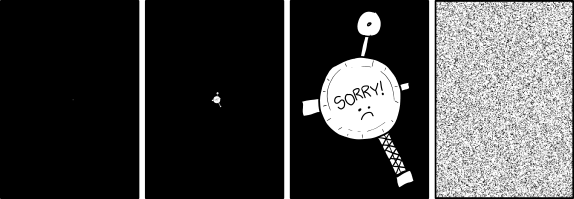
Hubble's last photo, what will it be?

*Hubble needs 3 gyros to be able to be controlled in the three axes. IIRC it has 6 (for redundancy). So I expect that when it gets down to 2 working gyros, they can't control it enough anymore (this is what I mean by the 'last gyro' failure, not getting down to zero working gyros)

I wonder if they will use Hubble right up until it becomes uncontrollable. NASA decided to deorbit the CGRO while it was still controllable. There don't seem to be any concrete plans for sending a robot to Hubble any time soon, either.
 
I wonder if they will use Hubble right up until it becomes uncontrollable. NASA decided to deorbit the CGRO while it was still controllable. There don't seem to be any concrete plans for sending a robot to Hubble any time soon, either.


From Wiki:

Servicing Mission 3A

Servicing Mission 3A, flown by Discovery, took place in December 1999, and was a split-off from Servicing Mission 3 after three of the six onboard gyroscopes had failed. A fourth failed a few weeks before the mission, rendering the telescope incapable of performing scientific observations. The mission replaced all six gyroscopes, replaced a Fine Guidance Sensor and the computer, installed a Voltage/temperature Improvement Kit (VIK) to prevent battery overcharging, and replaced thermal insulation blankets. The new computer is 20 times faster, with six times more memory, than the DF-224 it replaced. It increases throughput by moving some computing tasks from the ground to the spacecraft, and saves money by allowing the use of modern programming languages.


This indicates they may allow HST to fail before it goes down.
 
Well, Kepler is still operating even though it doesn't have the required number of gyros to do so perfectly. Granted, Kepler is far away from Earth but just because it doesn't have three gyros anymore won't mean Hubble is instantly inoperable.
 
I wonder if they will use Hubble right up until it becomes uncontrollable.

That is a possibility. Don't forget that during STS-125, the Soft Capture Mechanism was installed on Hubble, so that any spacecraft with that LIDS docking system (now deceased) could dock with it, whether it manned or unmanned.

Basically, I see no reason why a manned or unmanned spacecraft can't dock with a uncontrollable Hubble, which will, at the worse, just be tumbling or drifting. Crew have done uncooperative docking(s) before...
 
A photo of the James Webb Space Telescope!
 
Last edited:
If they do the deorbit right, it will be a fish. If they do it wrong, it will be the roof of your house.

Free telescope mirror for me if it hits my house!
 
Last edited:
The question is whether they would attempt that now. NASA has no room in its budget currently for a mission to Hubble, even looking forward to the 2020s.
Actually they do. The HST ops budget would be used to pay for and conduct the de-orbit mission.
 
Well, Kepler is still operating even though it doesn't have the required number of gyros to do so perfectly. Granted, Kepler is far away from Earth but just because it doesn't have three gyros anymore won't mean Hubble is instantly inoperable.

Kepler is not orbiting Earth, so it can use the constant solar energy to balance on its third axis while using its two functioning reaction wheels. This only enables the spacecraft to stare at one point (determined by where solar photons exert pressure on the spacecraft) in the sky for 83 days at a time. This mission design is not compatible with Hubble's purpose.

k2_explained_25nov_story_0.jpg


The major advantage Hubble has over ground based observatories is the ability to capture sharp images over a wide field of view. If the images are not sharp, like before the first servicing mission, the observatory is pointless.
 
The major advantage Hubble has over ground based observatories is the ability to capture sharp images over a wide field of view. If the images are not sharp, like before the first servicing mission, the observatory is pointless.

Not entirely. Before Sevicing Mission 1, Hubble was crippled with respect to its large optical component (and even that was still mitigated before COSTAR), but it had/has instruments not dependent on that mirror to do science return. It was still returning science data before SM-1.

The telescope isn't purely "visible light", but also studies in other wavelengths, such as ultraviolet. The COS, for example, does ultraviolet light. Even if the main optical component became faulty, COS would probably not be affected.
 
Not entirely. Before Sevicing Mission 1, Hubble was crippled with respect to its large optical component (and even that was still mitigated before COSTAR), but it had/has instruments not dependent on that mirror to do science return. It was still returning science data before SM-1.

The telescope isn't purely "visible light", but also studies in other wavelengths, such as ultraviolet. The COS, for example, does ultraviolet light. Even if the main optical component became faulty, COS would probably not be affected.

The science returned after failure of gyros would not justify the expenses of the telescope. Either it'd be repaired or deorbited.
 
Not entirely. Before Sevicing Mission 1, Hubble was crippled with respect to its large optical component (and even that was still mitigated before COSTAR), but it had/has instruments not dependent on that mirror to do science return. It was still returning science data before SM-1.

The telescope isn't purely "visible light", but also studies in other wavelengths, such as ultraviolet. The COS, for example, does ultraviolet light. Even if the main optical component became faulty, COS would probably not be affected.
It's true that the cause of Hubble's bad vision before the first servicing mission was caused by an improperly ground mirror, but the point is that the images weren't sharp. I assume if Hubble doesn't have enough working gyros, similar results will be obtained as before SM1. All of Hubble's instruments, from the spectrographs to cameras, will have their sensitivities and resolution significantly decreased if the telescope cannot point correctly.

While some wavelengths Hubble sees cannot be observed on the ground, continuing to fund a crippled, expensive flagship telescope seems unlikely with NASA's current budget. Even Spitzer's future is uncertain because the coolant was depleted (which doesn't affect all its observations), despite having unique capabilities.

For a much less convoluted response, just read RisingFury's post above mine.
 
Last edited:
Per Wikipedia [ame="http://en.wikipedia.org/wiki/Hubble_Space_Telescope"]Hubble Space Telescope - Wikipedia, the free encyclopedia[/ame] HST used to routinely work with only two active gyros, plus, it is unable to deorbit itself. Deorbiting will require a special mission to attach a propulsion module.

Thus the answer to the OP is "whatever happens to be the last image before the ultimate gyro failure".
 
Last edited:
If NASA want to keep space clean, then they would deorbit Hubble but I doubt they are that
"Space Friendly"?

---------- Post added at 07:04 PM ---------- Previous post was at 07:03 PM ----------

Can anybody else see a strange emojey in my post? A gun like this:??
 
The science returned after failure of gyros would not justify the expenses of the telescope. Either it'd be repaired or deorbited.

The issue is there's currently no way to do either and likely won't be when HST comes down.
 
Send a man-rated SpaceX Dragon when it becomes available with replacement parts in tucked away in the trunk section... :idea:

Hold on Hubble, hold on a little bit longer! :hail:
 
Back
Top