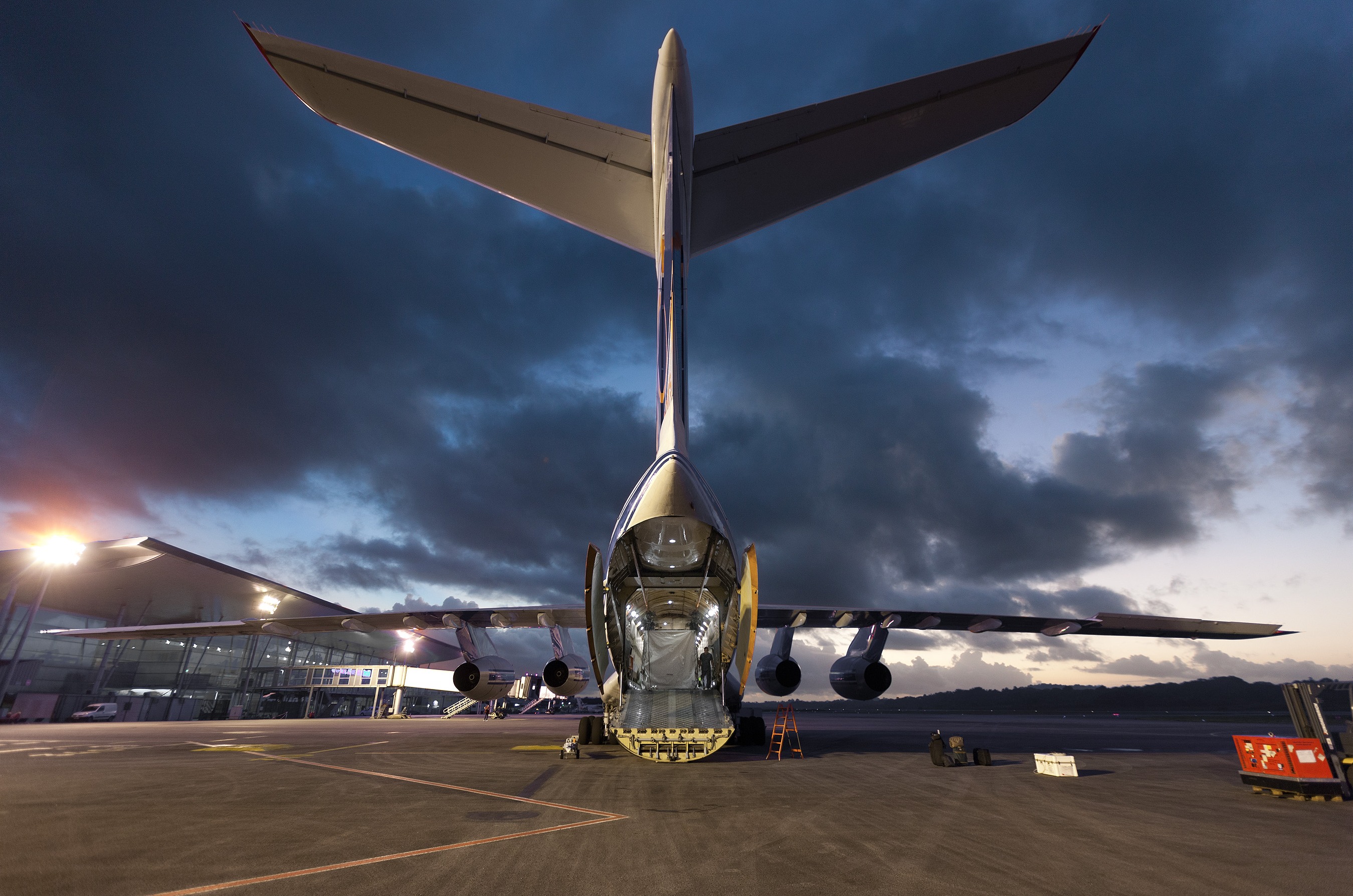
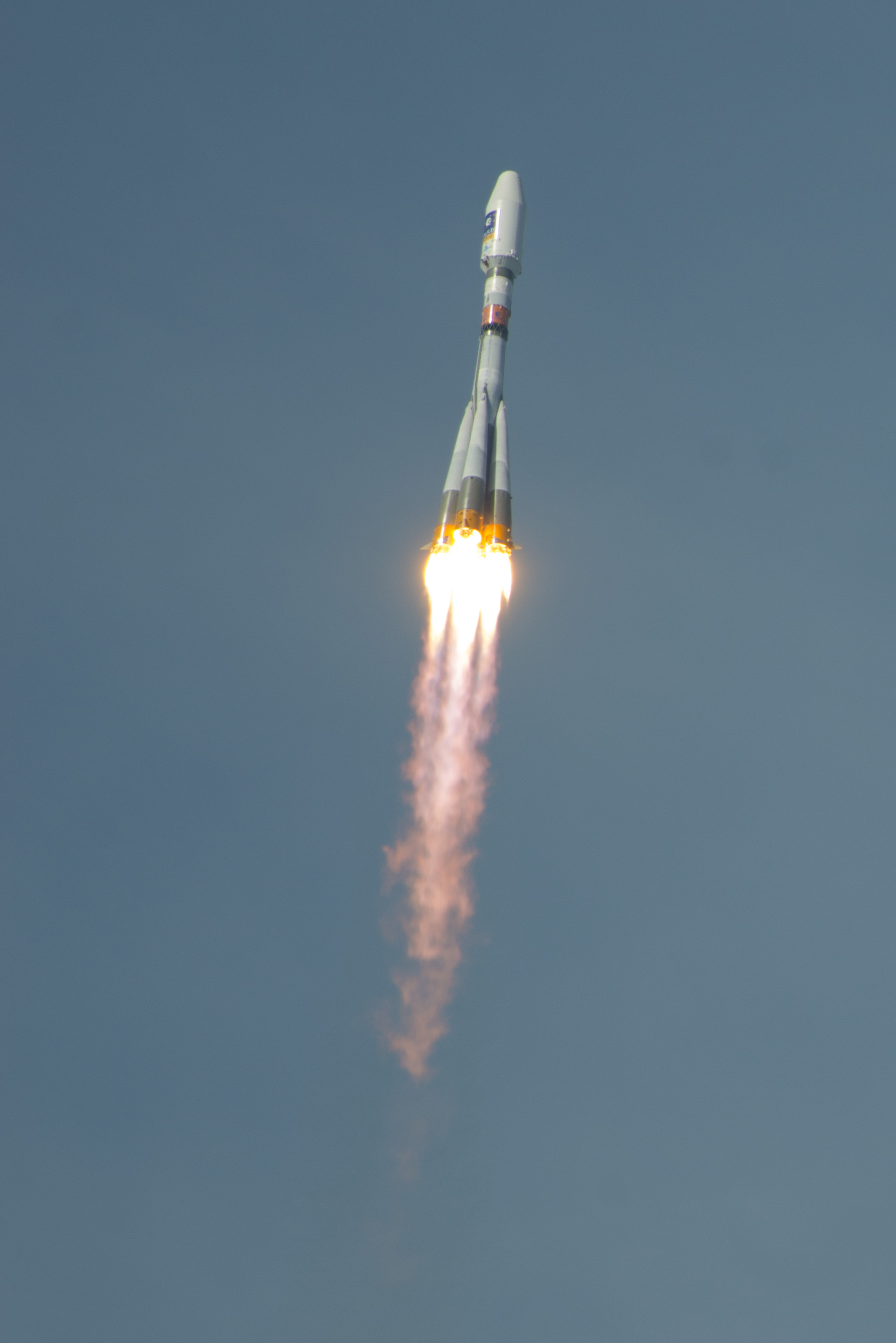
While all eyes are still on the "Falcon 8"  rofl and what happened on Sunday night, the good old master of the all-kerosene rocket club is making another flight again on Friday. It will be a tense moment though, because the last flight of the most powerful variant of the R-7 family ended in embarrassing failure last December, and the passengers on Arianespace flight VS03 are the second of two pairs of in-orbit testing satellites for the European Galileo navigation system, now lagging behind schedule for years but finally almost ready for large scale deployment. Barring weather and technological constraints, we should see a beautiful afternoon liftoff from the rain-forests of the northern Amazon on Friday.


Launch location:
Kourou ELS 5°18'18"N 52°50'02"W

Launch dates and times:
[table="head"]{colsp=7}Launch times (updated)
Time Zone|Australia - Sydney/AEST|Moscow / MSK/ UTC+4|CEDT UTC+2|Universal / UTC|Washington / EDT|French Guiana
Launch time:|05:15:01|22:15:01|20:15:01 |18:15:01|14:15:01|15:15:01
on:|Oct. 13, 2012|Oct. 12, 2012|Oct. 12, 2012|Oct. 12, 2012|Oct. 12, 2012|Oct. 12, 2012
{colsp=7}[highlight][eventTimer]2012-10-12 18:15:01?before|after;%dd% Days %hh% Hours %mm% Minutes %ss% Seconds %c%[/eventTimer] Galileo IOV-3/4 Launch[/highlight][/table]
Live Coverage
PAYLOADS 1/2
Galileo IOV-3/4 navigation satellites

The outcome of the first partnership between ESA and the European Commission, the 30-satellite Galileo navigation system will provide high-quality positioning, navigation and timing services to users across the whole world as a civil-controlled service offering guaranteed continuity of coverage.
Galileo’s Development and In-Orbit Validation phase was initiated in late 2003. This phase aims to perform an in-orbit validation of the system using a reduced constellation of four Galileo In-Orbit Validation (IOV) satellites – the minimum number to guarantee the provision of exact positioning and timing at test locations – in combination with Galileo’s terrestrial network of ground stations.
The first two IOV satellites were launched on 21 October 2011, with the next two following them in 2012. The four satellites perform a dual role, serving as a validation of the overall Galileo system while also being part the operational Galileo constellation – each IOV satellite being designed for a full 12-year lifespan providing navigation services to users worldwide.
Following launch of the IOV satellites, ESA’s ground station at Redu in Belgium will be employed first for the Launch and Early Phase (LEOP) and then, once the four satellites are operational, for the In-Orbit Test (IOT) programme.
This test programme will verify the performance of the navigation payload for the navigation signal: both the downlink (from the satellite, broadcast to users) and the uplink (from Galileo’s Ground Mission Segment, broadcast to the satellites for rebroadcast to users).
The results will be crucial to Galileo’s success, used to set benchmarks for their operational life and used as a reference across the entire Galileo constellation.
[table="head"]Characteristics|Values
Orbit| Medium-Earth orbit, altitude 23222 km, inclination 55.345°
Weight at launch|700 kg
Size (with solar wings stowed)|3.02 x 1.58 x 1.59 m
Size (with solar wings deployed)|2.74 x 14.5 x 1.59 m
Available power|1420 watts (sunlight) / 1355 watts (in eclipse)
Design life|more than 12 years
Prime contractor|EADS Astrium (platform) / Thales Alenia Space (assembly and testing)
Navigation payload|

Launch Vehicle:
[table="head"]{colsp=2}Characteristics
 |[table="head"]{colsp=2}

[/table]
[/table]
The launch vehicle's reliability standings
According to http://www.spacelaunchreport.com/log2012.html#rate:
Ascent profile


Weather Forecast for Sinnamary, French Guiana on October 12, 2012 (3 p.m.)
Overcast with a chance of rain, then a chance of a thunderstorm and rain in the afternoon. High of 32C with a heat index of 36C. Breezy. Winds from the ESE at 15 to 20 km/h. Chance of rain 50%.
References
http://www.esa.int/SPECIALS/Galileo_IOV/
http://www.arianespace.com
http://forum.nasaspaceflight.com
http://www.novosti-kosmonavtiki.ru
http://www.forum-conquete-spatiale.fr
http://www.spacelaunchreport.com
http://www.samspace.ru
http://www.laspace.ru
http://english.wunderground.com
rofl and what happened on Sunday night, the good old master of the all-kerosene rocket club is making another flight again on Friday. It will be a tense moment though, because the last flight of the most powerful variant of the R-7 family ended in embarrassing failure last December, and the passengers on Arianespace flight VS03 are the second of two pairs of in-orbit testing satellites for the European Galileo navigation system, now lagging behind schedule for years but finally almost ready for large scale deployment. Barring weather and technological constraints, we should see a beautiful afternoon liftoff from the rain-forests of the northern Amazon on Friday.
Launch location:
Kourou ELS 5°18'18"N 52°50'02"W
Launch dates and times:
[table="head"]{colsp=7}Launch times (updated)
Time Zone|Australia - Sydney/AEST|Moscow / MSK/ UTC+4|CEDT UTC+2|Universal / UTC|Washington / EDT|French Guiana
Launch time:|05:15:01|22:15:01|20:15:01 |18:15:01|14:15:01|15:15:01
on:|Oct. 13, 2012|Oct. 12, 2012|Oct. 12, 2012|Oct. 12, 2012|Oct. 12, 2012|Oct. 12, 2012
{colsp=7}[highlight][eventTimer]2012-10-12 18:15:01?before|after;%dd% Days %hh% Hours %mm% Minutes %ss% Seconds %c%[/eventTimer] Galileo IOV-3/4 Launch[/highlight][/table]
Live Coverage
- http://www.arianespace.tv/ - begins 20 minutes before the launch
PAYLOADS 1/2
Galileo IOV-3/4 navigation satellites
The outcome of the first partnership between ESA and the European Commission, the 30-satellite Galileo navigation system will provide high-quality positioning, navigation and timing services to users across the whole world as a civil-controlled service offering guaranteed continuity of coverage.
Galileo’s Development and In-Orbit Validation phase was initiated in late 2003. This phase aims to perform an in-orbit validation of the system using a reduced constellation of four Galileo In-Orbit Validation (IOV) satellites – the minimum number to guarantee the provision of exact positioning and timing at test locations – in combination with Galileo’s terrestrial network of ground stations.
The first two IOV satellites were launched on 21 October 2011, with the next two following them in 2012. The four satellites perform a dual role, serving as a validation of the overall Galileo system while also being part the operational Galileo constellation – each IOV satellite being designed for a full 12-year lifespan providing navigation services to users worldwide.
Following launch of the IOV satellites, ESA’s ground station at Redu in Belgium will be employed first for the Launch and Early Phase (LEOP) and then, once the four satellites are operational, for the In-Orbit Test (IOT) programme.
This test programme will verify the performance of the navigation payload for the navigation signal: both the downlink (from the satellite, broadcast to users) and the uplink (from Galileo’s Ground Mission Segment, broadcast to the satellites for rebroadcast to users).
The results will be crucial to Galileo’s success, used to set benchmarks for their operational life and used as a reference across the entire Galileo constellation.
[table="head"]Characteristics|Values
Orbit| Medium-Earth orbit, altitude 23222 km, inclination 55.345°
Weight at launch|700 kg
Size (with solar wings stowed)|3.02 x 1.58 x 1.59 m
Size (with solar wings deployed)|2.74 x 14.5 x 1.59 m
Available power|1420 watts (sunlight) / 1355 watts (in eclipse)
Design life|more than 12 years
Prime contractor|EADS Astrium (platform) / Thales Alenia Space (assembly and testing)
Navigation payload|
- Two Passive Hydrogen Maser atomic clocks
- Two Rubidium atomic clocks
- Clock monitoring and control unit
- Navigation signal generator unit
- L-band antenna for navigation signal transmission
- C-band antenna for up-link signal detection
- Two S-band antennas for telemetry and tele-commands
- Search and rescue antenna
Launch Vehicle:
[table="head"]{colsp=2}Characteristics
Soyuz-2.1b
Prime contractor:
|- Samara Space Sentre (Energia Holding enterprise)

GRAU Index:
|- 14A14
Height:
| 51.1 mDiameter:
| max 10.3 mLiftoff mass:
| 313 metric tonnesPayload mass:
| up to 7835 kg (a launch to LEO from Plesetsk)1st stage (boosters B, V, G, D):
|- 4 X RD-107 engines
- Propellants (T-1 Kerosene and LOX)
- Thrust/ISP in vacuum - / 320.2 s
- Thrust/ISP at sea level 85.6 tonnes / 263.3 s
2nd stage (core A):
|- 1 X RD-108 engine
- Propellants (T-1 Kerosene and LOX)
- Thrust/ISP in vacuum 94 tonnes / 320.6 s
- Thrust/ISP at sea level 80.8 tonnes / 257.7 s
3rd stage (block I):
|- 1 X RD-0124 engine
- Propellants (T-1 Kerosene and LOX)
- Thrust/ISP in vacuum 30.00 tonnes / 359 s
Upper Stage:
|
- GRAU Index: -
- Common Name: Fregat (meaning Frigate)
- Designer & Manufacturer: Lavochkin Association (NPO)
- Dimensions: Length 2.4 m, Diameter (max) 3.350 m
- Empty Mass 930 kg
- Propellants 5250 kg max
- Main Engine: 1 X S5.92
- Thrust in vacuum 2.0 tonnes of force (full power)
- Thrust in vacuum 1.4 tonnes of force (small power)
- ISP 333.2 s
Payload Fairing:
|- Diameter 3.7 m
- Length 7.7 m
[/table]
[/table]
The launch vehicle's reliability standings
According to http://www.spacelaunchreport.com/log2012.html#rate:
Code:
================================================================
Vehicle     Successes/Tries Realzd Pred  Consc. Last     Dates
                             Rate  Rate* Succes Fail
================================================================
Soyuz 2-1b/Fregat 6     7    .86  .78      0    12/23/11 2006-
Ascent profile
Weather Forecast for Sinnamary, French Guiana on October 12, 2012 (3 p.m.)
Overcast with a chance of rain, then a chance of a thunderstorm and rain in the afternoon. High of 32C with a heat index of 36C. Breezy. Winds from the ESE at 15 to 20 km/h. Chance of rain 50%.
References
http://www.esa.int/SPECIALS/Galileo_IOV/
http://www.arianespace.com
http://forum.nasaspaceflight.com
http://www.novosti-kosmonavtiki.ru
http://www.forum-conquete-spatiale.fr
http://www.spacelaunchreport.com
http://www.samspace.ru
http://www.laspace.ru
http://english.wunderground.com
Last edited: