Electric propulsion for VLEO satelites

sitha241

Donator
Donator
Joined
Feb 22, 2010
Messages
287
Reaction score
12
Points
33
Location
Zagreb
Hi guys, I hope some of you find this interesting.
I have been interested in space for a long time, ever since I was a kid, and eventually career path led me to founding my own R&D company and doing some cool space tech.
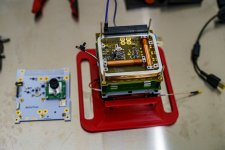
One of the things we work on is air-breathing electric propulsion engines, which are meant for VLEO operations and perpetual orbit maintenance without fuel onboard.
The cool thing about working with hardware is you get to see stuff working (eventually) and see it fly up.
I wonder could we simulate something like this in Orbiter?
 

Attachments

  • Velika stavka DSC04971.jpeg
    Velika stavka DSC04971.jpeg
    37.4 KB · Views: 10
perpetual orbit maintenance without fuel onboard
That... sounds interesting. How would it work?
I wonder could we simulate something like this in Orbiter?
A bit difficult to tell without additional detail, but probably yes. @Thunder Chicken has made an entire jet engine simulation, so air-breathing engines are not a show stopper.
 
That... sounds interesting. How would it work?

A bit difficult to tell without additional detail, but probably yes. @Thunder Chicken has made an entire jet engine simulation, so air-breathing engines are not a show stopper.
Hi jedidia!

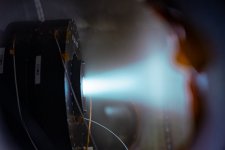
Solar provides the energy to ionize and propel any gas (usually atomic oxygen at those heights) with speed sufficient to add energy more to a satellite than atmospheric drag is removing. It is meant for very low earth orbit, low latency comms satellites.

System is comprised out of RF part for ionisation, intake and coils for accelerating the fuel.
 
I take it something like this?


It's basically an electric ramjet. This essentially produces thrust in the same manner as a jet engine, adding momentum to the reaction mass flowing through the engine. If you can determine the mass flow of air through the engine and the velocity of the air at the inlet and outlet, it should be possible to calculate the thrust.

The complications would be whether the air density is so low that the continuum assumption is invalid, and how to model the flow of plasma in the exhaust. Since it is moving at very high Mach number (20-30 for orbital operations I would imagine) you can still easily calculate the amount of air that flows into the engine based on ambient conditions. The challenge would then be figuring out the gas exhaust velocity based on the acceleration of the plasma and the expansion in the nozzle. This is not trivial as the gas particles are charged and do not behave like neutrally charged gas atoms.

Everything can be modeled. The question becomes whether you will be satisfied with a simple but approximate model or a complicated but accurate model. Unless you have test data to validate your model you will never know the difference.
 
Of course, you could also use Earths magnetic field for attitude control or propulsion....
 
I take it something like this?


It's basically an electric ramjet. This essentially produces thrust in the same manner as a jet engine, adding momentum to the reaction mass flowing through the engine. If you can determine the mass flow of air through the engine and the velocity of the air at the inlet and outlet, it should be possible to calculate the thrust.

The complications would be whether the air density is so low that the continuum assumption is invalid, and how to model the flow of plasma in the exhaust. Since it is moving at very high Mach number (20-30 for orbital operations I would imagine) you can still easily calculate the amount of air that flows into the engine based on ambient conditions. The challenge would then be figuring out the gas exhaust velocity based on the acceleration of the plasma and the expansion in the nozzle. This is not trivial as the gas particles are charged and do not behave like neutrally charged gas atoms.

Everything can be modeled. The question becomes whether you will be satisfied with a simple but approximate model or a complicated but accurate model. Unless you have test data to validate your model you will never know the difference.
Yes kinda simmilar :D
 
Of course, you could also use Earths magnetic field for attitude control or propulsion....
Yes, we use those in cubesats, they are called magnetotorquers for attitude control, cheap and effective. Pictured here is one from the first Croatian cubesat my company helped make and is bound to launch soon on SpaceX's Falcon9 on one of Transporter or Bandwagon missions.
 

Attachments

  • Velika stavka DSC07426.jpeg
    Velika stavka DSC07426.jpeg
    70.6 KB · Views: 12
On the side note, is anyone on this forum interested in space hardware? I would like to put my own photos and explanations (when not NDA problematic) about hardware design, electronics etc. I can occasionally make post about that stuff if anyone is interested.
 
On the side note, is anyone on this forum interested in space hardware? I would like to put my own photos and explanations (when not NDA problematic) about hardware design, electronics etc. I can occasionally make post about that stuff if anyone is interested.
As an electronics guy, definitely count me interested.
 
Back
Top