Idea Delta Glider Zero

RGClark, I am very tired of explaining this.
What part of "rocket propellant tanks need to be a dedicated structure as there are dedicated demands on them" and "you can't just fill the internal volume with propellant" do you not understand?
This has been explained multiple times over and over again.
Your only option is to try and make a dedicated propellant tank that is light enough for your needs, inside a vehicle that is light enough for your needs. And this is of course very difficult, but that is how the game goes.

Yes you can. For every orbital rocket they are essentially just flying fuel tanks. I'm filling the same amount of volume for these proposed SSTO's as for usual rockets.
It's not that difficult if you use composites for your structures.

Boeing proposes SSTO system for AF RBS program.
The new issue of Aviation Week has a brief blurb about a Boeing
proposal for the Air Force's Reusable Booster System (RBS) program:
Boeing Offers AFRL Reusable Booster Proposal - AvWeek - June.13.11
(subscription required).
"Darryl Davis, who leads Boeing's Phantom Works, tells AvWeek that
they are proposing a 3-4 year technology readiness assessment that
would lead up to a demonstration of a X-37B type of system
but would be smaller. Wind tunnel tests have been completed. Davis
says the system would be a single stage capable of reaching low Earth
orbit and, with a booster, higher orbits. The system would return to
Earth as a glider.
Davis says "that advances in lightweight composites warrant another
look" at single-stage-to-orbit launchers."
http://www.hobbyspace.com/nucleus/index.php?itemid=30110


Bob Clark
 
No, you cannot. It is not about the volume, it is about how the shell that contains that volume is constructed.

You can't just use the skin of the vehicle like that. Sorry.

Have you ever built anything out of composites? Have you ever built a rocket propellant tank out of composites? Composites are not a be-all, end-all, solve-all.

And of course you have all sorts of other stuff in that internal volume. You can't magically make that go away. Putting it in an external pod puts you at a loss, really.
 
Last edited:
:hesaid:

Because of the very high pressures they have to deal with, the propellant & oxydizer tanks have to be spherical or cylindrical with spherical ends. Those shapes are the more able to withstand high pressures. The same apply to pressurant tanks (usually He or N), that keep the main tanks pressurized as they deplete, almost always spherical.

So it's a strong limitation when it comes to spacecraft design, you can't put them anywhere.
 
You can also have ellipsoidal tank ends, many launch vehicles do this- see the shuttle external tank, Saturn V stages, Delta IV upper stages, etc.

I think it saves length and therefore mass. Still sound as a pressure vessel though.
 
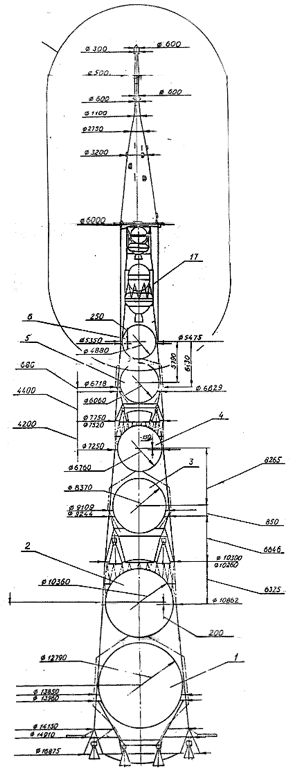
The N-1 is a perfect exemple of that : they used only (huge) spherical tanks, pressurizing them as much as possible :

n1cut4.jpg
 
No, you cannot. It is not about the volume, it is about how the shell that contains that volume is constructed.
You can't just use the skin of the vehicle like that. Sorry.
Have you ever built anything out of composites? Have you ever built a rocket propellant tank out of composites? Composites are not a be-all, end-all, solve-all.
And of course you have all sorts of other stuff in that internal volume. You can't magically make that go away. Putting it in an external pod puts you at a loss, really.

For orbital rockets its the pressurized fuel tanks that support the structural loads during flight. The other components are just hanging off the fuel tanks.
Composites don't have to be magic. They only have to be good enough. It's the reason why Boeing uses composite design for the reusable X-37B spacecraft. It's the reason why Rutan uses all composite design for the WhiteKnightTwo and SpaceShipTwo. It's the reason why the Air Force wants all composite design for its Reusable Booster System (RBS) program. It's the reason why Boeing when it looked at the Air Force requirements for using all composite design including the fuel tanks for the RBS program realized that meant you could actually get a SSTO under those conditions.
It's not a coincidence. The fact that you can save weight using composites actually means something.
I am not the expert. Boeing is. They are using largely composites in their 787 Dreamliner aircraft and in the X-37B spacecraft. I think they know how much weight you can save using composites.


Bob Clark
 
Too big to attach here - here's a link to the Composite Material Flammability Teleconference (NCAM & NASA 2002) that's got some really interesting info on composites.

Be sure to check out both Boeing and Lockheed's piggy-back spacecraft concepts on pages 116 and 117!

From page 12:
Lightweight Composite Hydrogen Tank
A new lightweight composite hydrogen tank for the Delta
Clipper-Experimental Advanced (DC-XA) vehicle, an unpiloted,
single-stage rocket being developed by NASA and McDonnell
Douglas Aerospace, has successfully completed testing at the
Marshall Space Flight Center, Huntsville, AL.
"This is really quite a breakthrough," said NASA's DC-XA
project manager Dan Dumbacher. "This is the largest composite
hydrogen tank ever to successfully survive flight operating
conditions. It demonstrates that composite tanks can be used
for other reusable launch vehicles in the future." "This will be the first
graphite epoxy cryogenic fuel tank to undergo flight testing," said Dave
Schweikle, McDonnell Douglas DC-XA program manager. "The tank
was designed and fabricated by McDonnell Douglas to hold liquid
hydrogen at minus 423 degrees Fahrenheit and to serve as an integral
part of the DC-XA's structure."

http://www.ericgreeneassociates.com/images/NASA_Fire_Workshop.pdf
 
Back
Top