

Another day, another Proton launch, and one that has a closer to home feeling to me! This time AsiaSat 7 of AsiaSat, based in Hong Kong, my hometown (with their satellite control center just 20 kilometers away from my home!), will be launched towards geostationary orbit. It will provide communication services across the Asia Pacific.
AsiaSat 7 will replace AsiaSat 3S (which will reach its age limit in 2014) at the orbital location of 105.5 degrees East. Based on the Space Systems/Loral 1300 platform, AsiaSat 7 will support a broad range of applications for the Asia-Pacific region, including television broadcast and VSAT networks.
AsiaSat 7 will carry 28 C-band and 17 Ku-band transponders, and a Ka-band payload. Its regionwide high power C-band beam covers Asia, the Middle East, Australasia and Central Asia, with Ku-band beams serving East Asia, South Asia and a steerable Ku beam.
The launch of AsiaSat 7, well ahead of the planned date for AsiaSat 3S’s replacement, is a testament to AsiaSat’s continued commitment to quality, reliability and uninterrupted services.
The AsiaSat-7 mission will be the 8th Proton launch of 2011 and the 371th Proton flight overall.
This will be the fifth commercial mission of the year for ILS and the 69th ILS Proton mission since the Proton April 1996 first commercial flight.
This will also be the 4th AsiaSat satellite launched with Proton. In addition, AsiaSat 7 will be the 20th Space Systems/Loral satellite launched on Proton.


Launch location:
Baikonur Launch pad no. 200/39 46° 2'23.85"N, 63° 1'54.98"E
Launch dates and times:
[table="head"]{colsp=6}Launch times
Time Zone|
{colsp=6}
[/table]
Live Coverage Of The Launch:
PAYLOAD
AsiaSat 7 communication satellite:


Mission Summary
AsiaSat 7, a Fixed Satellite Services (FSS) spacecraft, replaces and expands upon the services provided by AsiaSat 2 at 100.5 degrees east longitude. The satellite's payload carries both C- and Ku-band transponders and has a 15-year mission life. With some 300 digital television channels delivered by the company's satellites, AsiaSat provides services to both the broadcast and telecommunications industries across the Asia Pacific region.
[table="head"]{colsp=2}Summary
Parameter|Value
[/table]
[table="head"]Characteristics|
|
 [/table]
Launch Vehicle:
[table="head"]{colsp=2}Characteristics
 |[table="head"]{colsp=2}

[/table]
[/table]
The vehicle's reliability statistics according to http://www.spacelaunchreport.com/log2011.html#rate:
AsiaSat 7 Ascent Profile
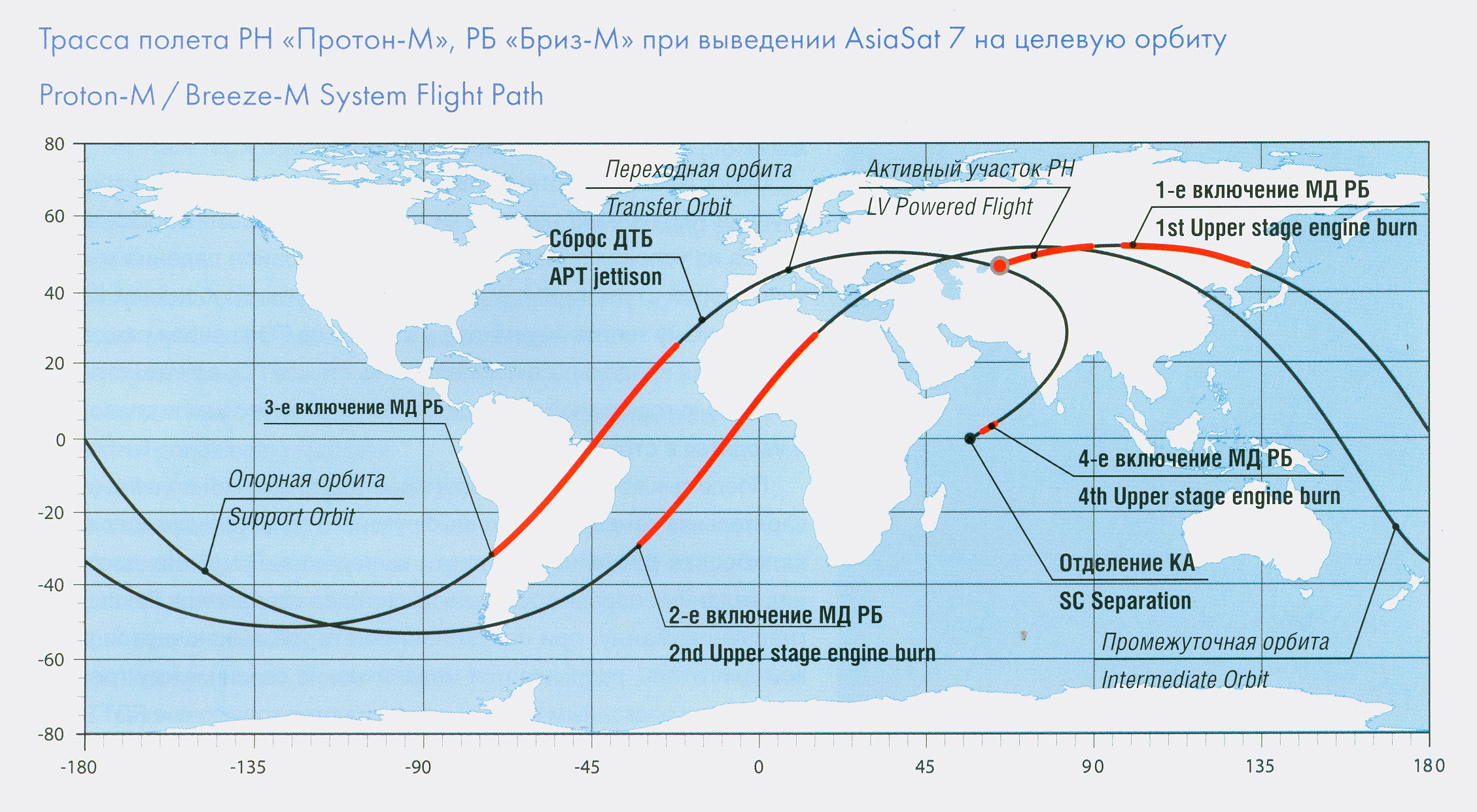
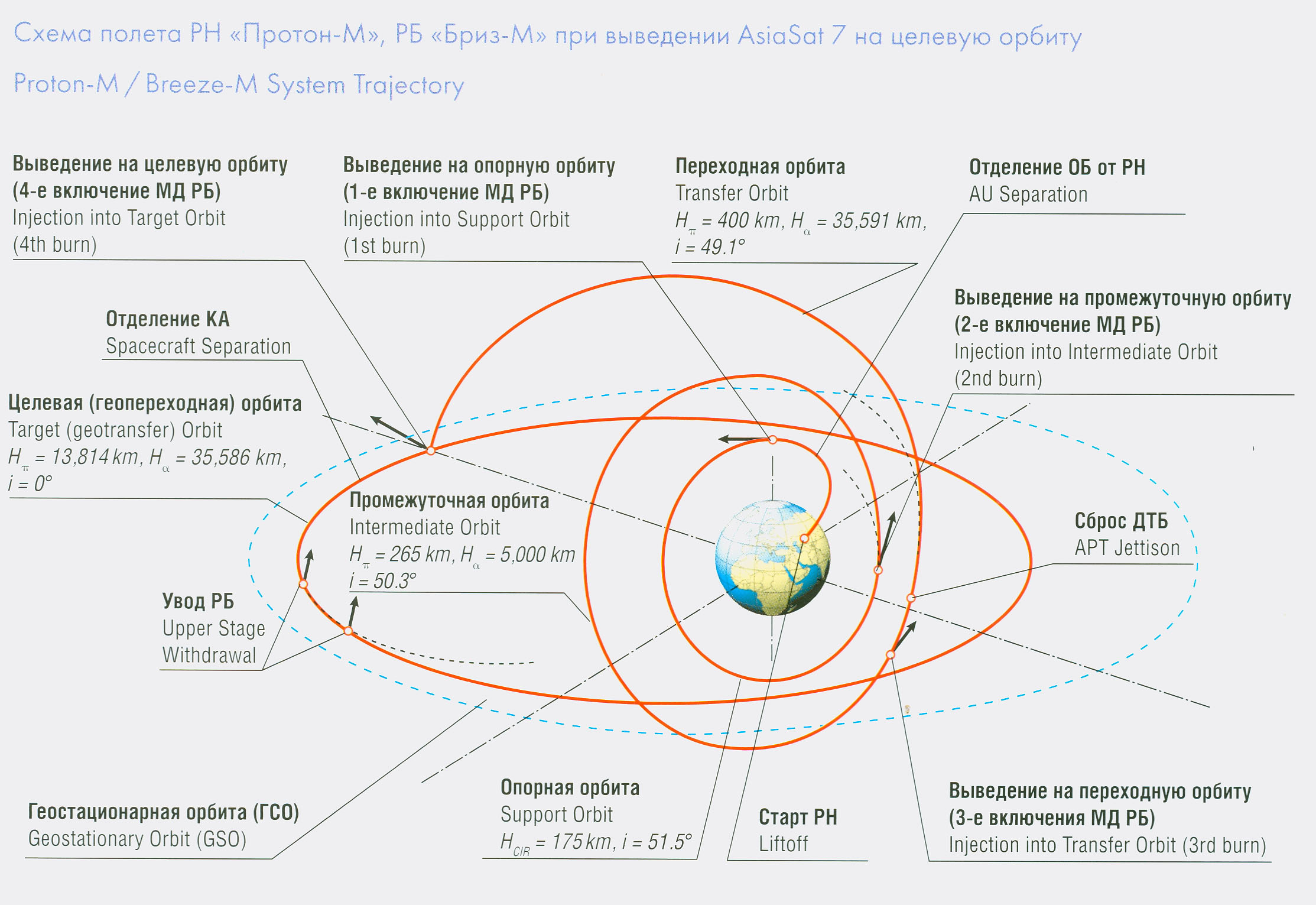
The Proton-M first three stages place the orbital unit (OU), which consists of a Breeze-M upper stage, adapter system and AsiaSat 7, into 51.5° inclination suborbital trajectory.
Proton-M powered flight lasts 582 seconds. The OU powered flight begins at the moment of the third stage separation.
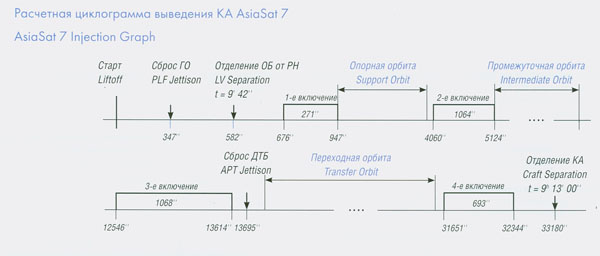
Immediately after the separation of the third stage booster, the Breeze-M stability engines start, damping the angular velocities of the third stage separation and then providing orbital unit orientation and stability during coast flight along a suborbital trajectory to await the first burn. The upper stage follows a five-burn injection profile.
AsiaSat 7 Ascent Timeline
[TABLE="head"]Event|Time rel lift-off|Time UTC|Comment
Ignition Start Sequence|-00:00:02.5|19:10:31.5 (Nov 25th)|
Stage 1 Ignition (40% thrust)|-00:00:01.75|19:10:32.25|
Command Stage 1 (100% thrust)|-00:00:00.9|19:10:33.1|
Maximum Dynamic Pressure|00:01:02|19:11:36|
1st/2nd Stage Separation|00:02:00|19:12:34|
2nd/3rd Stage Separation|00:05:27|19:16:01|
Payload Fairing Separation|00:05:48|19:16:22|
3rd Stage/Breeze M Separation|00:09:42|19:20:16|
1st Burn Ignition|00:11:16|19:21:50|
1st Burn Shutdown|00:15:47|19:26:21|1st Burn's Duration 00:04:31
2nd Burn Ignition|01:07:40|20:18:14|
2nd Burn Shutdown|01:25:24|20:35:58|2nd Burn's Duration 00:17:44
3rd Burn Ignition|03:29:06|23:39:40|
3rd Burn Shutdown|03:46:54|23:57:28|3rd Burn's Duration 00:17:48
APT Jettison|03:48:15|23:58:49|
4th Burn Ignition|08:47:31|03:58:05(Nov 26th)|
4th Burn Shutdown|08:59:04|04:09:38|4th Burn's Duration 00:11:33
Spacecraft Separation|09:13:00|04:23:34|
[/TABLE]
Weather forecast for Baikonur, Kazakhstan on November 25, 2011 (8 p.m.)
Time|Temps|Wind|Chill|Dew Point|Relative Humidity| Ceiling|Visibility|Wind|
8 PM|-6°C|-9°C|-6°C|-8°C|80%|10000 ft.|6 mi.|4 mph W|
 Overcast
Sunrise/Sunset and associated twilight times for Baikonur on Saturday, November 26, 2011
Times are local.
Event|Time
Astronomical twilight begins|07 : 16
Nautical twilight begins|07 : 52
Civil twilight begins|08 : 29
Sunrise|09 : 01
Transit (sun is at its highest)|13 : 35
Sunset|18 : 08
Civil twilight ends|18 : 40
Nautical twilight ends|19 : 17
Astronomical twilight ends|19 : 53
References
http://www.federalspace.ru
http://tvroscosmos.ru
http://www.khrunichev.ru
http://www.ilslaunch.com
http://tihiy.fromru.com/Rn/RN_Proton.htm
http://www.asiasat.com
http://www.ssloral.com
http://www.tsenki.com
http://forum.nasaspaceflight.com
http://www.novosti-kosmonavtiki.ru
http://www.spacelaunchreport.com
http://www.intellicast.com/Local/Forecast.aspx
http://www.good-stuff.co.uk/suntimes/sunmap.php
Pictures and Videos:


AsiaSat 7 will replace AsiaSat 3S (which will reach its age limit in 2014) at the orbital location of 105.5 degrees East. Based on the Space Systems/Loral 1300 platform, AsiaSat 7 will support a broad range of applications for the Asia-Pacific region, including television broadcast and VSAT networks.
AsiaSat 7 will carry 28 C-band and 17 Ku-band transponders, and a Ka-band payload. Its regionwide high power C-band beam covers Asia, the Middle East, Australasia and Central Asia, with Ku-band beams serving East Asia, South Asia and a steerable Ku beam.
The launch of AsiaSat 7, well ahead of the planned date for AsiaSat 3S’s replacement, is a testament to AsiaSat’s continued commitment to quality, reliability and uninterrupted services.
The AsiaSat-7 mission will be the 8th Proton launch of 2011 and the 371th Proton flight overall.
This will be the fifth commercial mission of the year for ILS and the 69th ILS Proton mission since the Proton April 1996 first commercial flight.
This will also be the 4th AsiaSat satellite launched with Proton. In addition, AsiaSat 7 will be the 20th Space Systems/Loral satellite launched on Proton.
Launch location:
Baikonur Launch pad no. 200/39 46° 2'23.85"N, 63° 1'54.98"E
Launch dates and times:
[table="head"]{colsp=6}Launch times
Time Zone|
Baikonur / UTC+6
| Hong Kong / UTC+8
| Universal / UTC
| Washington / EST
| Los Angeles / PST
Launch time (Primary):
|01:10:34
|03:10:34
|19:10:34
|14:10:34
|11:10:34
on:
|Nov. 26, 2011
|Nov. 26, 2011
|Nov. 25, 2011
|Nov. 25, 2011
|Nov. 25, 2011
{colsp=6}
[highlight][eventTimer]2011-11-25 19:10:34?before|after;%dd% Days %hh% Hours %mm% Minutes %ss% Seconds %c%[/eventTimer] AsiaSat 7 Launch[/highlight]
[/table]
Live Coverage Of The Launch:
- International Launch Services: http://asiasat7.imgondemand.com/ (begins at 20 minutes before lift-off)
- TSENKI Video Streams: http://www.tv-tsenki.com/livechoose.php
- Khrunichev COOPI (login: ? password: ?): http://coopi.khrunichev.ru/main.php?id=200
- Owners of PDA can watch the launch in test mode on: http://www.space-center.ru
PAYLOAD
AsiaSat 7 communication satellite:
Mission Summary
AsiaSat 7, a Fixed Satellite Services (FSS) spacecraft, replaces and expands upon the services provided by AsiaSat 2 at 100.5 degrees east longitude. The satellite's payload carries both C- and Ku-band transponders and has a 15-year mission life. With some 300 digital television channels delivered by the company's satellites, AsiaSat provides services to both the broadcast and telecommunications industries across the Asia Pacific region.
[table="head"]{colsp=2}Summary
Parameter|Value
Working Orbit:
|GEOOrbital Location:
|105.5° EastCoverage:
|Middle and Eastern AsiaApA at separation:
|35586 kmPeA at separation:
|13814 kmInc at separation:
|0°[/table]
[table="head"]Characteristics|
AsiaSat 7
Customer:
|- Asia Satellite Telecommunications Co. Ltd
Prime contractor:
|- Space Systems / Loral

Platform:
|- Space Service Loral LS-1300S
Mass at Separation:
|- 3760 kg
Dry Mass:
|- ?
Stabilization:
|- 3 axis stabilized
Dimensions (stowed):
|- 2779 mm x 3408 mm x 6460 mm
Batteries:
|- ?
Communication Payload:
|- 28 C-band transponders
- 17 Ku-band transponders
- 1 Ka-band transponder
Life time:
|- 15 years
|
Launch Vehicle:
[table="head"]{colsp=2}Characteristics
Proton-M / Briz-M
Prime contractor:
|- Khrunichev Space Centre

GRAU Index:
|- 8K82KM
Height:
| 58.2 m with upper stage and payload fairingDiameter:
| max 7.4 mLiftoff mass:
| 705 metric tonnesPayload mass:
| ~22 tonnes at LEO1st stage:
|- 6 X RD-275 engines
- Empty 30.6 tonnes
- Propellants 419.41 tonnes (UDMH and NTO)
- Thrust in vacuum 1069.8 tonnes of force
- Thrust at sea level 971.4 tonnes of force
2nd stage:
|- 1 X RD-0211 engine 3 X RD-0210 engines
- Empty 11.4 tonnes
- Propellants 156.113 tonnes (UDMH and NTO)
- Thrust in vacuum 237.4 tonnes of force
3rd stage:
|- 1 X RD-0213 engine & 1 X RD-0214 vernier engine
- Empty 3.7 tonnes
- Propellants 46.562 tonnes (UDMH and NTO)
- Thrust in vacuum 59.36 (core) + 3.15 (vernier) tonnes of force
Upper Stage:
|
- GRAU Index: 14S43
- Common Name: Briz-M
- Designer & Manufacturer: Khrunichev Space Centre
- Dimensions: Length 2.654 m, Diameter 4 m
- Empty Mass 2.2 tonnes
- Propellants 6 660 kg UDMH + 13 260 kg N2O4
- Flight time: no less than 24 hours
- Main Engine: 1 X 14D30
- Thrust in vacuum 2.0 tonnes of force
- ISP 328.6 s
- Main engine restarts: up to 8 times
- Precision Manoeuvering Engines: 4 X 11D458
- Thrust in vacuum 400 N each
- ISP 252 s
- RCS Engines: 12 X 17D58E
- Thrust in vacuum 13.3 N each
- ISP 274 s
Payload Fairing:
|- Diameter 4.35 m
- Length 11.6 m
[/table]
[/table]
The vehicle's reliability statistics according to http://www.spacelaunchreport.com/log2011.html#rate:
Code:
================================================================
Vehicle     Successes/Tries Realzd Pred  Consc. Last     Dates
                             Rate  Rate* Succes Fail
================================================================
Proton-M/Briz-M  46    50    .92  .90      4    08/17/11 2001-
AsiaSat 7 Ascent Profile
The Proton-M first three stages place the orbital unit (OU), which consists of a Breeze-M upper stage, adapter system and AsiaSat 7, into 51.5° inclination suborbital trajectory.
Proton-M powered flight lasts 582 seconds. The OU powered flight begins at the moment of the third stage separation.
Immediately after the separation of the third stage booster, the Breeze-M stability engines start, damping the angular velocities of the third stage separation and then providing orbital unit orientation and stability during coast flight along a suborbital trajectory to await the first burn. The upper stage follows a five-burn injection profile.
AsiaSat 7 Ascent Timeline
[TABLE="head"]Event|Time rel lift-off|Time UTC|Comment
Ignition Start Sequence|-00:00:02.5|19:10:31.5 (Nov 25th)|
Stage 1 Ignition (40% thrust)|-00:00:01.75|19:10:32.25|
Command Stage 1 (100% thrust)|-00:00:00.9|19:10:33.1|
Maximum Dynamic Pressure|00:01:02|19:11:36|
1st/2nd Stage Separation|00:02:00|19:12:34|
2nd/3rd Stage Separation|00:05:27|19:16:01|
Payload Fairing Separation|00:05:48|19:16:22|
3rd Stage/Breeze M Separation|00:09:42|19:20:16|
1st Burn Ignition|00:11:16|19:21:50|
1st Burn Shutdown|00:15:47|19:26:21|1st Burn's Duration 00:04:31
2nd Burn Ignition|01:07:40|20:18:14|
2nd Burn Shutdown|01:25:24|20:35:58|2nd Burn's Duration 00:17:44
3rd Burn Ignition|03:29:06|23:39:40|
3rd Burn Shutdown|03:46:54|23:57:28|3rd Burn's Duration 00:17:48
APT Jettison|03:48:15|23:58:49|
4th Burn Ignition|08:47:31|03:58:05(Nov 26th)|
4th Burn Shutdown|08:59:04|04:09:38|4th Burn's Duration 00:11:33
Spacecraft Separation|09:13:00|04:23:34|
[/TABLE]
Weather forecast for Baikonur, Kazakhstan on November 25, 2011 (8 p.m.)
8 PM|-6°C|-9°C|-6°C|-8°C|80%|10000 ft.|6 mi.|4 mph W|
Sunrise/Sunset and associated twilight times for Baikonur on Saturday, November 26, 2011
Times are local.
Astronomical twilight begins|07 : 16
Nautical twilight begins|07 : 52
Civil twilight begins|08 : 29
Sunrise|09 : 01
Transit (sun is at its highest)|13 : 35
Sunset|18 : 08
Civil twilight ends|18 : 40
Nautical twilight ends|19 : 17
Astronomical twilight ends|19 : 53
References
http://www.federalspace.ru
http://tvroscosmos.ru
http://www.khrunichev.ru
http://www.ilslaunch.com
http://tihiy.fromru.com/Rn/RN_Proton.htm
http://www.asiasat.com
http://www.ssloral.com
http://www.tsenki.com
http://forum.nasaspaceflight.com
http://www.novosti-kosmonavtiki.ru
http://www.spacelaunchreport.com
http://www.intellicast.com/Local/Forecast.aspx
http://www.good-stuff.co.uk/suntimes/sunmap.php
Pictures and Videos:
Last edited:


