Umm, with this launch being yet another "run of the mill" twin communication satellites launch, I'm running out of words to make an introduction. :rofl:
So without further ado, let's introduce the two passengers on the way today that will provide communication links across the southern hemisphere.....
Launch location:
Kourou Launch pad ELA-3 5° 14'06.34"N, 52° 46'06.34"W
Launch dates and times:
[table="head"]{colsp=7}Launch times
Time Zone|
Kourou / UTC-3
|
Rio de Janeiro / UTC-2
|
Paris /CEST
|
Universal / UTC
|
Washington / EST
|
Los Angeles / PST
Launch time (Primary):
|
18:05
|
19:05
|
22:05
|
21:05
|
16:05
|
13:05
on:
|
Nov. 10, 2012
|
Nov. 10, 2012
|
Nov. 10, 2012
|
Nov. 10, 2012
|
Nov. 10, 2012
|
Nov. 10, 2012
{colsp=7}
[highlight][eventTimer]2012-11-10 21:05:00?before|after;%dd% Days %hh% Hours %mm% Minutes %ss% Seconds %c%[/eventTimer] Ariane flight VA-210 Launch[/highlight]
[/table]
Live Coverage Of The Launch:
PAYLOAD 1
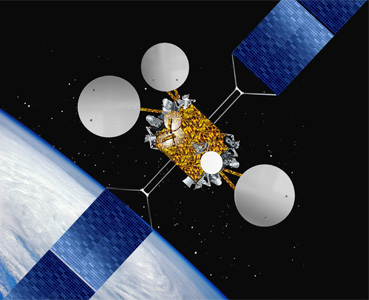
Eutelsat 21B communication satellite:
Mission Summary
Eutelsat Communications announced in June 2010 that it has selected Thales Alenia Space to build the 40-transponder Ku-band satellite Eutelsat W6A enabling a 50% increase in capacity operated at its 21.5° East location in geostationary orbit. Scheduled for launch in third quarter 2012, the satellite will replace Eutelsat‘s W6 craft at a core neighbourhood anchored for data, professional video and government services across Europe, North Africa, the Middle East and Central Asia.
Weighing in at five tons, the new satellite will be based on the Thales Alenia Space Spacebus C3 platform, with a scheduled in-orbit lifetime exceeding 15 years. It will be equipped with one broad footprint sweeping across Europe into North Africa and Central Asia, and two dedicated high-power beams to add increased flexibility for regional coverage of North Africa and the Middle East.
In December 2011 Eutelsat announced, that their satellite assets will be renamed under a unified brand name effective from March 2012. This satellite will become Eutelsat 21B.
[table="head"]{colsp=2}Summary
Parameter|
Value
Working Orbit:
|
GEO
Orbital Location:
|
21.5° East
Coverage:
|
Europe, Africa, Middle East
ApA at separation:
|
35925 km
PeA at separation:
|
249.4 km
Inc at separation:
|
2°
[/table]
[table="head"]Characteristics|
Eutelsat 21B
Customer:
|
Prime contractor:
|
Platform:
|
Mass at Separation:
|
Dry Mass:
|
Stabilization:
|
Dimensions (stowed):
|
Dimensions (deployed span):
|
On-board power:
|
Communication Payload:
|
Life time:
|
Transponders coverage:
|
|
|
|
|
[/table]
PAYLOAD 2
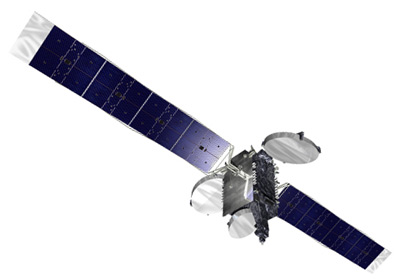
Star One C3 communication satellite:
Mission Summary
The Star One C3 satellite was ordered from Star One S.A. in March 2010 and will carry a hybrid payload and will be located at an orbital slot between 75 and 84 degrees West Longitude. Based on Orbital’s Enhanced Star-2.4 Bus, the spacecraft will carry 28 active C-band transponders for coverage of South America, and 16 Ku-band transponders with six switchable channels between Brazil and the Andean coverage region. Star One C3 will generate approximately five kilowatts of payload power and will feature two 2.3 meter deployable reflectors and one 1.4 meter earth deck-mounted antenna.
[table="head"]{colsp=2}Summary
Parameter|
Value
Working Orbit:
|
GEO
Orbital Location:
|
75° West
Coverage:
|
South America
ApA at separation:
|
35925 km
PeA at separation:
|
249.4 km
Inc at separation:
|
2°
[/table]
[table="head"]Characteristics|
Star One C3
Customer:
|
Prime contractor:
|
- Orbital Sciences Corporation
Platform:
|
Mass at Separation:
|
Dry Mass:
|
Stabilization:
|
Dimensions (stowed):
|
On-board power:
|
Payloads:
|
- 28 C-band transponders
- 16 Ku-band transponders
Life time:
|
Transponder coverage:
|
|
|
|
|
[/table]
Launch Vehicle:
[table="head"]{colsp=2}Characteristics
|[table="head"]{colsp=2}
Ariane 5 ECA
Prime contractor:
|
Height:
| 50.5 m with upper stage and payload fairing
Diameter:
| max 11.56 m
Liftoff mass:
| 780 metric tonnes
Payload mass:
| ~10 tonnes at GTO (1500 m/s to GEO)
SOLID ROCKET BOOSTER (EAP):
|
- 2 X P241 motor
- Empty 38 tonnes
- Propellants 240 tonnes (HTPB)
- Thrust in vacuum 700 tonnes of force
- Thrust at sea level 509.9 tonnes of force
CRYOGENIC MAIN CORE STAGE (EPC):
|
- 1 X Vulcain-2 engine
- Empty 14.7 tonnes
- Propellants 170 tonnes (LOX + LH2)
- Thrust in vacuum 139 tonnes of force
- Thrust at sea level 96 tonnes of force
CRYOGENIC UPPER STAGE (ESC-A):
|
- 1 X HM7B engine
- Empty 4.54 tonnes
- Propellants 14.9 tonnes (LOX + LH2)
- Thrust in vacuum 6.7 tonnes of force
Payload Fairing:
|
- Diameter 5.4 m
- Length 17 m
- Mass 2675 kg
[/table]
[/table]
The vehicle's
reliability statistics according to
http://www.spacelaunchreport.com/log2012.html#rate:
Code:
================================================================
Vehicle     Successes/Tries Realzd Pred  Consc. Last     Dates
                             Rate  Rate* Succes Fail
================================================================
Ariane 5-ECA     36    37    .97  .95     36    12/11/02 2002-
Ariane VA210 Ascent Profile
The launcher’s attitude and trajectory are totally controlled by the two onboard computers, located in the Ariane 5 vehicle equipment bay (VEB). 7.05 seconds after ignition of the main stage cryogenic engine at T-0, the two solid-propellant boosters are ignited, enabling liftoff. The launcher first climbs vertically for 6 seconds, then rotates towards the East. It maintains an attitude that ensures the axis of the launcher remains parallel to its velocity vector, in order to minimize aerodynamic loads throughout the entire atmospheric phase, until the solid boosters are jettisoned.
Once this first part of the flight is completed, the onboard computers optimize the trajectory in real time, minimizing propellant consumption to bring the launcher first to the intermediate orbit targeted at the end of
the main stage propulsion phase, and then the final orbit at the end of the flight of the cryogenic upper stage.
The main stage falls back off the coast of Africa in the Atlantic Ocean (in the Gulf of Guinea).
On orbital injection, the launcher will have attained a velocity of approximately 9352 meters/second, and will be at an altitude of about 654 kilometers.
The fairing protecting the Eutelsat 21B and Star One C3 spacecraft is jettisoned shortly after the boosters are jettisoned at about T+208 seconds.
Ariane VA210 Ascent Timeline
[TABLE="head"]Event|Time rel lift-off|Time UTC|Comment (altitude, velocity)
Start of synchronized sequence|-00:07:00|20:58:00|
Ignition of the cryogenic main stage engine (EPC)|00:00:00|21:05:00|
Liftoff (Ignition of solid boosters)|00:00:07.3|21:05:07.3|0 km 0 m/s
End of vertical climb and beginning of pitch rotation (10 seconds duration)|00:00:12.6|21:05:12.6|0.09 km 36.9 m/s
Beginning of roll manoeuvre|00:00:17|21:05:17|0.339 km 74.3 m/s
Jettisoning of solid boosters|00:02:22|21:07:22|67.9 km 2018 m/s
Payload Fairing Separation|00:03:28|21:08:28|115.2 km 2349 m/s
Shut-down of main cryogenic stage|00:08:51|21:13:51|180.4 km 6917 m/s
Separation of main cryogenic stage|00:08:57|21:13:57|178.7 km 6944 m/s
Ignition of upper cryogenic stage (ESC-A)|00:09:01|21:14:01|178.6 km 6946 m/s
Injection|00:24:58|21:29:58|654.6 km 9352 m/s
Separation of Eutelsat 21B satellite|00:28:03|21:33:03|1132.2 km 8960 m/s
Separation of Sylda 5|00:29:36|21:34:36|1426.8 km 8735 m/s
Separation of Star One C3 satellite|00:33:17|21:38:17|2217.6 km 8183 m/s
[/TABLE]
Weather forecast for Kourou, French Guiana on November 10, 2012 (6 p.m.)
Partly cloudy. Fog early. High of 33C. Breezy. Winds from the East at 10 to 20 km/h.
References
http://www.arianespace.com
http://www.videocorner.tv
http://www.eutelsat.com
http://www.orbital.com/SatellitesSpace/Communications/StarOne/
http://www.arianespace.com/images/launch-kits/launch-kit-pdf-eng/VA210-Eutelsat21B-StarOneC3-EN.pdf
http://english.wunderground.com
http://forum.nasaspaceflight.com
http://www.satbeams.com
http://www.satlaunch.net
http://www.spacelaunchreport.com
http://space.skyrocket.de









 Flight V210 Ariane 5, EUTELSAT 21B – STAR ONE C3 Launch Kit


