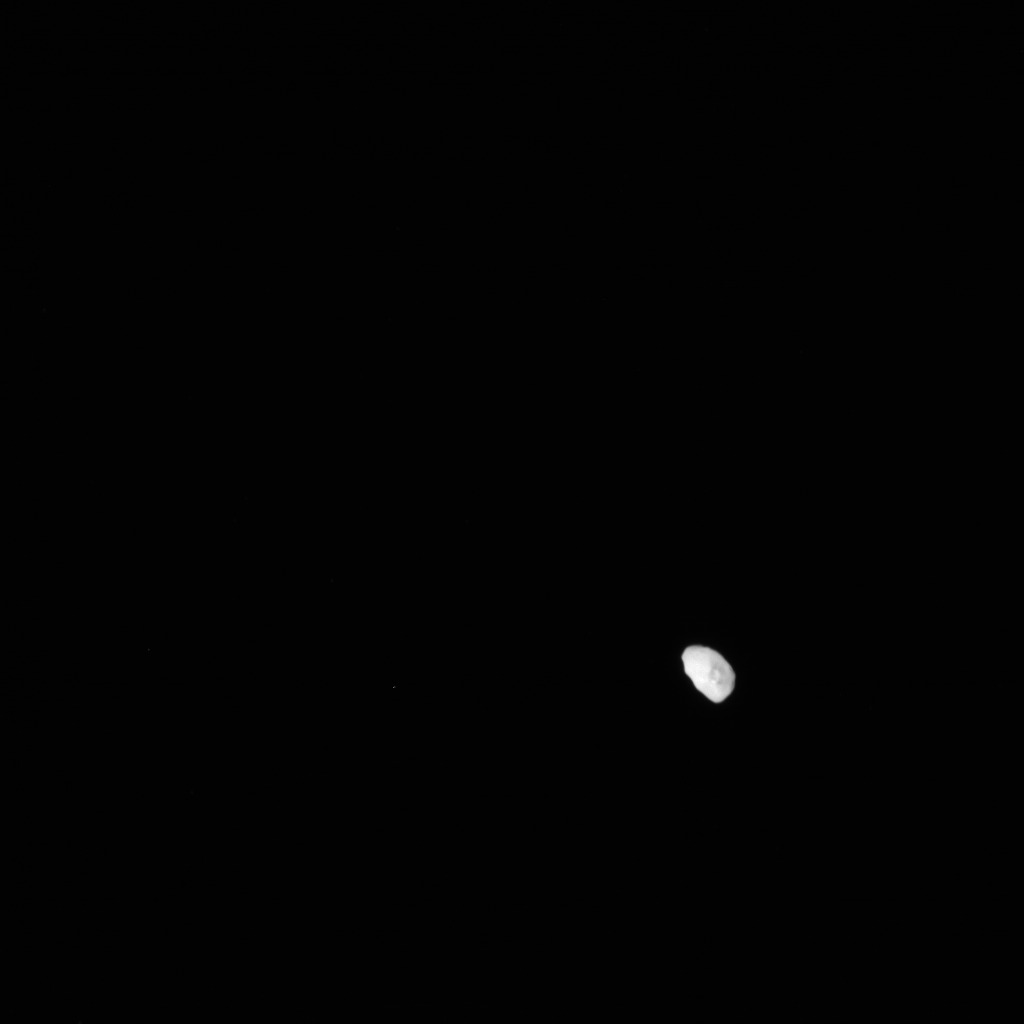
Updates NASA New Horizons Mission Updates

New target chosen for New Horizons:

http://news.yahoo.com/beyond-pluto-2nd-target-chosen-horizons-probe-233205157.html

The New Horizons team has selected an object named 2014 MU69, which lies roughly 1 billion miles (1.6 billion kilometers) beyond Pluto, as the next target for up-close study by the spacecraft, NASA announced today (Aug. 28).....

....That proposal is due in 2016, but the New Horizons team must start planning for an encounter with 2014 MU69 right away. The team will execute a series of four maneuvers in October and November of this year to put the probe on a path to encounter the new object. Any later course corrections will require more fuel and "add mission risk," the statement said. If the extension is approved, the probe is expected to reach 2014 MU69 on Jan. 1, 2019.
 
From Wikipedia ([ame="http://en.wikipedia.org/wiki/2014_MU69"]2014 MU69 - Wikipedia, the free encyclopedia[/ame])
The object 2014 MU69 is estimated to have a diameter of 30–45 km (20–30 mi).
 
http://pluto.jhuapl.edu/News-Center/News-Article.php?page=20150904
If you liked the first historic images of Pluto from NASA’s New Horizons spacecraft, you’ll love what’s to come.


Seven weeks after New Horizons sped past the Pluto system, the mission team will begin intensive downlinking of the tens of gigabits of data the spacecraft collected and stored on its digital recorders. The process moves into high gear on Saturday, Sept. 5, with the entire downlink taking about one year to complete.

With New Horizons past Pluto, the typical downlink rate is approximately 1-4 kilobits per second, depending on how the data is sent and which DSN antenna is receiving it.
Thats interesting, didn't think the Earth part would be a limiting factor?

N.
 
Last edited:
Thats interesting, didn't think the Earth part would be a limiting factor?

N.

DSN has 2 basic sizes of antenna's. Each site has 1 big one and several smaller ones.

Obviously the bigger ones may be needed for other missions and NH is probably at a lower priority atm.
 
DSN has 2 basic sizes of antenna's. Each site has 1 big one and several smaller ones.

Obviously the bigger ones may be needed for other missions and NH is probably at a lower priority atm.

To add, you can see live visualizations at DSN Now. Right now, the big dish in Australia is tracking New Horizons. Until New Horizons downlinks all the Pluto data in a year, I would expect to see it communicating frequently.
 
To tl8 and Unstung.
Still surprised a data rate of 1-4 KB/s should be limited by an earthbound dish, even a "small" one? Must be something else going on there.
Do they plan data-transfers for the DSN years in advance, and DH is just one of many missions competing for time?

N.
 
To tl8 and Unstung.
Still surprised a data rate of 1-4 KB/s should be limited by an earthbound dish, even a "small" one? Must be something else going on there.
Do they plan data-transfers for the DSN years in advance, and DH is just one of many missions competing for time?

N.

I don't know for sure, but my guess is that the size of a receiving antenna is directly related to how much data it can collect from a far away spacecraft's radio signal. The beam expands to cover a huge area of space at a distance of 30 AU, much wider than the diameter of Earth. The collecting area of a 35m dish is 1/4 that of a 70m dish. Therefore, it would collect 1/4 the amount of data over the same time (1 Kb/s, that's kilobits).

The available DSN time is planned well in advance to keep things running smoothly and effectively. It's probably like any other science telescope in that regard too, where scientists send requests for observing time.
 
http://pluto.jhuapl.edu/News-Center/News-Article.php?page=20150910

September 10, 2015
New Pluto Images from New Horizons: It’s Complicated

To Unstung above:

I see your point about the size of the dishes. However wouldn't that affect the sensitivity and signal/noise ratio, rather than the data-rate?
I suppose my surprise was that anything at our end would be a factor in the data rate. But maybe not much has changed in the DSN since NH was launched?
I was assuming it was all new, up to date equipment. Like what I haven't got...

N.
 
I see your point about the size of the dishes. However wouldn't that affect the sensitivity and signal/noise ratio, rather than the data-rate?
I suppose my surprise was that anything at our end would be a factor in the data rate. But maybe not much has changed in the DSN since NH was launched?

As I said, I can only guess, but I found this (among other answers):
Data rate is directly related to effective noise floor, which is related to bandwidth and received power (and lack of interference). Lower received power means increasing transmit power or reducing bandwidth (speed).
Source

It's helpful to think of radio waves as any other electromagnetic wave, and radio dishes as any other telescope that collects light. The wider the aperture, the faster the light collection.
 
Last edited:
Nicely done Unstung, that will do for me.

N.
 
Spherical-Mosaic-9-10-15.jpg


Surface-Features-9-10-15.jpg


Chaos-Region-9-10-15.jpg


Dark-Areas-9-10-15.jpg


charon-9-10-15.jpg


Composite-Haze-Image-9-10-15.jpg

:jawdrops:

Found here and here.
 
That enhanced pic of the atmosphere shows lots of layers... are they temperature inversions or something? :lol:

Really interesting stuff. Pluto looks like it's got ice concentrated in certain areas, not unlike Iapetus And Charon just looks like it's had the $%^& beaten out of it!
 
These new, STUNNING images make me think seriously about a FOI mission for Orbiter...
 
These images are so stunning that looks almost fake (don't misunderstand me!).
...I wonder how an atmosphere so thin and under a so faint illumination can show so evident features!
 
...I wonder how an atmosphere so thin and under a so faint illumination can show so evident features!

The atmosphere was shot backlit with a long exposure time, evident by the star trails. So the atmosphere is not easily seen with the limited light collection of the naked eye. LORRI is designed to be very sensitive and really brings out its detail, making haze layers noticeable.
 
Last edited:
Back
Top