Project Nova HLV

I'm considering switching from aluminum-lithium to stainless steel in the core stage in order to bring costs down - meaning that I have to recalculate the dry mass. The payload would suffer but I have some margin. This could enable a reusable version with the same design of Starship and my Argo spacecraft. The old-fashioned idea of a spaceplane would imply more redesign, less commonality with the expendable version, and potentially less payload due to the higher expected dry mass. I'm still in the decision-making phase.
 
A question for you guys: is hydrogen embrittlement a showstopper for LH2 driven stainless steel reusable spacecrafts?
I'm trying to give the maximum credibility to my project and if this emerges as grave weak point, I'm forced to rethink a good part of my architecture.
 
A question for you guys: is hydrogen embrittlement a showstopper for LH2 driven stainless steel reusable spacecrafts?
I'm trying to give the maximum credibility to my project and if this emerges as grave weak point, I'm forced to rethink a good part of my architecture.

Depends on the alloy used. Stainless steel can last long in hydrogen rich environments, but certain cheap alloys can only handle max. 30% hydrogen environment safely (When it is about something as long-lasting as gas pipelines).

Titanium for example suffers much more badly than stainless steel. But also, high-strength steel corrodes faster than softer steel alloys (less than 1000 MPa tensile strength)

If your missions are measured in days, not years, you shouldn't worry too much.
 
Depends on the alloy used.

austenitic 300-series alloy.
In my tank calculations I've assumed 6% densified LH2 (75,3 kg/m3). I've read that densified (subcooled) LH2 should further mitigate the problem.
My aim is to the Moon, not Mars, so my missions should be measured in weeks, few months at most (boiloff permitting) but the vehicle is meant as reusable and as such it should tolerate various cycles without losing safety.

This is a paper I've used as reference for densified propellants:
https://ntrs.nasa.gov/archive/nasa/casi.ntrs.nasa.gov/20030006266.pdf
 
Should be good to go. Low tensile strength, high corrosion resistance, gases don't creep as easily into it as in 200 series alloys.
 
Thank you, Urwumpe. I've also asked to some AIs; Grok easily dismissed the problem (Musk's mentality?), whileChatGPT has gone nuts :ROFLMAO:

 
Thank you, Urwumpe. I've also asked to some AIs; Grok easily dismissed the problem (Musk's mentality?), whileChatGPT has gone nuts :ROFLMAO:


Don't make me get started on AI. :ROFLMAO: My employer wants me to sell it, but I couldn't sell it too me in first place.
 
Last edited:
Math time!

I've calculated the expected performances with a stainless steel core stage instead of the aluminum one. LEO payload remains around 90 tons and the payload to the Moon, thanks to the big HES-4 upper stage, is not heavily affected and should still be in the right ballpark for the lander I'm designing.

The rationale for a stainless steel core stage is to keep down the costs for the expendable version, and to mantain commonality with the upcoming fully reusable version. That latter version will have less propellant capacity because the top must be cleared for the openable payload section. Fins, legs, thermal protection system, landing engines will be added. The payload for this fully reusable version of Nova will be around 30-35 tons to LEO, or 45-50 tons if a third booster is added. Enough to place there a substantial kick stage for further destinations, or a partially loaded lunar lander, to be sent towards the Moon. My idea is to make this the workhorse of the family instead of the intermediate "stubby" expendable version we discussed earlier in the topic.

Hopefully, some preliminary sketch soon.
 
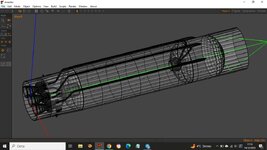
Work on the reusable version of the XCS core stage begins. Please note the three-engine configuration instead of the original with four.

Image1.jpg
 
Last edited:
I have wanting to see this mission to fly so if you did rocket I would be closer to seeing this come to lfe
 

Attachments

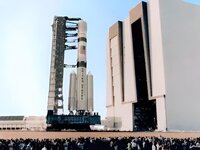
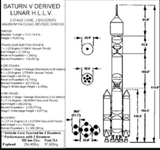
  • first-lunar-outpost-comet-vehicle-artist-concept-1.jpg
    first-lunar-outpost-comet-vehicle-artist-concept-1.jpg
    65.8 KB · Views: 11
  • first-lunar-outpost-vehicle-ascent-1.jpg
    first-lunar-outpost-vehicle-ascent-1.jpg
    103.4 KB · Views: 10
Looks like the "Comet" rocket concept. Very cool!
 
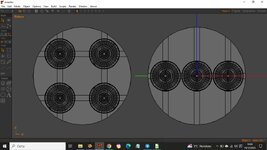
Arrangement of the XLS and XLS-R core stage engines (expendable and reusable, respectively). The propellant capacity (Lox/LH2) will be approximately 890,000 kg for the former and 650,000 kg for the latter.


Image1.jpg
 
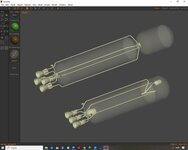
Propellant plumbing in the XCS-R reusable core stage (right) and in the standard heavy-lift XCR expendable stage (left). Pressurization and venting lines are not showed. Please note the header tanks in the XCS-R. Only the central engine will have the ability to relight for landing. A possible name for the XCR-R is "Ursa", after the Ursa Major constellation.

Image1.jpg
 
The external oxidant downcomers I've chosen for commonality with the expendable stage bothers me. They should be good at reentry due to the recent switch to stainless steel (they all are on the leeward side), but maybe some protection is still needed
 
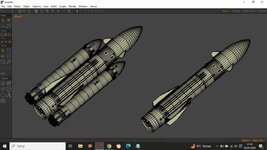
First project update of 2026. There are a lot of constraints on the rocket base that prevents the right placement of the rear fins for the core stage (XCR-R reusable version) in a Starship fashion, forcing a sort of midbody placement. Here, a preliminary sketch of the stack, with and without the side boosters. The core alone reminds me of a sort of AA-6 Acrid air-to-air missile. I've doubled the fins in the hope to retain efficiency, but I wonder if this configuration could actually work.

Image1.jpg
 
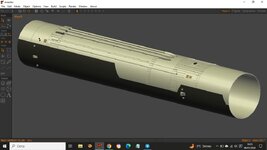
Advancements in the XCR-R, still lacking the "angry alligator" openable nosecone and the flaps. My decision to stick with a parallel staging configuration, mainly to avoid producing a mere copy of Starship, comes with difficulties. The main challenge now is posed by the side booster mounts, which must be somehow hidden under the heatshield for reentry. Still testing various solutions in this regard.Image1.jpg
 
The GOAT is BACK!!!! Just came across this project few days ago. Jarvis/Antares were my favorite Orbiter mods. Still hvae the old Jarvis/Antares User Manual.
 
Advancements in the XCR-R, still lacking the "angry alligator" openable nosecone and the flaps. My decision to stick with a parallel staging configuration, mainly to avoid producing a mere copy of Starship, comes with difficulties. The main challenge now is posed by the side booster mounts, which must be somehow hidden under the heatshield for reentry. Still testing various solutions in this regard.
Gonna look very Kerbal:D For Booster mounts you could use a simlar design to the ship catch pins on Starship whith them coverd in TPS.

Attachment shows example. left is booster right is ship. The boosters could simply drop away when engines are cut with small push from RCS to avoid collision with center core
 

Attachments

  • Screenshot 2026-01-07 140108.png
    Screenshot 2026-01-07 140108.png
    35.3 KB · Views: 3
Back
Top