Nicholas, I'm afraid these are photos of the last launch out of the same launch pad,
when Meridian 7 lifted off on October 30. :rofl:
Here's the real deal:
--------------------------------------------------------------------------
About the newest addition to the GLONASS fleet, the development of the next generation GLONASS-K satellites, featuring much longer lifetimes and new navigation signals (the civilian L3 signal ) to the current GLONASS-M satellites, was plagued with problems (on the atomic clock, for example) such that the first satellite (
launched in February 2011) never entered normal surface and the launch of this one was at least 2 years behind schedule. Nevertheless it become the 1st satellite enter the no.2 (of 3) orbital plane since November 2011 and may have the chance to enter normal service after half a year of testing!
Here's some information about the GLONASS-K satellites compiled by our old member SiberianTiger:
PAYLOAD
Glonass-K1 (Uragan-K1) navigation satellite:
Spacecraft Overview
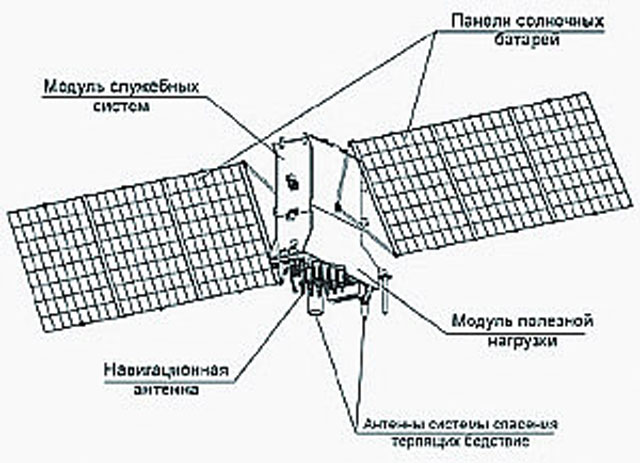
Uragan-K1 or GLONASS-K (originally called Uragan-K) spacecraft are the third generation of GLONASS navigation satellites. These satellites have an increased lifetime of 10 - 12 years, reduced weight of only 935 kg and offer an additional L-Band navigational signal.
The Uragan-K1 spacecraft are 3-Axis stabilized, nadir pointing with dual solar arrays.
The payload consists of L-Band navigation signals in 25 channels separated by 0.5625 MHz intervals in 2 frequency bands: 1602.5625 - 1615.5 MHz and 1240 - 1260 MHz. EIRP 25 to 27 dBW. Right hand circular polarized. On-board cesium clocks provide time accuracy to 1000 nanoseconds. A civil reference signal on L2 frequency was to be added after the completion of flight testing of Glonass-M in 2004 to substantially increase the accuracy of navigation relaying on civil signals. A third civil reference signal within the new frequency band of 1164-1215 MHz offered by the Glonass-K satellite to enable civil airlines to use satellite-aided positioning as the primary navigation facility.
The two Uragan-K1 spacecraft will be launched from Plesetsk on Soyuz-2-1b Fregat boosters. They were built to be launched in pairs, but as only the two prototypes are built, this will not be used.
After the two prototypes, this series will be replaced with the improved Uragan-K2 (GLONASS-K2) series.
[table="head"]{colsp=2}Summary
Parameter|
Value
Working Orbit:
|
MEO
Orbital Plane:
|
III
ApA at separation:
|
19 100 km
PeA at separation:
|
19 100 km
Inc at separation:
|
64.8°
[/table]
[table="head"]Characteristics|
Glonass-K
Parts diagram:
|
Customer:
|
- Joint Stock Company «Russian Space Systems», the primary operator of GLONASS system.
Prime contractor:
|
- JSC "Information Satellite Systems Reshetnev Company"
Platform:
|
Mass at Separation:
|
Dry Mass:
|
Stabilization:
|
Dimensions:
|
Batteries:
|
Life time:
|
Time-keeping Payload:
|Cesium or Rubidium Synchronizing complex developed by Russian Institute of Radio Navigation and Time, with timing stability improved to 5E-14 (compared to 1E-13 Glonass-M type sats have).
Navigation Payload:
|Developed by Joint Stock Company «Russian Space Systems», with added 1202.025 MHz L3 CDMA channel (Glonass-M have only FDMA channels).
Secondary Unclassified Payload:
|SARSAT receiver.
[/table]



 , SpaceEagle
 .
.