Humor Random Comments Thread

But I've got feed pump controls spread across three workplaces.

Sounds like Christmas is earlier this year. :thumbup:

---------- Post added at 10:33 AM ---------- Previous post was at 08:50 AM ----------

China has overtaken Russia in Space - now China has the second most satellites in Earth orbit (142), after the USA (549). Russia dropped to 131. The rest of the world operates 483 satellites.

Current active population:

Region | Number | Altitude
Clarke belt|481|35,781 km
HEO|41|200 - 400,000 km
MEO|87|2000 - 36,000 km
LEO|696|200 - 2000 km
 
Hurrah, UK is still in the league with............1.


N.
 
Working on a...space module, and want some simple advice. I know 3.5 meters (diameter) is really small, smaller than most of the Russian modules, and just slightly more than Cygnus.

But is a 3.5 m (diameter) space too tight for long term occupation?
 
Last edited:
Working on a...space module, and want some simple advice. I know 3.5 meters is really small, smaller than most of the Russian modules, and just slightly more than Cygnus.

But is a 3.5 m space too tight for long term occupation?

I'm going to guess you meant X meters as a diameter measure, then something like length or something. Without knowing how long 'long-duration' means to you, I can't give a simpler answer than more is generally better the longer the mission lasts. It also depends on the configuration of your habitat, with outside diameters of the habitat not being as important as the inside 'usable' diameter, the part between any equipment on the walls and the walls themselves. A habitat need not hold it's own life support equipment, and could have it in another habitat or unpressurized service module, but having something above a bare minimum for accumulating equipment, tools, or or other stuff that people drag with them.

What's the bare minimum though, I'm not sure. Two meters might be fine as a inside diameter for two to three weeks(I'm basing this on the Soyuz orbital module and a bit of common sense, YMMV), though any extra diameter for more volume would be welcomed, I think, especially on longer stays. I do know back during the Shuttle's development, the faction at NASA looking forward to space stations argued hard for 15 ft(4.57 m) as the diameter for station parts, thus setting the Shuttle's payload bay diameter, but since I'm not aware of the details I really can't comment meaningfully on why 15 ft was the number they settled on. The NTRS might have some useful info, so it's likely worth a few searches.
 
I'm going to guess you meant X meters as a diameter measure, then something like length or something. Without knowing how long 'long-duration' means to you, I can't give a simpler answer than more is generally better the longer the mission lasts. It also depends on the configuration of your habitat, with outside diameters of the habitat not being as important as the inside 'usable' diameter, the part between any equipment on the walls and the walls themselves. A habitat need not hold it's own life support equipment, and could have it in another habitat or unpressurized service module, but having something above a bare minimum for accumulating equipment, tools, or or other stuff that people drag with them.

What's the bare minimum though, I'm not sure. Two meters might be fine as a inside diameter for two to three weeks(I'm basing this on the Soyuz orbital module and a bit of common sense, YMMV), though any extra diameter for more volume would be welcomed, I think, especially on longer stays. I do know back during the Shuttle's development, the faction at NASA looking forward to space stations argued hard for 15 ft(4.57 m) as the diameter for station parts, thus setting the Shuttle's payload bay diameter, but since I'm not aware of the details I really can't comment meaningfully on why 15 ft was the number they settled on. The NTRS might have some useful info, so it's likely worth a few searches.

Sorry, I did indeed mean diameter with regards to the value. It seems a bit small, to me, but the module in question is actually (supposed to be) derived from a resupply vehicle, hence the diameter.

Since it's part of a space station, it's meant to support visitations with duration on the order of 3-8 months. The space station's complete habitable volume is essentially just 3x these modules grouped together. So not a lot.


Also, I think the Shuttle's payload bay diameter was set by the NRO, specifically to hold the KH-9 HEXAGON.
 
Last edited:

Keep in mind that 3.5 meters is external diameter. You need insulation that'll decrease it's internal size. Then I'm not sure how people would feel inside tube so you may consider flattening the walls.


I made quick draft (seen below)

Panel width here is ~126cm and oposite panels are ~3.05 meters apart so I think that may not be enough living space. However that also depends on lenght. How long is this module?

CBM not to scale)
module0001.jpg
 
Hey, has anyone seen this?

I know it's just a fan trailer, but I would pay a terrifying amount of money to see such a movie...and I'm not even a KSP fan:lol:

This looks like it has the potential to make you laugh and cry by turns.
 
Brilliant juxtaposition of the Gravity footage. Context is everything! :rofl:

I know it's just a fan trailer, but I would pay a terrifying amount of money to see such a movie...

It would likely suffer from the same problem that the recent minions did, and the penguins before them: Protagonists have to talk, and some characters just aren't made for that.
 
Brilliant juxtaposition of the Gravity footage. Context is everything! :rofl:


It would likely suffer from the same problem that the recent minions did, and the penguins before them: Protagonists have to talk, and some characters just aren't made for that.

Ah, but that means the theater would be less crowded, so you could see and hear the show without the aggravation. Always think positive:thumbup:
 
Looks like we are going to replace two LP turbine rotors this outage instead of just one. Because of the way "they" designed and built our condenser, the "C" (Charlie) turbine gets a lot of abuse. Bravo turbine was scheduled to be replaced anyway; but after an inspection a few days ago, a flatbed arrived here with a large familiar object attached.
 
Keep in mind that 3.5 meters is external diameter. You need insulation that'll decrease it's internal size. Then I'm not sure how people would feel inside tube so you may consider flattening the walls.

I made quick draft (seen below)

Panel width here is ~126cm and oposite panels are ~3.05 meters apart so I think that may not be enough living space. However that also depends on lenght. How long is this module?

CBM not to scale)
module0001.jpg

The module cylindrical section is 7 meters in length, not accounting for the forward and aft bulkheads.

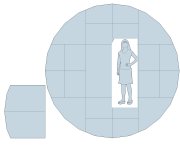
While I wasn't aware of the insulation and its impact on volume, I was concerned more about internal payload racks and how much space they would take up. Crude visualization:

VnDhEX7.png


The leftmost object is the payload rack cross-section.
 
Last edited:
Looks like we are going to replace two LP turbine rotors this outage instead of just one. Because of the way "they" designed and built our condenser, the "C" (Charlie) turbine gets a lot of abuse. Bravo turbine was scheduled to be replaced anyway; but after an inspection a few days ago, a flatbed arrived here with a large familiar object attached.

They have those things in stock? Or constantly on the move to avoid paying taxes?
 
They have those things in stock? Or constantly on the move to avoid paying taxes?

The turbine vendors do keep a bit of a stock. They usually have a very good idea when their customer's plants come up for outages and overhauls and produce them accordingly ahead of time. I'd guess the extra LP turbine came off the end of their production pipeline (originally earmarked for a customer with an outage still months away). Operators are usually doing inspections during outages and may find that they need to replace a turbine or other component, and they really can't afford to wait for weeks for the vendor to make a new turbine before they can rebuild and restart, so the vendors stock accordingly.
 
Also, I think the Shuttle's payload bay diameter was set by the NRO, specifically to hold the KH-9 HEXAGON.

A KH-9 only has a diameter of 10 feet or just over 3 meters, a whole meter shorter than than the Shuttle's bay diameter; on the face of it, a KH-9 doesn't need that much room. This history of the decisions leading to the Space Shuttle(linked to the relevant chapter) attributes the length requirement on the payload bay to the Air Force(particularly cause of the KH-9), with NASA being the first ones to settle on 15 ft as the diameter, mostly for space stations. Relevant quote for the text:

While NASA did not need so much length, its officials wanted a 15-foot diameter to accommodate modules for a space station. This reflected a new approach to the design of such stations. The studies of the 1960s, including those that Paine had initiated in 1969, had envisioned a space station as a single unit that would fly atop a Saturn I-B or Saturn V. As the prospects for Saturns faded while those of the Shuttle seemed to advance, it appeared prudent to envision a class of stations that could be assembled in space as an [226] array of cylindrical modules, one module per shuttle flight. A shuttle bay with this diameter would accommodate modules 14 feet across, intermediate between the 10 feet of MOL and the 22 feet of Skylab. 51


This quote also illustrates one important consideration- the largest diameter module you can launch depends in some degree on the width allowed be your launcher. Anyway, historical digression over.

attachment.php


Made obvious by my crude crop and paste edit of your illustration, there's not enough room for someone to face either (long)end of the module and 'stand'. I imagine it make it tough to move about, ad should feel quite a bit claustrophobic. Removing the top and bottom racks, or making them half as deep, should be a easy enough fix to that problem, and also provide more usable volume to move people or the payload racks themselves. As a bonus I think it'll provide a easy reference on orientation, since one couldn't stand between the 'walls'.

Volume-wise, I suspect it might still be a bit cramped, but increasing the length should help. Another possibility is to remove a few racks to create a open area in a module, allowing for a dining or work area(perhaps only in one or two of the modules on your station), which would also bump up usable volume. If your 3d modelling program has a function to calculate volume, I think doing a few test configurations would be a great idea to find out how much room you actually have.
 

Attachments

  • VnDhEX7edited.jpg
    VnDhEX7edited.jpg
    48.8 KB · Views: 117
Ok, did so revisions, managed about 40.6 m3 of habitable crew volume. Zvezda has 46.7 m3 of habitable crew volume.

Interesting how cramped some of these modules are.

Interior_of_Zarya_ISS_module.jpg

Forward_view_of_interior_of_Zvezda.jpg


Will have to revise the payload racks though:
ZIpfDtF.png
 
Back
Top