


Sea Launch has finally started the year with the launch campaign of Intelsat 19, one of five Intelsat satellites to be launched this year. This satellite will bridge communications between the Pacific Ocean, from the Far East to the western coast of the United States. The trip to space is now trusted upon one of the best designed rockets ever (or at least what I thought
 ), the Zenit rocket. Launching into the dark skies over the central Pacific Ocean, the trip will take just less than an hour.
Launch location:
Odyssey Launch Platform, located at 0°N, 154°W
Launch dates and times:
[table="head"]{colsp=5}Launch times
Time Zone
|
Local / UTC-10
| Universal / UTC
| Los Angeles / PDT
| Moscow / UTC+4/
Launch time (Primary):
|19:23:39
|05:23:39
|22:23:39
|09:23:39
on:
|Jun. 1, 2012
|Jun. 1, 2012
|May. 31, 2012
|Jun. 1, 2012
{colsp=5}
[highlight][eventTimer]2012-06-01 05:23:39?before|after;%dd% Days %hh% Hours %mm% Minutes %ss% Seconds %c%[/eventTimer] Intelsat 19 Launch[/highlight]
[/table]
Live Coverage Of The Launch:
- Sea Launch Video Streams: http://www.sea-launch.com/current_index_webcast.html - coverage will begin at 05:05 UTC / 22:05 PDT
PAYLOAD
Intelsat 19 communication satellite:
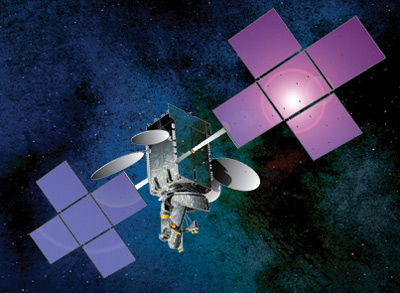
Spacecraft Overview
Space Systems/Loral announced in June 2009 that it has been awarded a contract to provide two new satellites to Intelsat, the leading provider of Fixed Satellite Services (FSS) worldwide. The two satellites, Intelsat 19 and Intelsat 20, will be among the most powerful FSS satellites ever built with unprecedented capacity to provide services for broadband, video, and voice applications.
Intelsat 19 and Intelsat 20 will replace existing satellites that currently provide services to five continents and will offer services for broadcast television and telecommunications. The satellites also will have the capacity to support mobile communications and higher data rate network services.
Intelsat 19 is the 36th satellite that Space Systems/Loral will provide to Intelsat and it is scheduled for launch in 2011. It will replace the Intelsat 8 satellite at 166 degrees East longitude. The satellite has 34 Ku-band transponders that can be switched between four different footprints that cover Australia and the Pacific Ocean region, and 24 C-band transponders that will be connected to a high-power footprint covering Australia, New Zealand, Southeast Asia, Japan, and the western United States. The satellite's C-band capacity will provide enhanced distribution of content throughout Asia-Pacific with reach to the Western United States.
Both satellites are built on the LS-1300 satellite platform, which provides the flexibility for a broad range of applications. They are designed to provide service for at least 15 years.
[table="head"]{colsp=2}Summary
Parameter|Value
Working Orbit:
|GEOOrbital Location:
|166° EastCoverage:
|Southeast Asia, Australia, New Zealand, US west coastApA at separation:
|35636 kmPeA at separation:
|870 kmInc at separation:
|0°[/table]
[table="head"]Characteristics|
Elektro-L
Customer:
|- Intelsat

Prime contractor:
|- Space Systems/Loral

Platform:
|- LS-1300E
Mass at Separation:
|- 5600 kg
Dry Mass:
|- ?
Stabilization:
|- 3 axis stabilized
Dimensions:
|- 26 x 9 x 8 m
Power at end-of-life:
|- 15.0 kW
Primary Payload:
|- 34 Ku-band transponders can be switched between four different footprints that cover Australia, the North West Pacific, the North East Pacific and the South West Pacific regions.
- 24 C-band transponders will be connected to a high-power footprint that covers Australia, New Zealand, Southeast Asia, Japan and the US west coast.
Coverage area:
|
|

|

|

|

Life time:
|- 15+ years
|

Launch Vehicle:
[table="head"]{colsp=2}Characteristics
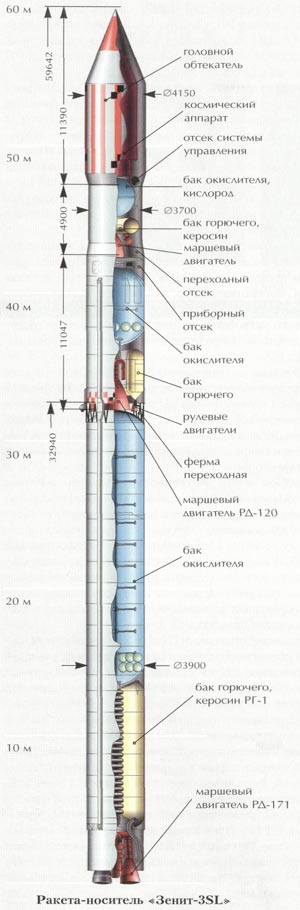
Zenit-3SL / Blok DM-SL
Prime contractor:
|- Yuzhmash (A.M. Makarov Yuzhny Machine-Building Plant) - Ukraine
GRAU Index:
|- 11K77
Height:
| 58.7 m with upper stage and payload fairing Diameter:
| max 4.1 mLiftoff mass:
| 473 metric tonnes Payload mass:
| ~6 tonnes at GTO1st stage:
|- 1 X RD-171 engine
- Empty 33.9 tonnes
- Propellants 318.8 tonnes (RG-1 Kerosene and LOX)
- Thrust in vacuum 7 908 kN
- Thrust at sea level 7 259 kN
2nd stage:
|- 1 X RD-120 engine + 1 X RD-8 vernier engine
- Empty 9.3 tonnes
- Propellants 80.6 tonnes (RG-1 Kerosene and LOX)
- Thrust in vacuum 834 + 78 kN
Upper Stage:
|
- GRAU Index: - 11S861
- Common Name: Block DM-SL
- Designer: Designer: RKK Energia
- Manufacturer: "Krasmash" Krasnoyarsk Machine Building Plant
- Dimensions: Length 5.5 m, Diameter 4.1 m
- Empty Mass: 2.2 tonnes
- Propellants load: 15.095 tonnes (RP-1/LOX)
- Main Engine: 1 X RD-58M
- Thrust in vacuum 8.67 tonnes of force
- ISP 352 s
Payload Fairing:
|- Diameter 4.1 m
- Length 10.4 m
[/table]
[/table]
The vehicle's reliability statistics according to http://www.spacelaunchreport.com/log2011.html#rate:
For Zenit-3SL,
Code:
================================================================
Vehicle     Successes/Tries Realzd Pred  Consc. Last     Dates
                             Rate  Rate* Succes Fail
================================================================
Zenit 3SL/DMSL   28    31    .90  .88      7    1/30/07  1999-
Intelsat 19 Ascent Profile

[TABLE="head"]Orbit #|Orbit Nature|Perigee h, km|Apogee H, km|Inclination
1|2nd stage separation|-2174|188|0°
2|Parking|180|1065|0°
3|GEO-transfer|866|35770|0°
4|Target GTO|870|35636|0°
[/TABLE]
Intelsat 19 Ascent Timeline


[TABLE="head"]Event|Time UTC|Comment
Lift-off|05:23:39|
1st Stage Separation|05:26:09|
2nd/upper Stage Separation|05:32:10|
1st Burn Ignition|05:32:20|
1st Burn Shutdown|05:37:26|1st Burn's Duration 00:05:06
2nd Burn Ignition|06:07:27|
2nd Burn Shutdown|06:13:57|2nd Burn's Duration 00:06:30
Spacecraft Separation|06:23:47|
[/TABLE]
Photos of preparations of the launch will come soon.
References
http://www.sea-launch.com
http://www.yuzhmash.com
http://www.yuzhnoye.com
http://forum.nasaspaceflight.com
http://www.novosti-kosmonavtiki.ru
http://www.spacelaunchreport.com
http://www.ssloral.com/html/satexp/intelsat19.html
http://www.intelsat.com/network/satellite/


