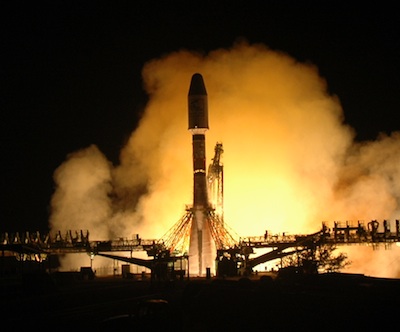
Launch News (Failure) Meridian #5 atop Soyuz-2.1b/Fregat on December 23, 2011

What did you use?
What addon? Soyuz FG/U V1.2 by Thorton. Unless something went wrong in the scenario, I have no clue why it would be 425 Kilometers southeast of the crash site.

Edit: Short of a proper addon is correct.
 
Popovkin's reaction....

Bad PR from Popovkin: in the post-docking media briefing of the Soyuz TMA-03M, he tried to avert all questions about the failure. When the reporters ask one by one, he answered that the industry is still in the process of recovering (bad tracking systems, young workforce etc. etc.), then after the congratulation messages from NASA and ESA, he angrily walked out of the press room without answering the last question from a reporter about the accident! :facepalm:
 
Mmh... at least it was "only" a miltary launch... It probably shows that the issues with quality control are not over yet...
 
paddd.JPG


The known location of the found piece of debris is Vagaitsevo village in Ordynsky district. The following is just topping over my mind! :facepalm:

http://www.lifenews.ru/news/77860

"The debris fell 3 km away from the district's centre right on a residential house in Vagaitsevo village. During impact of a titanium piece measuring 1 meter in diameter a family was in the living room. At present moment, a teams from Army and Federal Securiy Service are working at the scene", said a source in the territorial Emergency Command.

The heavy piece of metal accelerated to a great speed fell on the house's roof like a meteorite. Now all people are evacuated, the scene is under examination.

Accroding to eyewitnesses, a huge fireball plummeted down from the sky, hitting on a roof of a small house. The home's owner Andrey at that moment went out to take firewood for his oven, while his wife and kids stayed inside.

Now servicemen from the local FSS have already extracted a piece of the satellite from the destroyed house. It looks like a metal ball with 50 cm radius.

People at NK say it's most likely a pressure tank from the Block I.
 
Bad PR from Popovkin: in the post-docking media briefing of the Soyuz TMA-03M, he tried to avert all questions about the failure. When the reporters ask one by one, he answered that the industry is still in the process of recovering (bad tracking systems, young workforce etc. etc.), then after the congratulation messages from NASA and ESA, he angrily walked out of the press room without answering the last question from a reporter about the accident! :facepalm:

Not just from any reporter. I didn't see the TV coverage but if she said she was from NK she's either Yulia or Katya (Yulia Ecomonova or - more likey - Yekaterina Zemlyakova).
 
It appears that an engine failure can be confirmed by existing telemetry data. According to a poster at NK:

http://www.novosti-kosmonavtiki.ru/phpBB2/viewtopic.php?p=859765#859765

I have observed the process as non-participant, but closely. According to reports from the range tracking, the two first stages worked fine. After T+288 the 3rd stage engine has begun burning. After the stack arrived within reach from Khimki, Fregat telemetry began coming through the antenna at Lavochkin. Before T+425 everything went normally. At this mark, the signal has significantly dropped in volume and the telemetry has shown the gyro-platform gymbal lock in 5 seconds, and this would only be possible if the stack had swayed by no less than 40 degrees. It could happen if the object has strongly tumbled. It seems to me, such dynamics can only follow an engine's explosion. I can't think of any other explanation.
 
User granat from Russian astronomy forum has made a series of pictures from Yarovoyue (Altai region), 52.93N, 78.58E. It makes the disaster development visible. The time marks are UTC+7.

19:15:28|19:17:11
index.php
|
index.php

19:15:48|19:17:24
index.php
|
index.php

19:15:59|19:17:40
index.php
|
index.php

19:16:12|19:19:12
index.php
|
index.php

19:16:21|19:19:25
index.php
|
index.php

19:16:30|19:19:35
index.php
|
index.php

19:16:42|19:19:42
index.php
|
index.php

19:16:54|19:19:51
index.php
|
index.php

19:17:03|
index.php
|
 
ohh dear...this will probably mean another slowdown in Soyuz launches
 
Apologies for butting in, but I wonder if the piece of debris shown in the photograph in this news article looks like it might have come from this failed launch of Meridian 5:

image_2011122314563269EBDEE0-BB8C-1B0A-9ABD217F9B0150F2.jpg
 
Spaceflight Now

Soyuz rocket falls in Siberia after launch mishap

[FONT=VERDANA, ARIAL, HELVETICA, SANS-SERIF][SIZE=-2]BY STEPHEN CLARK
SPACEFLIGHT NOW

Posted: December 23, 2011[/SIZE][/FONT]
spacer.gif


23soyuzmeridian_400332.jpg


A Soyuz rocket and a Russian military communications satellite crashed in Siberia on Friday, continuing a pesky series of launch mishaps blemishing Russia's space program in the last year

Russian rocket failures have lost navigation, research and communications satellites since December 2010. Another Soyuz rocket crashed in August with a Progress resupply craft bound for the International Space Station. And Russia's Phobos-Grunt Mars probe is stuck in orbit around Earth after its rocket pack floundered shortly after launch in November. The Phobos-Grunt craft, which was designed to return samples from a moon of Mars, will probably fall back to Earth in January.

The mishap Friday occurred about seven minutes after the Soyuz rocket fired away from the Plesetsk Cosmodrome in northern Russia at 1208 GMT (7:08 a.m. EST). The kerosene-fueled rocket pointed southeast from Plesetsk, a military-run launching base in Arkhangelsk oblast.

The problem struck during the rocket's third stage burn, but there were no reliable reports on the cause of the failure by Friday afternoon. "This is a significant failure," said Vladimir Popovkin, head of Roscosmos, the Russian space agency. "This proves that this area of space industry is in sort of a crisis. I can say, even now, the problem lies in the engine, but to be more certain we need to take a look at the telemetry. I believe that tomorrow we will have results that we'll be able to tell you about."

The Soyuz rocket is currently the only vehicle able to transport crews to the International Space Station, but Friday's doomed mission used a different version of the launcher.

The booster used during Friday's launch flew in the Soyuz 2-1b configuration, which features a modernized digital control system and an RD-0124 third stage engine. The Soyuz-U and Soyuz-FG launchers, which haul supplies and crews to the space station, rely on an older model RD-0110 third stage engine.

It was unclear immediately what impact Friday's failure would have on the Soyuz launch manifest. Another Soyuz was due to haul six Globalstar communications satellites into orbit Dec. 28.

rocket-1.jpg

[FONT=Verdana, Arial, Helvetica, sans-serif][SIZE=-2]File photo of a Soyuz rocket on the launch pad at Plesetsk Cosmodrome. Credit: Roscosmos[/SIZE][/FONT]

Soyuz rockets are scheduled to launch another Progress cargo craft to the space station in January and the next three-person crew in late March.
The Soyuz rocket fell back to Earth a few minutes after launch Friday, according to reports.

The RIA Novosti news agency reported debris was found in the region of Novosibirsk, the third-largest city in Russia. Novosibirsk is about 1,600 miles southeast of the Plesetsk Cosmodrome.

It was carrying a Meridian communications satellite for the Russian military.

A Fregat upper stage was supposed to boost the Meridian payload into a high-altitude oval-shaped orbit stretching up to 25,000 miles above Earth.
This high-altitude perch, commonly called a Molniya orbit, allows satellites to stay in view of Russian territory for several hours during each circuit around the planet. Satellites in this type of orbit cover polar regions, areas out of reach of many traditional communications spacecraft in equatorial orbits.

The Meridian communications satellite was designed link terrestrial military forces, ground stations, aircraft and ships with command and control centers. The craft launched Friday was the fifth Meridian satellite launched by Russia since 2006.

Built by ISS Reshetnev, a Russian space contractor, the Meridian satellites are replacements for Molniya communications satellites covering high latitude regions of Russia.

The string of Russian rocket failures began in December 2010 with the loss of three Glonass navigation satellites on a Proton rocket. A Rockot vehicle placed a military research craft in the wrong orbit in February, then another Proton upper stage failed during a civil communications launch in August.
The Soyuz rocket failure with the Progress resupply ship grounded the venerable rocket for more than a month.

"Yes, there are problems, and we need to modernize," Popovkin said, saying Russia needs to upgrade facilities at its spaceports and tracking facilities.

Popovkin also highlighted the aging of the Russian space workforce as a systemic problem.
 
So, how many Rocket failures have we had this year? I think I've lost track.
 
So, how many Rocket failures have we had this year? I think I've lost track.

This is the sixth. The five previous ones are:

February 1: Rockot-KM: GEO-IK-2 (wrong orbit achieved, Briz-KM upper stage failed to re-ignited due to a software bug)

March 4: Taurus XL: Glory (failed to reach orbit, payload fairing failed to separate)

August 17: Proton-M/Briz-M: Express AM-4 (wrong orbit achieved, Briz-M upper stage lost attitude control during burn #3 due to a software error)

August 18: Long March 2C: Shijian-11-04 (failed to reach orbit, second stage vernier engine support structure failed in flight, led to loss of attitude control)

August 24: Soyuz-U: Progress M-12M (failed to reach orbit, third stage engine gas generator failed at T+ 325 seconds)
 
Seventh, if you count Phobos-Grunt. Although that was an integrated cruise stage...
 
Ok, we are short of a proper addon, I see.

I have tried a very rough simulation of the actual launch, with a custom scenario created with several add-ons (notably the French Soyuz add-on modified by me) and custom configuration files to fit approximately with the parameters of the Soyuz-2-1b/Fregat and the Meridian payload. With a shutdown of the engine at T+ 421 seconds, I have the ground speed at ~ 5.67 km/s, the altitude at ~166 km, the nominal point of re-entry south-southwest of Novosibirsk, and the time of re-entry at about 11 minutes after launch (~12:19 UTC, in agreement of the photos taken on the ground). More information will come later when I can do another refined simulation...
 
Last edited:
Apologies for butting in, but I wonder if the piece of debris shown in the photograph in this news article looks like it might have come from this failed launch of Meridian 5:

image_2011122314563269EBDEE0-BB8C-1B0A-9ABD217F9B0150F2.jpg

No, the image is apparently unrelated. The Meridian and the upper stage have crashed last night in Siberia in December. Which, I can assure you, rules out this sunny lawn background.

By the way, the house which the debris piece fell on, is situated at Cosmonauts street in the village. :facepalm:
 
Back
Top