- Joined
- Feb 13, 2008
- Messages
- 5,398
- Reaction score
- 8
- Points
- 0
- Location
- Khimki
- Website
- tigerofsiberia.livejournal.com



Launch site:
Baikonur Launch pad no. 200/39 46° 2'23.85"N, 63° 1'54.98"E
Launch date: November 14, 2010
The launch time is:
3:29:20 a.m. AEST 15.11.2010
23:29:20 Baikonur 14.11.2010
20:29:20 Moscow 14.11.2010
17:29:20 UTC Nov 14, 2010
1:29:20 p.m. EST Nov 14, 2010
[eventTimer]2010-11-14 17:29:20?before|after;%dd% Days %hh% Hours %mm% Minutes %ss% Seconds %c%[/eventTimer] SkyTerra-1 Launch
Payload: MSV-1 (SkyTerra-1) broadcasting satellite
Target orbit: GTO
Orbital slot: 101.3° W Longitude GEO
Contract Life: 12 years
Coverage: C0NUS, the Caribbean, Hawaii
Call sign: S2358
Beacon(s): 11450
This will be the 7th Proton launch of the year for ILS and the 63rd ILS Proton mission overall since the Proton April 1996 first commercial flight. This will also be the 1st LightSquared satellite launch with Proton. In addition, the SkyTerra 1 will be the 14th Boeing satellite launched on a Proton vehicle.
Spacecraft: MSV-1 (SkyTerra-1)
Platform: Boeing (Hughes) BSS-702

Manufacturer: Boeing

Description and Purpose:
SkyTerra 1 and SkyTerra 2 are the next-generation mobile communications satellite platforms, using both space and terrestrial elements to deliver mobile voice and data services throughout North America

LightSquared (formerly named SkyTerra LP) selected Boeing in January 2006 to build and deliver two Space-Based Networks (SBN), consisting of two 702HP satellites designed for geomobile services, four uplink gateway sites, and Ground-Based Beam Forming (GBBF) equipment. The two SBNs are a component of an integrated satellite-cellular hybrid communications network that will provide ubiquitous fourth-generation coverage throughout the United States and Canada. An SBN will provide user access via typical wireless devices such as cell phones, PDAs, and laptops.
The LightSquared system coverage area comprises the continental United States, Canada, Alaska, Hawaii, Puerto Rico, the Virgin Islands, Mexico and the Caribbean. The SkyTerra SBN system design provides on-orbit flexibility, such as frequency spectrum modification, capacity redistribution and spot beam reconfiguration to meet changing business demands over time. For example, in the event a natural disaster compromises the ground-based cellular service infrastructure, the SBN system can adapt to provide additional voice and data service capacity to the affected geographic region.
The SkyTerra satellites build off the success of the Thuraya mobile communication system. The payloads' utilization of technical advancements (including a larger L-band reflector, digital channelizer and higher power solid state power amplifiers) enables broadband communications through small user terminals that are similar to standard terrestrial devices. The platform incorporates several key new technologies, including an upgraded electrical power subsystem consisting of Lithium-Ion battery packs.
The two satellites are built at Boeing satellite integration and test complex in El Segundo, CA. Harris Corporation of Melbourne, FL. developed the satellites' 22-meter L-band reflector. ViaSat's Comsat Laboratories of Germantown, MD. is providing the GBBF equipment, the uplink beacon stations and the control and monitoring system of the ground stations. SED Systems of Saskatoon, Canada, is providing the antennas, RF elements, and integration services at the gateway stations.
Users of SkyTerra's MSAT devices will have to update their frequencies to adapt for the transition to the new network, as instructed here: http://www.skyterra.com/about/frequency-updates.cfm
A review from the service user's standpoint (http://hothardware.com/News/Can-GSMSatellite-Hybrid-Phones-Go-Mainstream/):
This new hardware will be designed to work with so-called hybrid phones that operate on traditional cell towers (GSM or CDMA, as with current cellphones on AT&T, Verizon, etc.) and satellite service. This capability means that users can safely make calls on normal cell towers while in covered areas, but sat signal can be fetched if users stray too far from the beaten path.
Still, the phones are expected to cost just under $1,000 each, and there's little to no chance that they'll ever end up in retail stores of traditional cellphone operators. On top of all that, sat calls are expected to run customers around $1 per minute, making it outrageously expensive for the average joe. In fact, unless that call was mission critical, we'd wager that the user could either wait until they found a landline or just drive a few miles towards town in order to fetch a single bar of cell signal. Finally, traditional cell service is now much, much more widely available compared to even a decade ago. In fact, it's tough to find too many wide open spaces that can't be reached at least partially by a CDMA or GSM phone. We don't doubt that there's a niche market willing to splurge on a GSM / satellite hybrid phone, but we can't ever see this thing going anywhere close to mainstream.
A historical note
http://www.satellitetoday.com/st/headlines/34622.html
SkyTerra-1 Launch Postponed After Boeing Discovers Technical Glitch
[Satellite TODAY 07-22-10] SkyTerra Communications, which is now LightSquared after yesterday’s $7 billion deal between Harbinger and Nokia, will delay the launch of the $400 million SkyTerra-1 satellite after being notified of a technical glitch by manufacturer Boeing Co., LightSquared announced July 20.
The launch was originally scheduled for Aug. 16. SkyTerra-1, the first of two satellites will now be launched into orbit by ILS from Kazakhstan in December or early 2011. LightSquared said that Boeing would run additional tests on the spacecraft in preparation of the new launch date.
Harbinger plans to use SkyTerra-1 to set up a wholesale 4G wireless network serving nearly the entire U.S. population by the end of 2015.
SkyTerra-1 Specifications
Orbit|GEO
Orbital Location|101.3° W
Operator|LightSquared
Coverage|C0NUS, the Caribbean, Hawaii
Prime Contractor|Boeing
Platform|BSS-702 GEM
In-orbit Mass (beginning of life)|3,200 kg
Launch Mass|5,390 kg
In-orbit Dimensions|H: 22m, W: 29m, L: 41m
Stowed Dimensions|H: 9m, W: 3m, L: 4m
Mission Life|15 years
Propulsion|100 lbf High Performance Liquid Apogee Thruster; 4 - 5 lbf Axial thrusters; 4 - 2.2 lbf East/West thrusters
Antennas|22m L-band reflector; 2m Ku-band antenna; T&C wide coverage antennas
Payload|Flexible Digital Channelizer; L-band SSPA; 100W Ku-band TWTAs
Batteries|2 Li-Ion battery packs
Solar, beginning of life|14 kw
Solar, end of life|13 kw
Solar Panels|2 - 5 panel wings Ultra Triple Junction (UTJ) gallium arsenide solar cells
Beam footprint information
http://www.satbeams.com/satellites?id=2475
also:

Launcher: Proton-M with Briz-M upper stage

Rocket Family|Proton
Designation|8K82M
Class|Heavy
Type|Expendable
Designer|Salut Design Bureau
Manufacturer|Khrunichev State Research and Production Space Center
Stages|4
Height, mm|42340
Diameter, mm|7400
Launch Mass, kg|700000
SkyTerra-1 Ascent Profile
The Proton-M three-stage rocket places the orbital unit (OU), which consists of a Breeze-M upper stage, adapter system and SkyTerra 1, into 51.5° inclination suborbital trajectory. Proton-M powered flight lasts 581 seconds. The OU powered flight begins at the moment of the third stage separation.
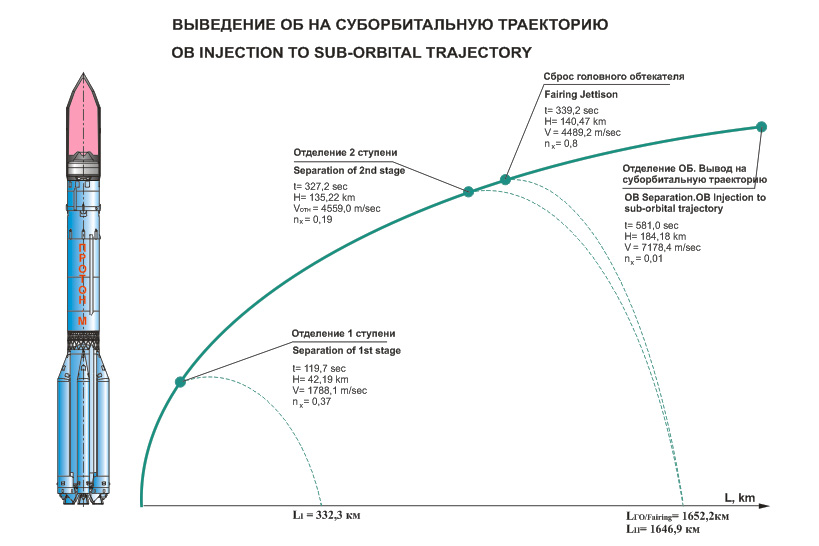
Immediately after the separation of the third stage booster, the Breeze-M stability engines start, damping the angular velocities of the third stage separation and then providing orbital unit orientation and stability during coast flight along a suborbital trajectory to await the first burn. The upper stage follows a five-burn injection profile.
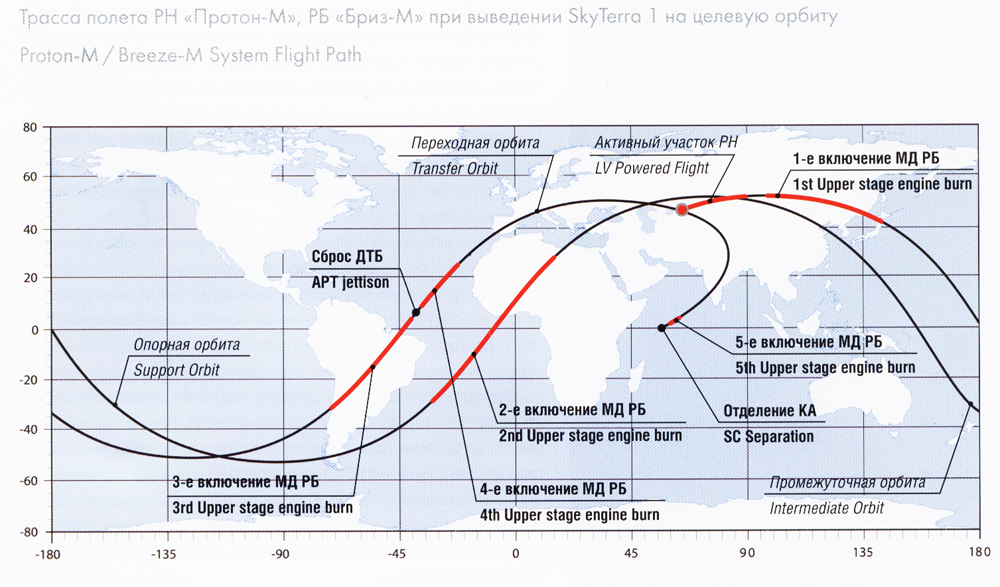
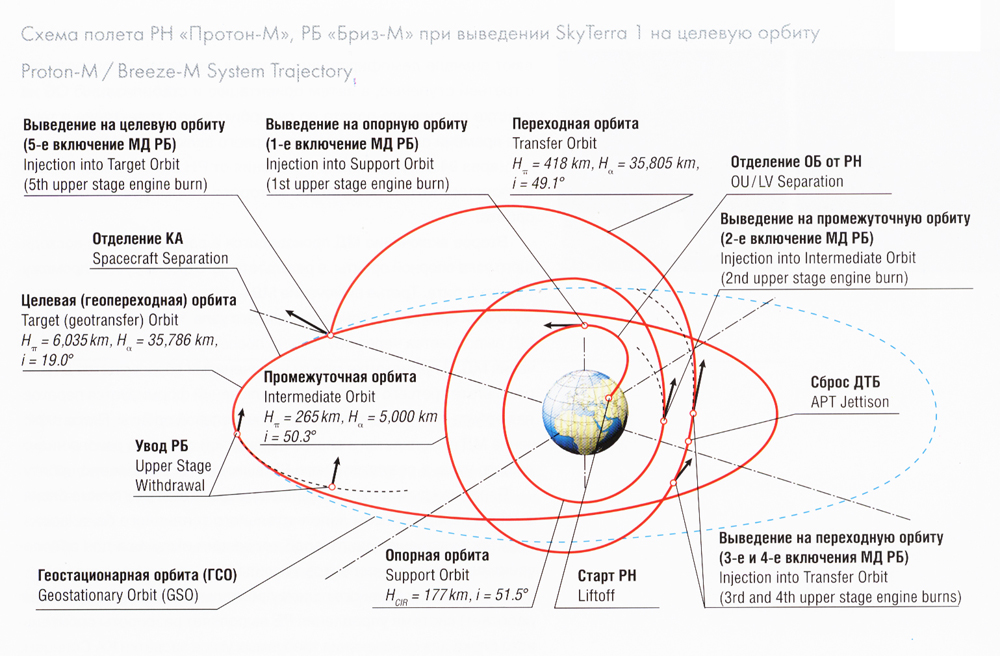
Ascent timeline:
Ignition Start Sequence|-00:00:02.5|17:29:17.5|
Stage 1 Ignition (40% thrust)|-00:00:01.75|17:29:18.25|
Command Stage 1 (100% thrust)|-00:00:00.9|17:29:19.1|
Maximum Dynamic Pressure|00:01:02|17:30:22|
1st/2nd Stage Separation|00:02:00|17:31:20|
2nd/3rd Stage Separation|00:05:27|17:34:47|
Payload Fairing Separation|00:05:46|17:35:06|
3rd Stage/Breeze M Separation|00:09:41|17:39:01|
1st Burn Ignition|00:11:15|17:40:35|
1st Burn Shutdown|00:18:24|17:47:44|1st Burn's Duration 00:07:09
2nd Burn Ignition|01:08:21|18:37:41|
2nd Burn Shutdown|01:25:49|18:55:09|2nd Burn's Duration 00:17:28
3rd Burn Ignition|03:28:39|20:57:59|
3rd Burn Shutdown|03:40:57|21:10:17|3rd Burn's Duration 00:12:18
APT Jettison|03:41:47|21:11:07|
4th Burn Ignition|03:43:14|21:12:34|
4th Burn Shutdown|03:48:06|21:17:26|4th Burn's Duration 00:04:52
5th Burn Ignition|08:53:06|2:22:26 a.m. Nov. 15|
5th Burn Shutdown|09:00:21|2:29:41 a.m. Nov. 15|5th Burn's Duration 00:07:15
Spacecraft Separation|09:14:00|2:43:20 a.m. Nov. 15|
[eventTimer]2010-11-15 02:43:20?before|after;%dd% Days %hh% Hours %mm% Minutes %ss% Seconds %c%[/eventTimer] SkyTerra-1 Spacecraft Separation
The vehicle's reliability statistics according to http://www.spacelaunchreport.com/reliability2010.txt:
Code:
================================================================
Vehicle     Successes/Tries Realzd Pred  Consc. Last     Dates
                             Rate  Rate* Succes Fail
================================================================
Proton-M/Briz-M  38    41    .93  .91     19    03/14/08 2001-
(ranks at 15th among all rockets and 5th among GEO launchers)
Weather forecast for Baikonur, Kazakhstan on November 14, 2010 (11 p.m.)
11 PM|+5°C|+3°C|+5°C|0|Low|+1°C|79%|0%|0%|7%|16 km|WSW 2.24 m/s|

Sunrise/Sunset and associated twilight times for Baikonur on Friday, October 15, 2010
Times are local.
Astronomical twilight begins|07 : 02
Nautical twilight begins|07 : 37
Civil twilight begins|08 : 13
Sunrise|08 : 44
Transit (sun is at its highest)|13 : 31
Sunset|18 : 18
Civil twilight ends|18 : 48
Nautical twilight ends|19 : 24
Astronomical twilight ends|20 : 00
Watching the launch live
ILS broadcast will begin 30 minutes before the lift-off (at 17:00 UTC).
TSENKI broadcast will begin at 18:30 MSK (15:30 UTC) and end at 21:30 (18:30 UTC)
- ILS Launch Services http://skyterra1.imgondemand.com/
- Khrunichev COOPI (login: MSV1 password: LMSV1): http://coopi.khrunichev.ru/main.php?id=200
- Owners of PDA can watch the launch in test mode on: http://www.space-center.ru
- TSENKI Video Streams: http://www.tsenki.com/broadcast/broadcast/
References
http://www.federalspace.ru
http://tvroscosmos.ru
http://www.ilslaunch.com
http://www.khrunichev.ru
http://coopi.khrunichev.ru
http://www.lightsquared.com
http://www.skyterra.com
http://www.satbeams.com
http://www.satellitetoday.com
http://www.boeing.net
http://hothardware.com
http://forum.nasaspaceflight.com
http://www.novosti-kosmonavtiki.ru
http://www.spacelaunchreport.com
http://www.intellicast.com/Local/Forecast.aspx
http://www.good-stuff.co.uk/suntimes/sunmap.php