Venting

Bloodworth

Orbinoob
Joined
Oct 14, 2008
Messages
544
Reaction score
2
Points
16
Sorry, just wanted to vent my frustration with my skills for a moment. I've never really done wheels (horizontal) landings in orbiter before, so I decided today was the day. I made a quick (nominally)final approach scenario with the XR2 at wideawake and went to town. I've been at it since 9am this morning and have run the scenario close to 50 or 60 times. EVERY DAM TIME, I wind up touching down at between 6 and 8vms and collapse the landing gear. I even collapsed them once when I touched down at 4.3vms :(

So far I have managed a successful landing exactly twice. Grrrrrrrrrr.
 
As silly as it seems, I suggest some touch-and-go landings with the XR2. She's actually REALLY well-behaved at around 150-175m/s when you're landing. You can also land at up to a 10 degree angle from horizontal, from what I remember. Keep an eye on your vspeed gauge on the HUD - it makes it a lot easier to control. Also, remember it's better to float a bit and punch it if you think you're going to overrun the end of the runway than to come down too hard and hose your gear. :thumbup:
 
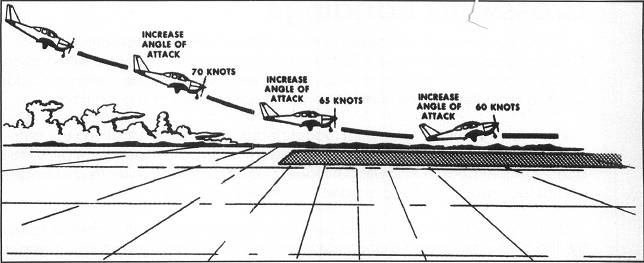
Do exactly like we do in real life flight lessons, learn to adjust power, or in the case of a gliding landing, pitch and angle of attack so that you control precisely your vertical speed. Do your practices at an altitude of at least 1000 meters... when you feel ready, your HUD is your best friend to learn to point the ship correctly for a runway landing.

Learn to have your circled crosshairs (impact point) slightly short of the runway threshold, at a speed of 150 m/s ... When you hear the altitude calls for 100 and less, pull up gently to put your aim point all the way at the horizon and keep her like that while your airspeed drops... without looking at your vertical speed, it will go to a safe value as you're flaring the ship by aiming farther down the runway.

Try to keep her at at altitude of 5 to 10 meters above the runway while you're bleeding speed off... Don't deploy the speedbrakes yet. Let her bleed forward velocity and she'll loose lift and settle to the runway... When you finally get main gear touchdown, deploy the aerobrakes and the retro rockets and stop her...
 
Generally I aim for the lights in front of the runway and have a rather steep glideslope, like the Shuttle. Then I level out and pull off a long flare.
 
As a very inexperienced flight simmer, I find the XR2 a pleasure to land. It's got a VS indicator integrated into the primary HUD, so even if I'm coming in absurdly fast it's just a matter of flaring super quickly to get under 5 m/s before I touch down. I'm not always successful, but it's just a matter of practice.
 
If you are in a hurry and want to completely skip the landing and taxing to the hangar, you can try this: [ame="http://www.vimeo.com/10850462"]Orbiter - Parking an XR5[/ame] :lol:
 
One thing to keep in mind is your vessel mass: coming down from a typical orbital flight you'll have MUCH less fuel on board and an extremely lower vessel mass. The ship will be able to withstand a higher vertical speed at landing if it's low on fuel: with full tanks anything above 3m/s will get you into trouble if I remember the manual right. So dump all scram fuel and at least two thirds of main fuel, that'll still be enough for a couple of go arounds!

Just keep practicing! :)
 
Last edited:
If you are in a hurry and want to completely skip the landing and taxing to the hangar, you can try this: :lol:
...

I would consider that a bug in the XR5's flight model, lol...
 
HEADLINE: Big lady surprisingly agile. ;)
 
That looks like thrust vectoring xD

Bloodworth: I remember making a post exactly like this one when I first started playing Orbiter, I had the same issue with the DGIII. The gear kept on collapsing. Try first landing with a dry tank configuration. That'll make it easier. Once you get good control, then you can even land the thing with the tanks full :D
 
Last edited:
One thing to keep in mind is your vessel mass: coming down from a typical orbital flight you'll have MUCH less fuel on board and an extremely lower vessel mass. The ship will be able to withstand a higher vertical speed at landing if it's low on fuel: with full tanks anything above 3m/s will get you into trouble if I remember the manual right. So dump all scram fuel and at least two thirds of main fuel, that'll still be enough for a couple of go arounds!

It's a very important point. And even more : the heavier is your ship, the more inertia it has. That means that your ship will take more time to "react" and modify it's trajectory.

NB : dgatsoulis, your "landing" is really impressive !! :rofl:
 
Last edited:
Sorry, just wanted to vent my frustration with my skills for a moment. I've never really done wheels (horizontal) landings in orbiter before, so I decided today was the day. I made a quick (nominally)final approach scenario with the XR2 at wideawake and went to town. I've been at it since 9am this morning and have run the scenario close to 50 or 60 times. EVERY DAM TIME, I wind up touching down at between 6 and 8vms and collapse the landing gear. I even collapsed them once when I touched down at 4.3vms :(

So far I have managed a successful landing exactly twice. Grrrrrrrrrr.

DGIV could withstand a max of 2 m/s of vertical speed.
If you think of it, that's very fast.

I think this may help.

105-1.jpg


See complete reading here.
 
Indeed. Just checked it and unless I fail at unit conversion 2m/s is somewhere near 400ft/minute! That would be a hard landing in, say, a GA airplane.
 
Very impressive, the XR-5 stunt landing is completely awesome.
Congratulations dgatsoulis !
 
Indeed. Just checked it and unless I fail at unit conversion 2m/s is somewhere near 400ft/minute! That would be a hard landing in, say, a GA airplane.

Yeah, the ships should bounce a lot more on landing with such vertical speeds... Anything above 50 ft/min on a Cessna C-172 or similar will do what I call the Dolphin Swim... The main gear skip back up, but this causes a sudden pitch down while you're gaining altitude, then the nose wheel makes contact first and the pitching moment makes the main gear contact the ground and bounces while the nose wheel raises back up and the cycle repeats... :blink:

And since you're loosing airspeed while this happens, your angle of contact keeps increasing, and since you usually are close to stall speed on landing, you can't correct with elevetor input to pitch up, but rather use the power to even out the oscillation, which you can't do in a glider.

So with a gliding approach and landing, you really have to grease it on first main gear contact...
 
I haven't even tried landing an XR-2 before, but I've had this experience with the Deltaglider-IV.
Unfortunately, instead of getting better, it's resulted in weird landing approaches like pitching up 60-75 degrees and slowing with the hover engines, then settling on the runway. I even managed to pull off one of Dgatsoulis' amazing flips (although I broke the gear at 4 m/s), WITHOUT COG-shifting!! (As the 'IV doesn't support that.)

Anyway, follow these guys' advice; it seems like they really know what they're talking about (I'll probably use a few of the pointers myself. :lol:)

The amazing flip (which I've called the dgatflip):
[ame="http://www.youtube.com/watch?v=bXmGmO-k04c"]YouTube- Orbiter - XR2Landingwithstyle.avi[/ame]
 
Yeah, the ships should bounce a lot more on landing with such vertical speeds... Anything above 50 ft/min on a Cessna C-172 or similar will do what I call the Dolphin Swim... The main gear skip back up, but this causes a sudden pitch down while you're gaining altitude, then the nose wheel makes contact first and the pitching moment makes the main gear contact the ground and bounces while the nose wheel raises back up and the cycle repeats... :blink:

And since you're loosing airspeed while this happens, your angle of contact keeps increasing, and since you usually are close to stall speed on landing, you can't correct with elevetor input to pitch up, but rather use the power to even out the oscillation, which you can't do in a glider.

So with a gliding approach and landing, you really have to grease it on first main gear contact...
How this looks IRL:
 
Actually, that looks like a propjob version of whats called PIO's or "Pilot Induced Oscillations". It's a problem that is usually encountered with jet aircraft on approach to landing, but here it is in a propjob.
 
Back
Top