

- Joined
- Feb 13, 2008
- Messages
- 5,398
- Reaction score
- 8
- Points
- 0
- Location
- Khimki
- Website
- tigerofsiberia.livejournal.com
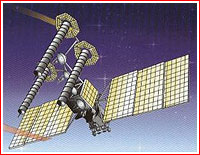
On May 4, Russian Space Force will launch 4th in the series Meridian satellite to work as a part of the United System of Satellite Communications 2nd generation (USSC-2) used by various governmental agencies of Russia, including the armed forces. Placed in a Molniya orbit, it provides high latitude transponder coverage, while Raduga class satellites residing in the GEO, provide global coverage. Meridian is viewed upon as a replacement for the older Molniya-3 spacecraft class.

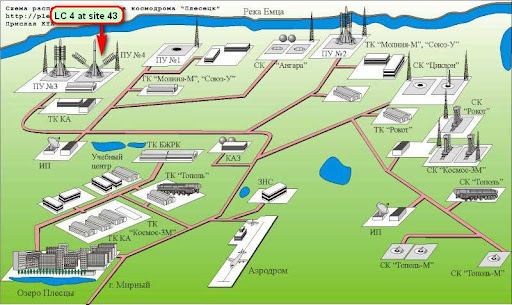
Launch location:
Plesetsk Launch pad no. 43/4 62°55'44.06"N, 40°27'24.71"E
Launch dates and times:
[table="head"]{colsp=5}Launch times
Time Zone|Australia - Sydney/AEST|Moscow / MSKS (UTC+4)/|Universal / UTC|Washington / EDT
Launch time:|3:41:33 a.m.|21:41:33|17:41:33|1:41:33 p.m.
on:|May 5, 2011|May 4, 2011|May 4, 2011|May 4, 2011
{colsp=5}[highlight][eventTimer]2011-05-04 17:41:33?before|after;%dd% Days %hh% Hours %mm% Minutes %ss% Seconds %c%[/eventTimer] Meridian #4 Launch[/highlight][/table]
Live Coverage Of The Launch:
None available, sorry.
PAYLOAD
Meridian #4 (14F112) navigation satellite.
Spacecraft Overview
According to unofficial postings on the web, the Meridian satellite is equipped with a pressurized service module and a three-axis attitude control system. Some of the systems, including onboard flight control computer and propulsion might be similar to those developed for the Uragan-M navigation satellite. The spacecraft also sports solar panels capable of rotating themselves toward the sun, along a single axis.
Both, Uragan and Meridian satellites were developed at NPO PM in Zheleznogorsk, where the latter project apparently originated back in 1978. NPO PM developed absolute majority of Russian spacecraft for telecommunications and navigation, both military and civilian.
As with Uragan satellites, the production of operational Meridian satellites was apparently subcontracted to PO Polyot in the city of Omsk. During several aerospace exhibitions in Russia circa 2001, the organization released a photo of a satellite, which was advertised as “new” Molniya, which is a communications satellite, operating in the highly elliptical orbit.
Meridian satellites reside in Molniya orbits (900 km x 39000 km; 65°)
On May 4, 2011 fourth Meridian will be launched.
[table="head"]Characteristics|

[/table]
Launch Vehicle:
[table="head"]{colsp=2}Characteristics
 |[table="head"]{colsp=2}

[/table]
[/table]
Meridian Ascent Profile
The Soyuz rocket will launch eastwards from Plesetsk and deliver the upper composite into a suborbital trajectory with the apogee of 204 kilometers and the perigee of eight kilometers. 60 seconds after separation from the third stage, the Fregat upper stage fires for the first time, entering the initial circular orbit with the altitude of 203 kilometers. 49.5 minutes after the launch, the Fregat's engine fires again for 10.5 minutes, stretching the orbit into a 290 by 39,500-kilometers ellipse. The satellite and its upper stage then coast to the high point of the orbit, where some seven hours after the launch, the Fregat fires for 15 seconds, rising perigee to 1,000 kilometers. The Meridian satellite and the Fregat upper stage then separate.
Approximate Ground Track Plot
Western part (Northern European Russia):

Eastern part (Western Siberian Russia):

It's noticeable that many Siberian towns have a good contrail viewing opportunity after sunset this Wednesday.
Cloud cover in Western Siberia at 20:00 MSKS on 04.05.2011:

Associated NOTAM's
Plot of the area reserved by the NOTAM:

Weather forecast for Plesetsk, Russia on May 4, 2011 (9 p.m.)
Time|Temps|Wind|Chill|Heat Index|UV Index|Dew Point|Relative Humidity|Precip|Snow|Clouds|Visibility|Wind|Weather
9 PM|12°C|11°C|12°C|0|Low|7°C|72%|40%|0%|41%|16KM|ESE 3.13 m/s|
 Showers
Sunrise/Sunset and associated twilight times for Plesetsk on Wednesday, May 4, 2011
Times are local.
Event|Time
Astronomical twilight begins|n/a
Nautical twilight begins|n/a
Civil twilight begins|03 : 43
Sunrise|04 : 46
Transit (sun is at its highest)|13 : 15
Sunset|21 : 44
Civil twilight ends|22 : 47
Nautical twilight ends|n/a
Astronomical twilight ends|n/a
References
http://forum.nasaspaceflight.com
http://www.novosti-kosmonavtiki.ru
http://space.skyrocket.de
http://www.spacelaunchreport.com
http://www.russianspaceweb.com
http://npopm.ru
http://www.samspace.ru
http://www.laspace.ru
http://www.geomidpoint.com/destination/
http://www.gpsvisualizer.com/calculators
http://www.notamdecoder.com/
http://gsak.net/google/polygoneditor.html
http://wap.marsian.borda.ru/?1-3-30-00000001-000-0-0-1171904149
http://www.intellicast.com
http://www.gismeteo.ru
http://www.good-stuff.co.uk/suntimes/sunmap.php
Launch location:
Plesetsk Launch pad no. 43/4 62°55'44.06"N, 40°27'24.71"E
Launch dates and times:
[table="head"]{colsp=5}Launch times
Time Zone|Australia - Sydney/AEST|Moscow / MSKS (UTC+4)/|Universal / UTC|Washington / EDT
Launch time:|3:41:33 a.m.|21:41:33|17:41:33|1:41:33 p.m.
on:|May 5, 2011|May 4, 2011|May 4, 2011|May 4, 2011
{colsp=5}[highlight][eventTimer]2011-05-04 17:41:33?before|after;%dd% Days %hh% Hours %mm% Minutes %ss% Seconds %c%[/eventTimer] Meridian #4 Launch[/highlight][/table]
Live Coverage Of The Launch:
None available, sorry.
PAYLOAD
Meridian #4 (14F112) navigation satellite.
Spacecraft Overview
According to unofficial postings on the web, the Meridian satellite is equipped with a pressurized service module and a three-axis attitude control system. Some of the systems, including onboard flight control computer and propulsion might be similar to those developed for the Uragan-M navigation satellite. The spacecraft also sports solar panels capable of rotating themselves toward the sun, along a single axis.
Both, Uragan and Meridian satellites were developed at NPO PM in Zheleznogorsk, where the latter project apparently originated back in 1978. NPO PM developed absolute majority of Russian spacecraft for telecommunications and navigation, both military and civilian.
As with Uragan satellites, the production of operational Meridian satellites was apparently subcontracted to PO Polyot in the city of Omsk. During several aerospace exhibitions in Russia circa 2001, the organization released a photo of a satellite, which was advertised as “new” Molniya, which is a communications satellite, operating in the highly elliptical orbit.
Meridian satellites reside in Molniya orbits (900 km x 39000 km; 65°)
On May 4, 2011 fourth Meridian will be launched.
[table="head"]Characteristics|
Meridian
Parts diagram:
|
Customer:
|- Russian MoD.
Prime contractor:
|- JSC "Information Satellite Systems Reshetnev Company"

Platform:
|- Uragan-M (?)
Mass at Separation:
|- ?
Dry Mass:
|- ?
Stabilization:
|- 3 axis stabilized
Dimensions:
|- ?
Batteries:
|- ?
Life time:
|- 7 years
Communication Payload:
|Believed to have three high-gain transponders. Another reported payload is low-channel Pritsep duplex communucation payload for navy users, which uses a centimetre-range wavelength.[/table]
Launch Vehicle:
[table="head"]{colsp=2}Characteristics
Soyuz-2.1a
Prime contractor:
|- Samara Space Sentre (Energia Holding enterprise)

GRAU Index:
|- 14A14
Height:
| 51.1 mDiameter:
| max 10.3 mLiftoff mass:
| 313 metric tonnesPayload mass:
| up to 6830 kg (a launch to LEO from Plesetsk)1st stage (boosters B, V, G, D):
|- 4 X RD-107 engines
- Propellants (T-1 Kerosene and LOX)
- Thrust/ISP in vacuum - / 320.2 s
- Thrust/ISP at sea level 85.6 tonnes / 263.3 s
2nd stage (core A):
|- 1 X RD-108 engine
- Propellants (T-1 Kerosene and LOX)
- Thrust/ISP in vacuum 94 tonnes / 320.6 s
- Thrust/ISP at sea level 80.8 tonnes / 257.7 s
3rd stage (block I):
|- 1 X RD-0110 engine
- Propellants (T-1 Kerosene and LOX)
- Thrust/ISP in vacuum 30.38 tonnes / 326 s
Upper Stage:
|
- GRAU Index: -
- Common Name: Fregat (meaning Frigate)
- Designer & Manufacturer: Lavochkin Association (NPO)
- Dimensions: Length 2.4 m, Diameter (max) 3.350 m
- Empty Mass 930 kg
- Propellants 5250 kg max
- Main Engine: 1 X S5.92
- Thrust in vacuum 2.0 tonnes of force (full power)
- Thrust in vacuum 1.4 tonnes of force (small power)
- ISP 333.2 s
Payload Fairing:
|- Diameter 3.7 m
- Length 7.7 m
[/table]
[/table]
Meridian Ascent Profile
The Soyuz rocket will launch eastwards from Plesetsk and deliver the upper composite into a suborbital trajectory with the apogee of 204 kilometers and the perigee of eight kilometers. 60 seconds after separation from the third stage, the Fregat upper stage fires for the first time, entering the initial circular orbit with the altitude of 203 kilometers. 49.5 minutes after the launch, the Fregat's engine fires again for 10.5 minutes, stretching the orbit into a 290 by 39,500-kilometers ellipse. The satellite and its upper stage then coast to the high point of the orbit, where some seven hours after the launch, the Fregat fires for 15 seconds, rising perigee to 1,000 kilometers. The Meridian satellite and the Fregat upper stage then separate.
Approximate Ground Track Plot
Western part (Northern European Russia):
Eastern part (Western Siberian Russia):
It's noticeable that many Siberian towns have a good contrail viewing opportunity after sunset this Wednesday.
Cloud cover in Western Siberia at 20:00 MSKS on 04.05.2011:
Associated NOTAM's
B2103/11 - TEMPO DANGER AREA NZD025, SUBANTARCTIC REGION, IS PRESCRIBED AS FLW: ALL THAT AIRSPACE BOUNDED BY S5145.0 E16300.0 S5700.0 E17600.0 S6000.0 E17234.0 S5635.0 E16300.0 S5145.0 E16300.0 ACTIVITY: MISSILE RE-ENTRY ADMINISTERING AUTHORITY: CIVIL AVIATION AUTHORITY OF NEW ZEALAND. PRESCRIBED PURSUANT TO CIVIL AVIATION RULE PART 71 UNDER A DELEGATED AUTHORITY ISSUED BY THE DIRECTOR OF CIVIL AVIATION. SFC - FL999, DAILY 1720-1900, 04 MAY 17:20 2011 UNTIL 07 MAY 19:00 2011. CREATED: 27 APR 02:30 2011
Plot of the area reserved by the NOTAM:
Weather forecast for Plesetsk, Russia on May 4, 2011 (9 p.m.)
9 PM|12°C|11°C|12°C|0|Low|7°C|72%|40%|0%|41%|16KM|ESE 3.13 m/s|
Sunrise/Sunset and associated twilight times for Plesetsk on Wednesday, May 4, 2011
Times are local.
Astronomical twilight begins|n/a
Nautical twilight begins|n/a
Civil twilight begins|03 : 43
Sunrise|04 : 46
Transit (sun is at its highest)|13 : 15
Sunset|21 : 44
Civil twilight ends|22 : 47
Nautical twilight ends|n/a
Astronomical twilight ends|n/a
References
http://forum.nasaspaceflight.com
http://www.novosti-kosmonavtiki.ru
http://space.skyrocket.de
http://www.spacelaunchreport.com
http://www.russianspaceweb.com
http://npopm.ru
http://www.samspace.ru
http://www.laspace.ru
http://www.geomidpoint.com/destination/
http://www.gpsvisualizer.com/calculators
http://www.notamdecoder.com/
http://gsak.net/google/polygoneditor.html
http://wap.marsian.borda.ru/?1-3-30-00000001-000-0-0-1171904149
http://www.intellicast.com
http://www.gismeteo.ru
http://www.good-stuff.co.uk/suntimes/sunmap.php


