

Soheil_Esy
Fazanavard فضانورد
- Joined
- Apr 5, 2015
- Messages
- 744
- Reaction score
- 20
- Points
- 18
2015/08/28
TAIYUAN, Aug. 27 (Xinhua) -- China's Yaogan-27 remote sensing satellite was sent into space on Thursday at 10:31 a.m. Beijing Time, from Taiyuan launch site in Shanxi Province, north China.
The satellite will mainly be used for experiments, land surveys, crop yield estimates and disaster prevention.
Yaogan-27 was carried by a Long March-4C rocket, the 207th mission for the Long March rocket family.
China launched the first "Yaogan" series satellite, Yaogan-1, in 2006.
Pre launch

Launcher testing

Pre launch fourth inspection

Equipment fine tuning

Antenna testing

Payload transport

Lifting of payload
Launch


Video
http://v.qq.com/page/p/0/1/p0017ewnv01.html
Two Line Element Set (TLE):
On the ground


http://www.chinaspaceflight.com/satellite/Yaogan/YG-27.html
TAIYUAN, Aug. 27 (Xinhua) -- China's Yaogan-27 remote sensing satellite was sent into space on Thursday at 10:31 a.m. Beijing Time, from Taiyuan launch site in Shanxi Province, north China.
The satellite will mainly be used for experiments, land surveys, crop yield estimates and disaster prevention.
Yaogan-27 was carried by a Long March-4C rocket, the 207th mission for the Long March rocket family.
China launched the first "Yaogan" series satellite, Yaogan-1, in 2006.
China's global anti-access/area-denial (A2AD) strategy
2015-08-28
The YG-27 satellite just launched into orbit on August 27 is the 5th of the YG-8 class. Previously launched satellites are YG-8 (2009), YG-15 (2012), YG-19 (2013) and YG-22 (2014).
The YG-8 class is a family of optical military satellite dedicated to the precise identification of naval surface targets, after having first been pre-located by the five triplets military naval signals reconnaisance satellites (YG-9, YG-16, YG- 17, 20-YG and YG-25), similar to American NOSS.
YG-27 is part of China's global anti-access/area-denial (A2AD) strategy.
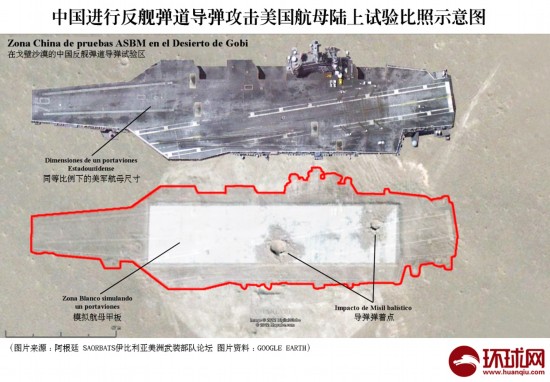
The Chinese anti-ship system uses the Dong Feng 21D (DF-21D) anti-ship ballistic missile (ASBM) as offensive vector.
Dongfeng-21D ASBM
2014-09-19
Dongfeng-21D delivers a 500 kilograms armour-penetrating warhead, can use external channel targeting data transmission. DF-21D circular error probability (CEP) is less than 10 meters, to ensure accurate hit of US nuclear powered aircraft carrier class targets.
DF-21D is a second-generation Chinese medium-range ground strategic missiles. The missile is an improvement of the DF-21 ballistic missile, it has two solid-fuel rocket engines, fitted on road mobile launchers and has a maximum range of 2,700 kilometers. Nuclear warheads and EMP warheads are optional upgrade versions to ensure a maximum efficiency against US carrier groups.




http://www.360doc.com/content/14/0919/16/1420784_410731101.shtml
Xianglong-2.0
2013-11-20
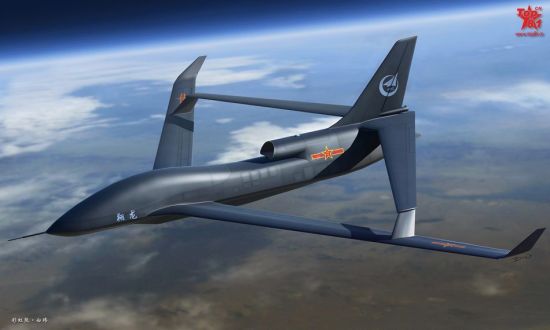
Xianglong-2.0 high altitude unmanned reconnaissance aircraft is another component of China's global anti-access/area-denial (A2AD) strategy. It is used to track enemy CVBGs. Its cruising speed is 750 km/h with top speed of 800 km/h. Its deployment theater covers 2000 km x 2000 km betwen the Ryukus and Okinawa islands, with an array of 4 to 6 Xianglong-2.0. Scanning coverage is said to be twice that of equivalent enemy UAVs. In this case reaction time is under an hour. Its use allows to counter expected jamming of space based assets (recon and communication satellites). In this case, Xianglong-2.0 can also provide alternative communication data link. Data collected can feed the offensive vectors such as DF-21D ASBM. Autonomy is 10 hours.
http://mil.news.sina.com.cn/2013-11-20/0951750411.html
http://mp.weixin.qq.com/s?__biz=MzA...n=f107b2a478ff547c04ed4898468ecf29&scene=0#rd
New updated Combined-Arms Saturation Attack Video
Pre launch
Launcher testing
Pre launch fourth inspection
Equipment fine tuning
Antenna testing
Payload transport
Lifting of payload
Launch
Video
http://v.qq.com/page/p/0/1/p0017ewnv01.html
Two Line Element Set (TLE):
Code:
1 40878U 15040A   15240.44921391 -.00000045  00000-0  00000+0 0  9991
2 40878 100.4963 298.7904 0007746 269.2925 090.7308 13.15940931   171
On the ground
28 August 2015
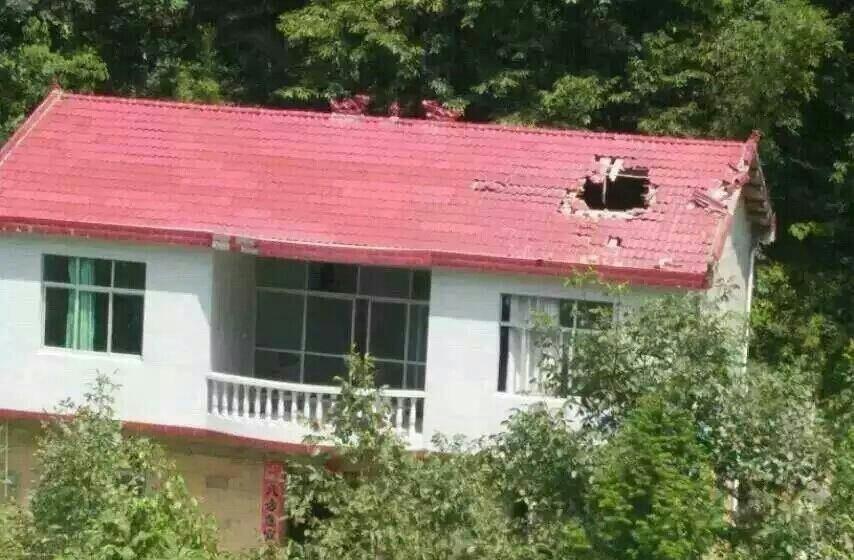
On August 27 at 10:40 am an "unidentified object" fell from the sky in Ankang City, Shaanxi Province, Xunyang Red Army town on a farmer's house. Glass windows in the vicinity were smashed, there is no personal injury reported yet.
http://news.ifeng.com/a/20150828/44538683_0.shtml
http://www.chinaspaceflight.com/satellite/Yaogan/YG-27.html
Last edited:

 .
.


