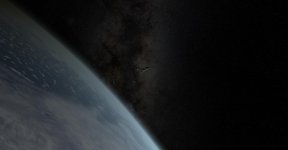
OHM ESO sky

OrbitHangar

Addon Comments
Joined
Apr 9, 2008
Messages
3,832
Reaction score
18
Points
0

Author: rawash

Hi,
I've created an celestial sphere background from ESO (https:// www.eso.org/public/images/eso0932a/) to use with Orbiter 2016 & 2010-P1.
I feel it more realistic than stock ones.
There's some glitches and sometimes not aligned perfectly. Just try it.


Installation:

Just copy the content of this archive into your Orbiter installation folder,

Or copy the "MW.tex" file into your "Textures\csphere" folder and add the following line
ESO sky|csphere\MW
into the configuration file "bkgimage.cfg" of the folder "Config\Csphere"

Then activate it by selecting the entry ESO sky in the list of background in the "Visual effects" tab of the launcher.

In my installation, I use an intensity of 0.20 with D3D9Client + ENB Series for D3D9 (http://francophone.dansteph.com/?page=addon&id=173 )

Warning: it's an 124Mo texture


Credit: ESO/S. Brunier


DOWNLOAD
 
VERY VERY NICE

2016-09-17_174414.jpg
 
I've been wondering a lot about these: is it realistic? do astronauts see the milky way in that way from orbit? all the pix I saw from space is just a black sky with white stars, but even during nights on earth you can see the milky way, so I was wondering if you can see it that way from orbit
 
You can not see it from orbit. The reason is that your vision is blinded by multiple light sources. Main one is the Sun but when our star is behind Earth there are ISS or spacecraft interior lights switched on. I think you have to shut down all lights and let your eyes get used to darkness and THEN you'll be able to see Milky Way and things like that.. This is a very inusual situation on orbit and this is the reason why I consider background not so realistic (never used them)
The addon is well done, however :thumbup:
 
I'm an astrophotographer and I can answer this a bit.

No, the astronauts on the ISS do not see the Milky Way this way. Rather, they see a grey/white band going across the sky. The reason being is that your eye has a very small aperture thus only collects a small amount of light, and as such we cannot pick up any color like depicted in this addon with the naked eye. However, if you had a DSLR camera and took a 10-20 second exposure you'd roughly see something like this. With that said, I do think this is a very awesome addon from a visual standpoint. Worth the download!
 
Last edited:
This may not be 100% accurate as far as what actually can be seen by the naked eye in Earth orbit, but, IMO, this looks far better and more realistic than the stock celestial.:cheers:
 
I have to thank rawash on this background! It is brilliant!
With the right setting it makes the sky interesting, without too much bright spots. Especially for deep space missions, it makes looking out of the window worthwhile. :)
 
I use ESO sky with an intensity of 0.4, so it does not stand out too bright against planet surfaces.

But, this will not generate an image like the one above. For a picture like this, you have to visit low Earth orbit in person. :)
 
Thanks, what parameters do you use for the apparent magnitude? I have it set 0 to 6.5, exponential and 0.05. It seems pretty real, but I'm always looking to improve.
 
Apparent magnitude: 1.0 mapped to max brightness 1
Apparent magnitude: 7.0 mapped to min brightness 0.10
Magnitude brightness mapping: exponential

I think, this is pretty much the default setting.
Will try your setting as well, to see the difference.

picture.php

Sun and Milky Way rising above the horizon with the settings mentioned above,
default graphics client.
 
Last edited:
Slight issue when installing this mod on a case-sensitive filesystem:

Orbiter looks for the configuration file named bkgimage.cfg within ./Config/CSphere/ but installing this mod will put the configuration file in ./Config/Csphere/

I fixed this by just moving bkgimage.cfg from ./Config/Csphere/ to ./Config/CSphere/
 
You can not see it from orbit. The reason is that your vision is blinded by multiple light sources. Main one is the Sun but when our star is behind Earth there are ISS or spacecraft interior lights switched on.

Definitively. Most pictures taken from space display no stars, only a deep black sky. It is even worse on the Apollo missions footage, as the lunar dust reflects a lot of light. Also spacecraft, spacesuits and station parts are usually white or shiny and are actually designed to be visible and reflect light (and heat).
 
Back
Top